


Here’s our concise guide to the likely outcomes of the midterm elections once voting concludes on November 3.
Trump’s approval rating is historically weak, but it has recovered slightly during the last week. The lowest net approval rating Trump received in the RealClearPolitics polling aggregate was -22% in late October. It’s now -20%. That is still the worst midterm rating for any president since George W. Bush in 2006, when Republicans lost control of both houses of Congress.
The president’s approval rating is usually the strongest indicator of how the midterms are likely to go. And the odds of Democrats taking both houses of Congress are the highest they’ve been all year. Prediction market Kalshi puts the odds of Democrats winning the House of Representatives at 94%, with the Dems’ Senate odds at 75%. Here are the overall odds for the balance of power in Congress next year:
While the House seems like a shoo-in for Democrats at this point, Senate control will hinge on as many as 11 races likely to be close.
[Take The Weekly WTF News Quiz]
The Cook Political Report categorizes seven Senate races as tossups: Alaska, Iowa, Kansas, Maine, Michigan, Ohio and Texas. The Center for Politics at the University of Virginia rates those races differently, but it still foresees close contests. It ranks five of those seven states—Alaska, Kansas, Maine, Ohio and Texas—as “leans Democratic,” which means the Democratic candidate has an edge, but either side could still win. It counts Michigan as “likely Democratic,” meaning the Dem is favored to win and a Republican victory would be an upset. And it rates Iowa as “leans Republican,” with Republicans favored to hold the seat.
Democrats hold 47 Senate seats now. They need 51 for a majority that can overcome Vice President JD Vance’s tie-breaking vote. For a “Fetterman-proof majority,” meaning they don’t need to rely on the unpredictable Democratic Sen. John Fetterman of Pennsylvania, they’d need 52 seats.
To reach 52, they need to flip five Republican seats without losing any seats they currently hold. Here’s one plausible way to do that. First, Democrats need to hold Michigan. And they’re likely to flip a North Carolina Senate seat from red to blue. That would give them a net gain of one, with four more to go. If they flipped four of these six toss-ups—Alaska, Iowa, Kansas, Maine, Ohio and Texas—they’d have 52. If they flip just three of those six, they’d still have a simple majority of 51.
[The Trump economic bust, in 10 charts]
We’ll show the Kalshi odds for each of those seven close Senate races. But first a word about prediction markets and political forecasts. The mechanics of betting, which determine prediction market odds, provide deceptively precise numerical odds. And it’s not yet clear whether prediction markets are any better at forecasting election outcomes than polls, which have become notoriously inaccurate, especially in midterms. Polls are one of the factors that help determine prediction market odds, and whether garbage in means garbage out is one of the questions analysts will be dissecting after the elections.
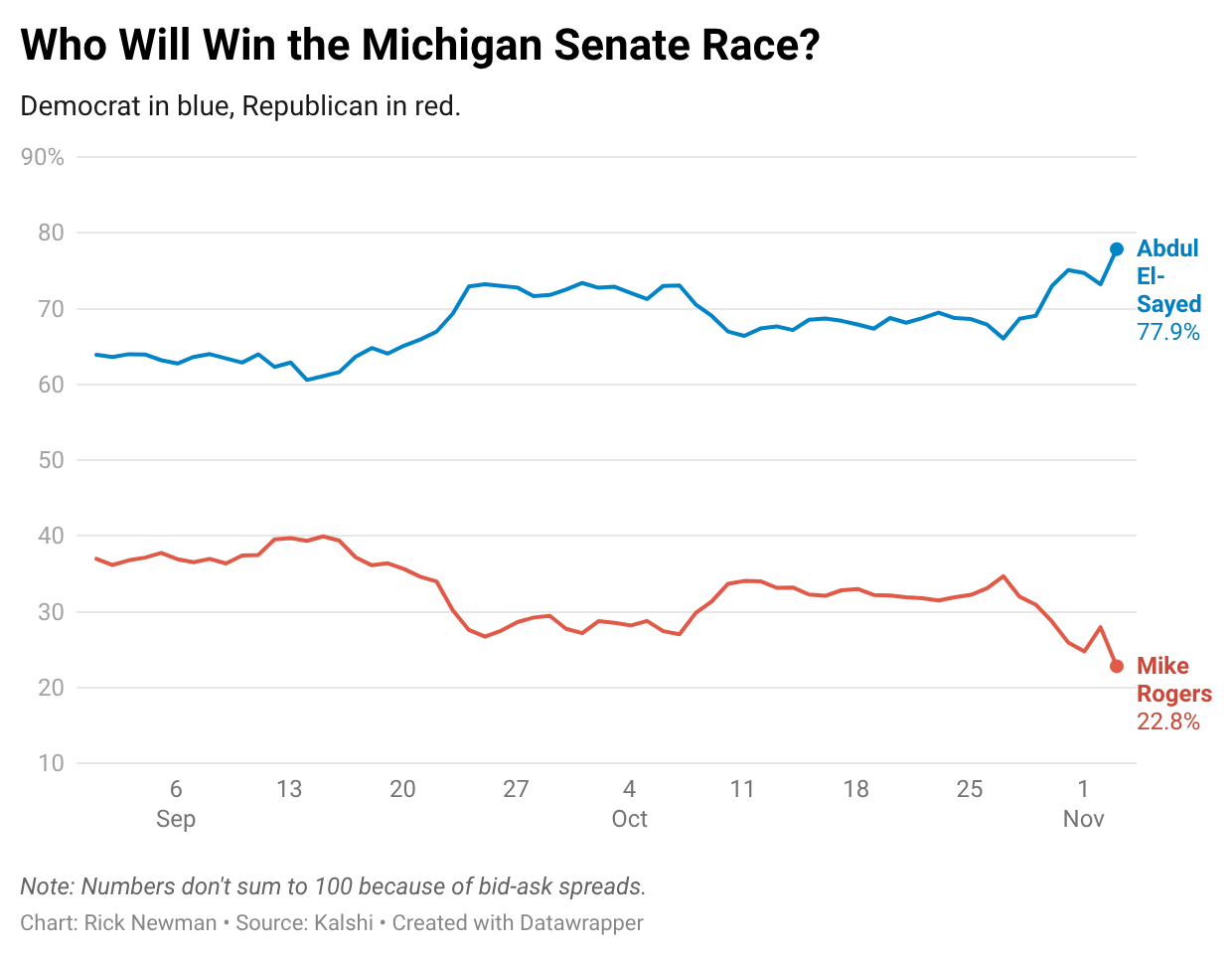
With that disclaimer out of the way, here’s what the Alaska Senate race looks like. If the controversy over Democrats “stacking the ballot” by recruiting an independent candidate with the same name as the incumbent Republican Senator Dan Sullivan riled voters, it’s not showing up in the election odds for Democrat Mary Peltola. (Note that in all of the following charts, the numbers represent the likelihood of each candidate winning, not a breakdown of the likely vote.)
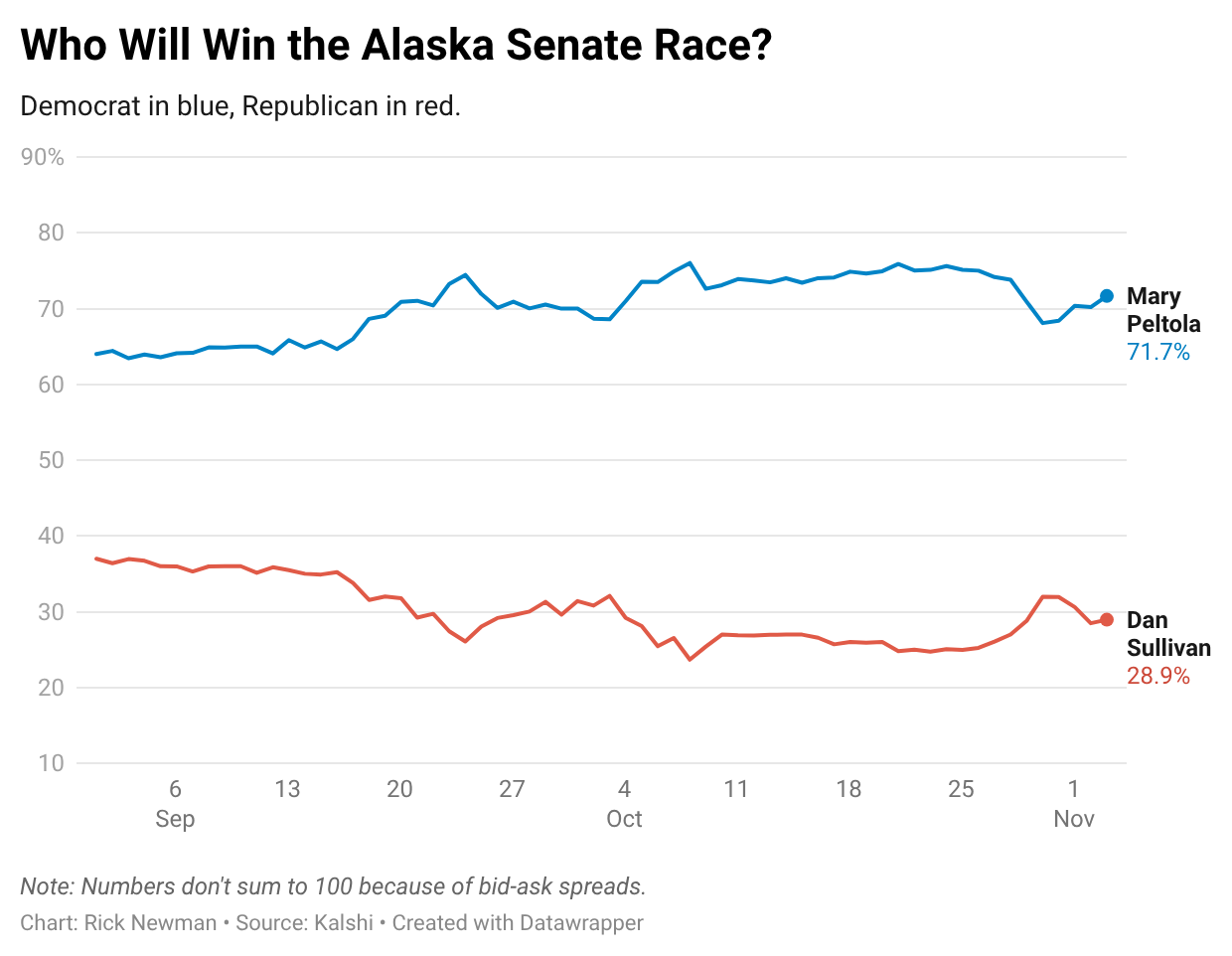
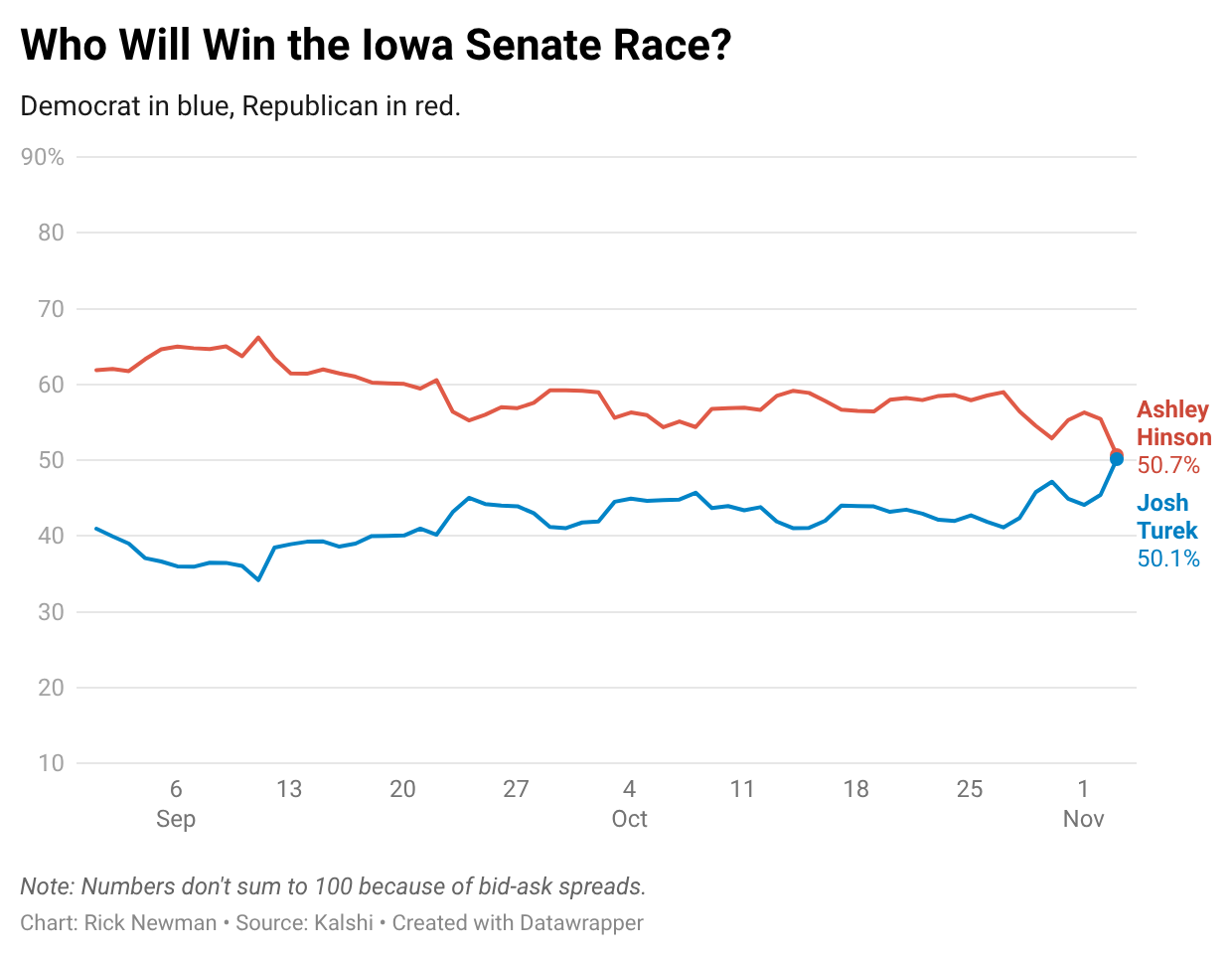
Here’s Iowa. Note that the Center for Politics rates this race “leans Republican,” while the betting-market odds basically show a dead heat.
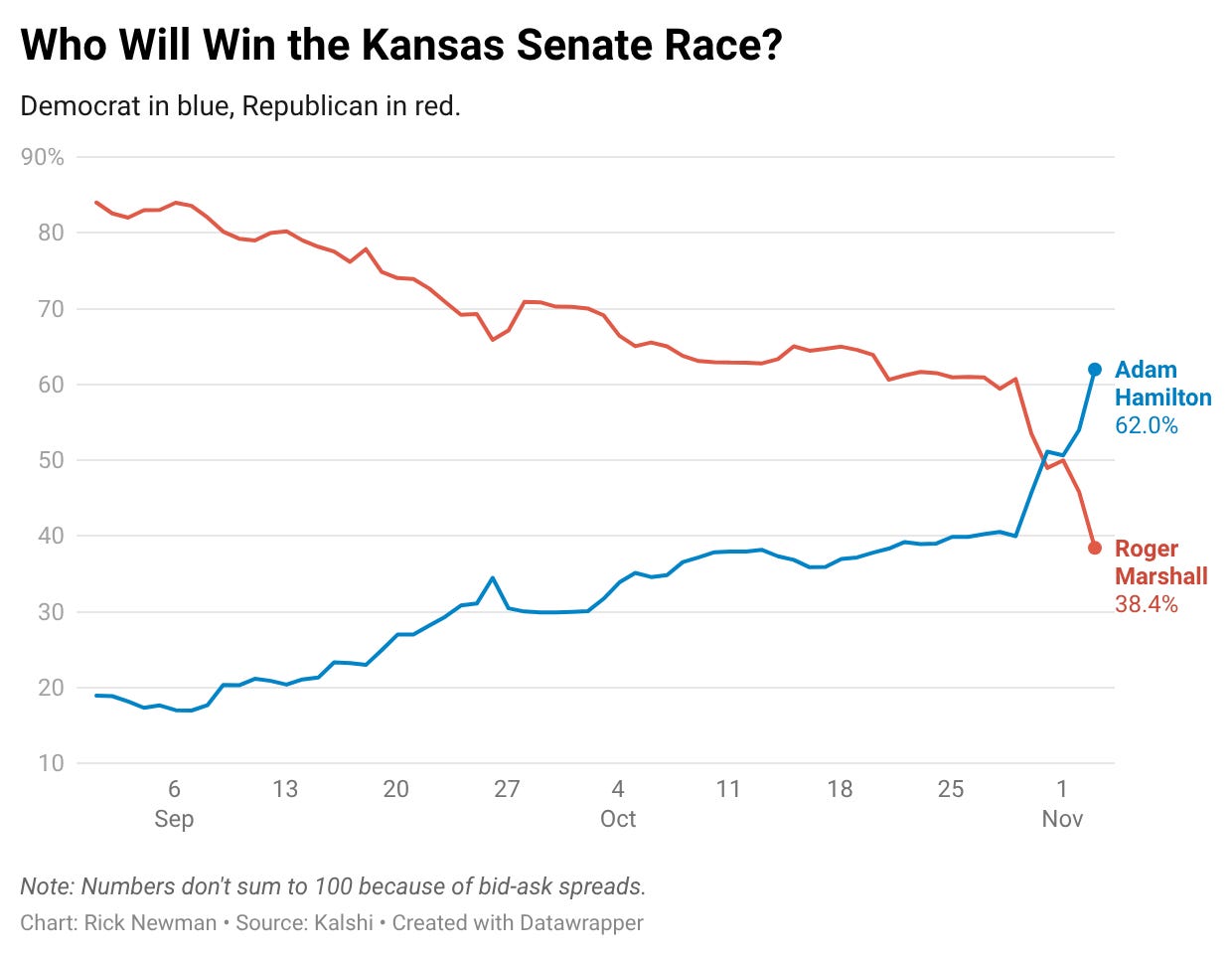
Here’s Kansas. If the Kalshi odds are right and Democrat Adam Hamilton wins, he will be the first Democratic senator to represent Kansas since 1939.
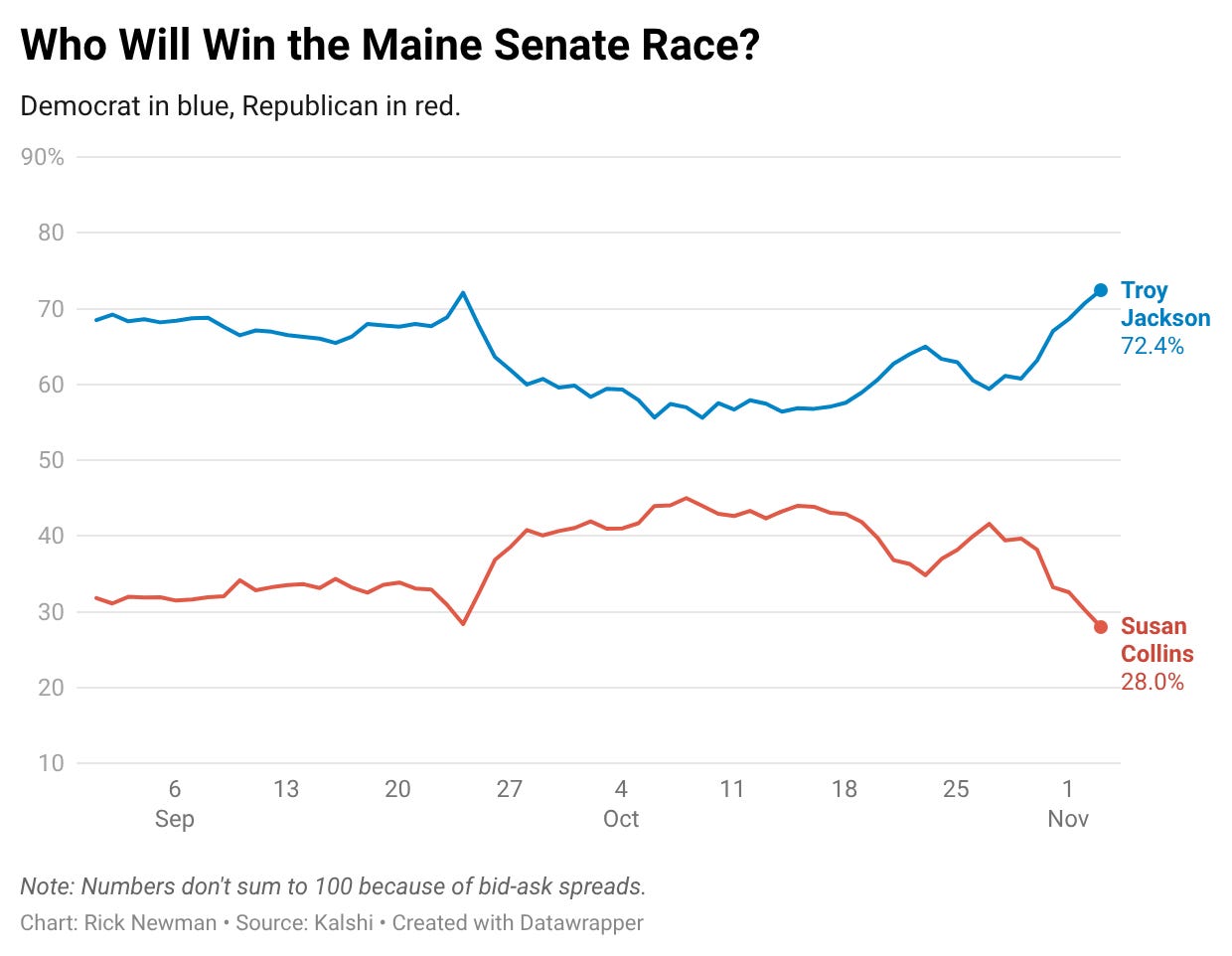
Here’s Maine. Republican Susan Collins is wily and Democrat Troy Jackson is a late entrant, yet Jackson’s odds have been surging.
Here’s Michigan. The Democrat who ran against Abdul El-Sayed in the Democratic primary and lost, Haley Stevens, just endorsed the Republican Mike Rogers, causing an uproar in the Democratic Party. Markets don’t think that will matter.
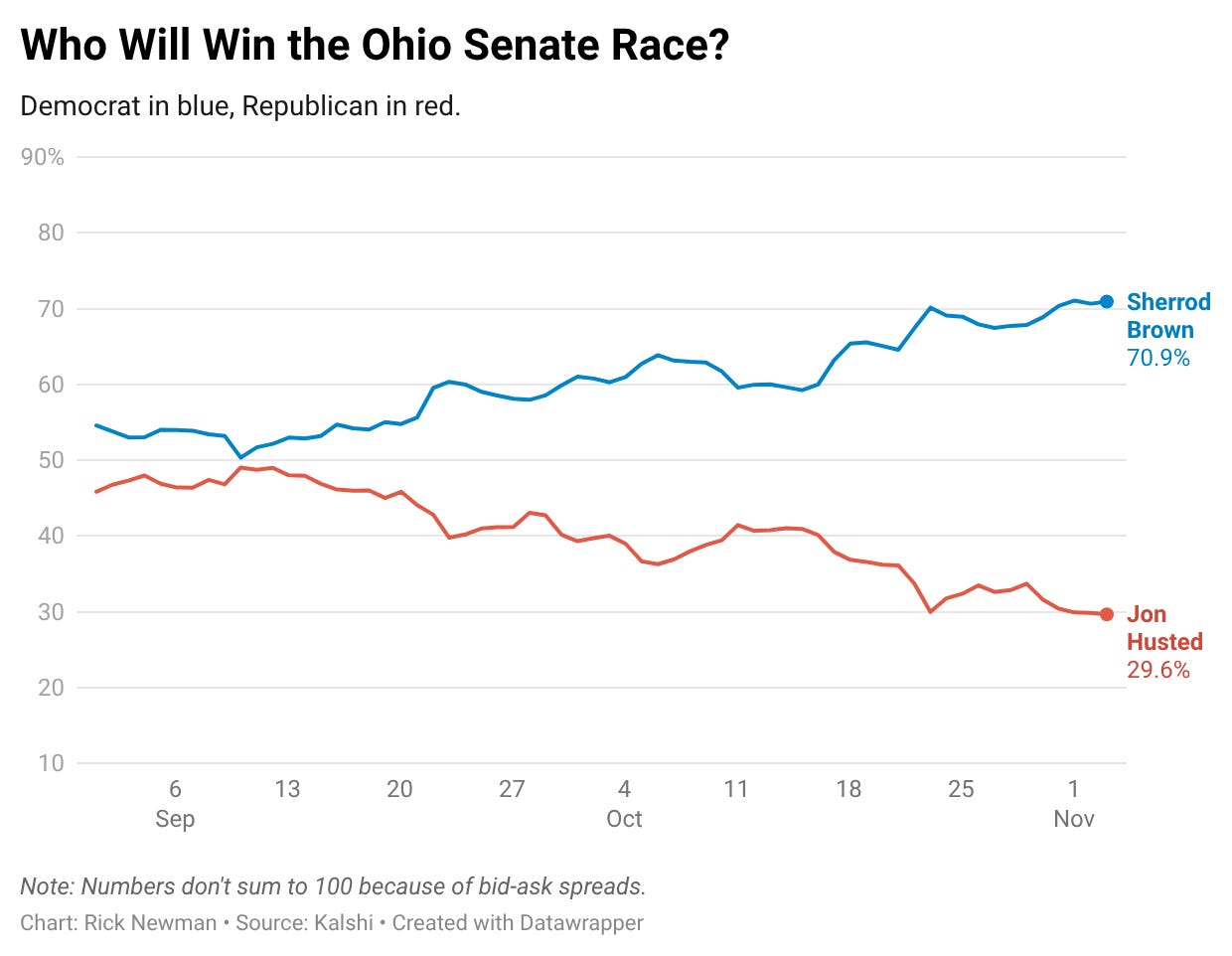
Here’s Ohio. Sherrod Brown is the former Democratic senator who lost his seat in 2024 and is trying to win it back. Looks like he will.
And here’s Texas. A win by Democratic candidate James Talarico would probably be the biggest earthquake of the midterms. Texas is Trump country and Trump has endorsed Republican Ken Paxton. A Talarico win would be a powerful repudiation of Trump.
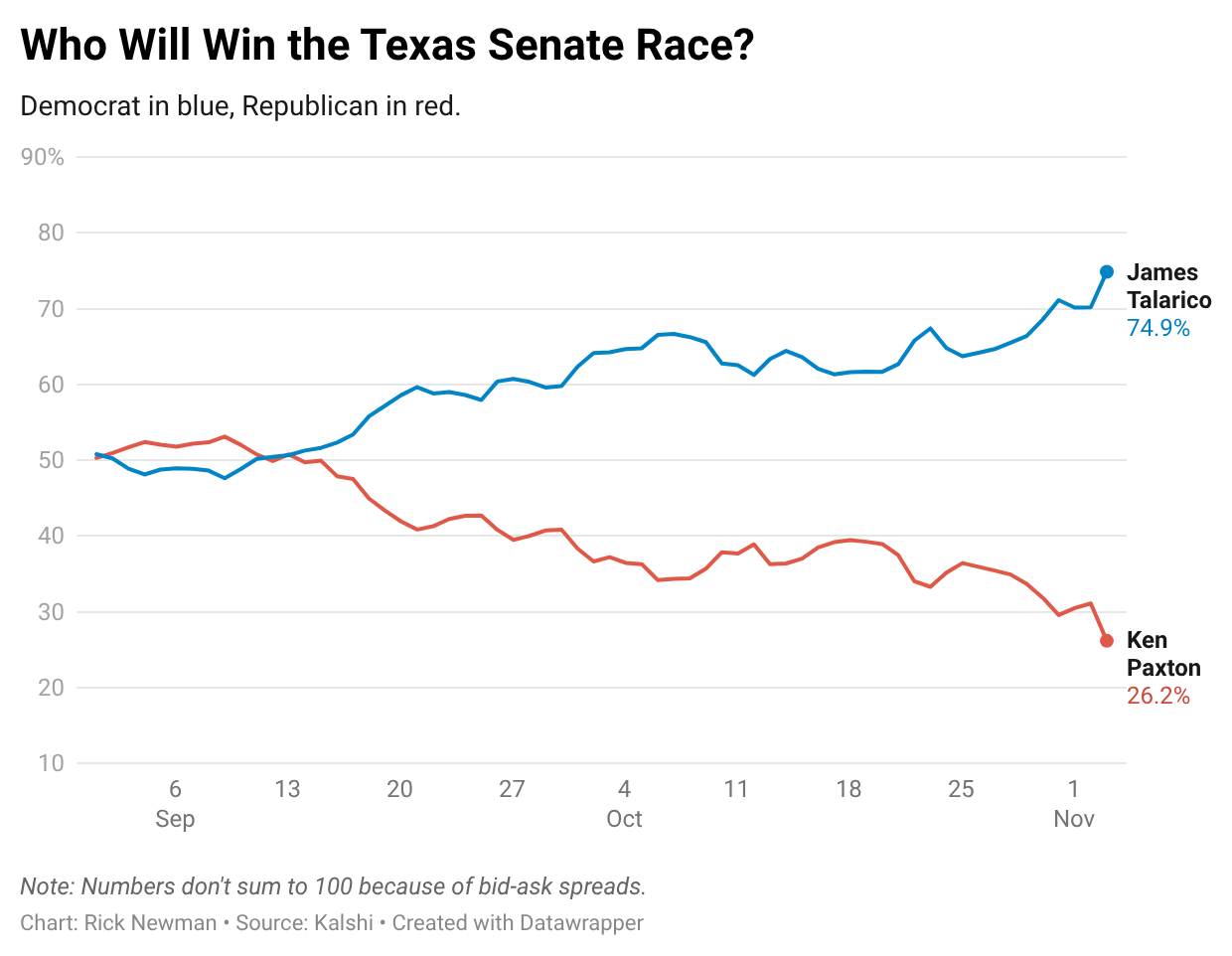
Just to emphasize it one more time: Prediction odds probably fail to capture how close many of these races will be. If Talarico wins, for example, it could be by a margin of 1% of the vote or less. His 75% chance of winning doesn’t reflect that.
[7 things to watch for after Election Day]
Governors’ races are important too, and Democrats seem likely to make gains there as well. Republicans now control 26 states, Democrats 24. With a good night, Dems could end up with nearly 30 governorships. Cook Political says Democrats have a good chance of flipping control in Alaska, Iowa, and Ohio, with toss-up races in Georgia and Nevada. If it’s a blue tsunami, they could even win Texas.
If a Democratic sweep materializes, there could be signs of that by midnight Eastern Time on Election Day, November 3. Ohio, for instance, counts ballots quickly, and if Democrats win the Senate and governor’s races there, those wins could signal a big night for Democrats. The margin of victory will be a tell, too. Iowa, Kansas, and Texas also count quickly. But if toss-up races are close, it could take days or even weeks to know how the balance of power in Congress will shake out.
Trump has threatened to interfere with the elections in a variety of ways. But so far, there’s not much actual interference. Courts have largely rejected his efforts to restrict mail-in voting. He hasn’t declared a national emergency or tried to impose martial law, as he hinted he might. There are no reports, so far, of armed federal agents congregating near polling places or threatening to seize election equipment.
[12 Trump election swindles to watch for]
Trump seems sure to kvetch about any election outcome he doesn’t like and claim fraud, as he has done before. But that won’t change any votes. His lawyers are likely to sue to contest the outcome of some elections, but those efforts have broadly failed, as well. The people might actually get the final word in the 2026 elections.
Meanwhile, enjoy a cartoon.
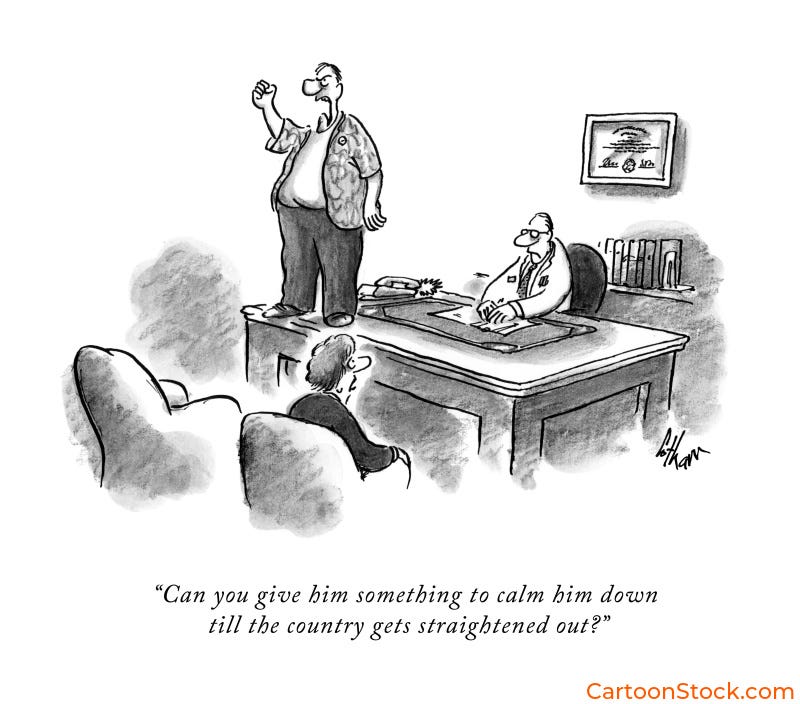
You can order this cartoon👆 and play cartoon-themed puzzles and word games at CartoonStock.com.