


THE TOP 5:
“The world’s gone wrong.” That’s the title of a gripping new song (and forthcoming album) by American treasure Lucinda Williams. “She tries hard to ignore the news … she can’t believe the things she’s read … some days she can’t get outta bed.”
Anybody else feel this way after the fatal stabbings of Rob and Michele Reiner😠, after the Brown University shootings and related murder of an MIT physicist😠, after the Bondi Beach terror attack in Australia😠?
Lucinda Williams had a stroke in 2020 at the age of 67, and can no longer play a guitar. She could have hung it up. But she keeps creating and performing. Resilience and vulnerability coincide. “Looking for comfort in a song,” she sings in “The World’s Gone Wrong.” Yep. There, or anywhere.
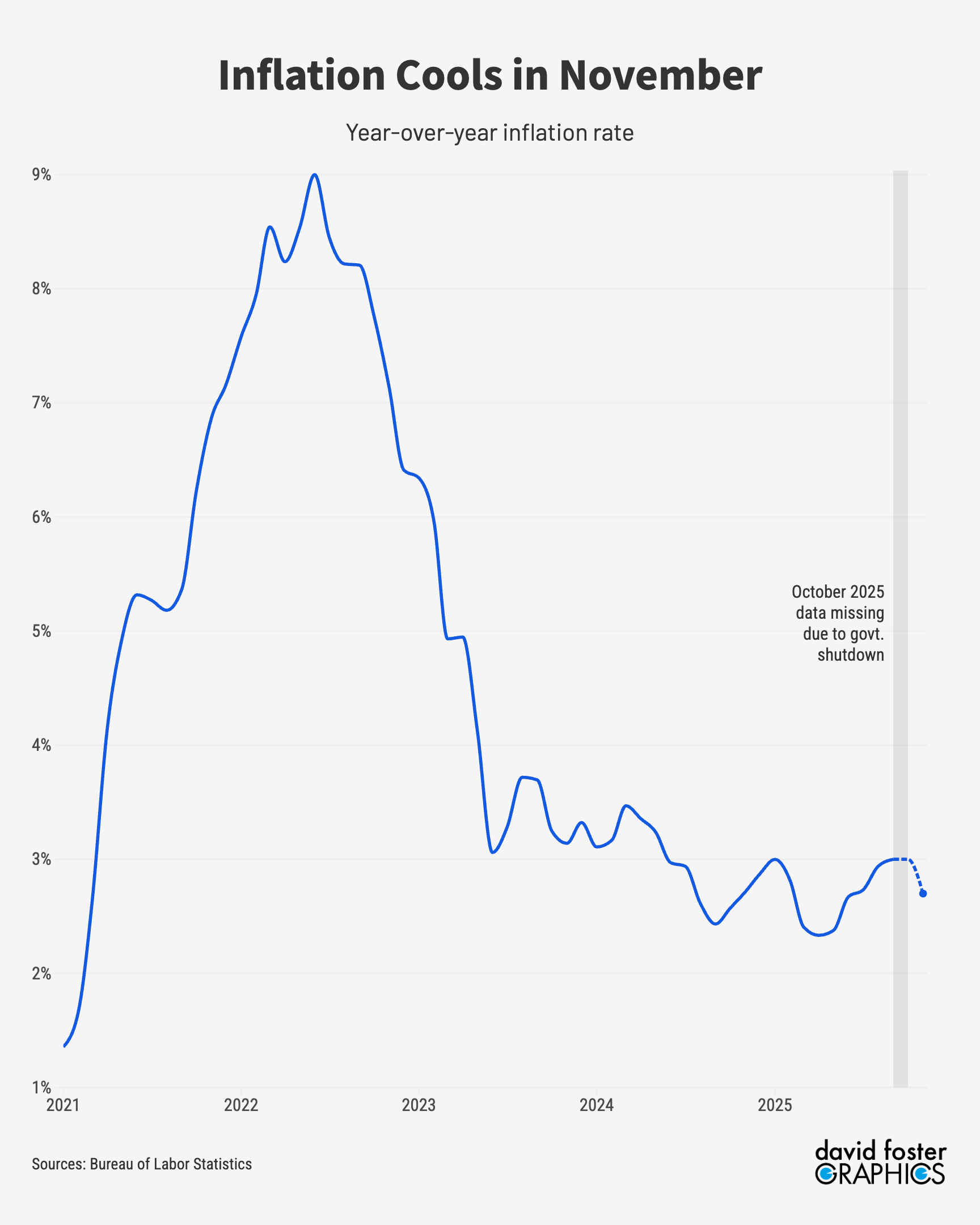
Dodgy data. Delayed government reports on jobs and inflation finally arrived, and … we still don’t really know what’s going on. The inflation update was the “most dubious,” according to Capital Economics, because a big reported drop in inflation doesn’t square with other trends. The inflation rate supposedly dropped from 3% in September to 2.7% in November, but the Labor Dept. had to change the way it measures prices because of the 6-week government shutdown. And there’s no data at all for October.
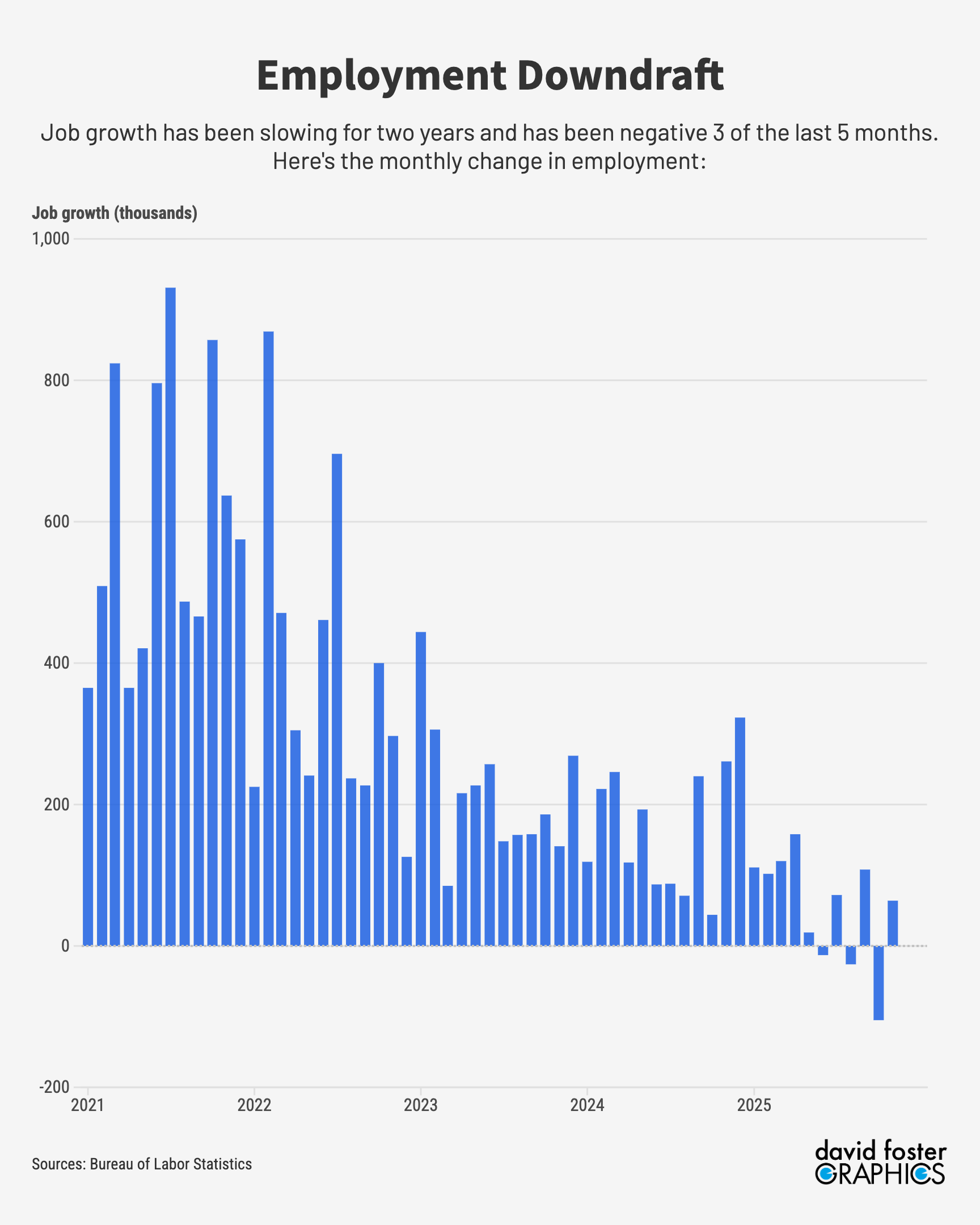
The delayed jobs report shows a jump in the unemployment rate, from 4.4% in September to 4.6% in November (with no number for October). Total employment dropped by 41,000 jobs from September to November. That fits the trend of slowing job growth that’s been in place for the last six months. But the shutdown messed with that survey, too.
We’ll get better data when the next jobs report comes out on January 9, and the inflation report arrives on January 13. That will be in time for the next Federal Reserve policy meeting, which starts on January 29. A lousy jobs report paired with tame inflation might induce another short-term interest rate cut. But for now, the CME’s FedWatch tool puts the odds of a cut at just 22%.
The S&P 500 index rose a smidgen for the week. The NASDAQ 100 lost a smidgen.
Trump’s affordability bender. Trump gave a televised TV address on December 17 to insist “prices are down” and “inflation has stopped.” That’s not true. Nor were many of Trump’s other claims, such as his boast that some drug prices are down by 600%, which is mathematically impossible. It was a fact-checker’s field day.
[Wanna test how much you know about the Trump economy? Take the Pinpoint Quiz.]
Trump is talking up the economy for obvious reasons. Voters are souring on his economic program and Democrats have been winning elections by targeting ordinary people’s affordability concerns. Trump can’t jawbone voters into feeling better. One reason we know that is Joe Biden tried the same thing and failed miserably. And Biden was more honest about the facts than Trump is.
Biden’s self-cheerleading always began with a recitation of what was going right—mainly record job growth—and after a while, Biden would say, but we’ve got more work to do. Then he’d try to feel people’s pain on inflation while promising that his team was on it. But Biden never made anybody feel better. His approval rating was dismal by his fourth year—even though inflation was falling by then--and never bounced back.
Trump is louder than Biden, but his powers of persuasion won’t be any better. The 2025 tax cuts will boost growth next year, but Trump basically has no serious plans to lower the cost of housing, health care, heat or electricity. When I watched Trump’s speech on December 17, I thought he sounded like somebody who’s never had to decipher a utility bill, fight with an insurance company or even price-shop. Anybody who has ever shopped for bargains knows you can’t save more than 100%!
Health insurance bummer. Congress is done for the year, and it did not renew expiring subsidies that helped lower the cost of insurance for more than 20 million people who buy policies through the Affordable Care Act. Insurance premiums for many of those folks will rise by hundreds of dollars per month starting in January.
This isn’t completely settled. Congress can still renew the subsidies in 2026, or pass some other kind of relief. But Republicans have no plan and the Democratic plan—just keep the subsidies going—is a nonstarter for Republicans. That leaves two bullheaded parties focused more on scoring political points than on helping Americans who need it.
[More: 3 Trump disasters that didn’t happen in 2025]
There are two basic problems, and they’re both huge ones. First is the cost of health care and insurance for ordinary people, which Democrats, to their credit, addressed when they passed the ACA in 2010. The law has substantially improved the availability and affordability of insurance. But it didn’t address the rising cost of health care throughout the system, which is what Republicans want to do. But they don’t agree on how, and Trump, their leader, has basically run from the issue.
Trump did say on December 19 that he reached deals with nine pharmaceutical firms that will help lower some drug prices. But follow the fine print. Trump has repeatedly announced deals this year that are more like handshake agreements to make a deal in the future. Many of these “deals” don’t change much. As Americans are learning, Trump saying something is cheaper doesn’t automatically make it cheaper.
Bombs fly. But not at Venezuela, which is bracing for some sort of US military action, which Trump keeps threatening. Instead, Trump ordered the bombing of facilities supposedly belonging to the ISIS terror group in Syria, after a December 13 ambush in Palmyra that killed three Americans working on counterterrorism operations. There are around 1,000 US troops in Syria, where ISIS and other terror cells still have footholds in remote areas.
The Pentagon described the retaliatory strikes as a “massive attack” against weapons stockpiles and other terrorist sites. Any other president might have taken similar moves to avenge the deaths of US servicemembers. But terrorist groups learned long ago not to cluster assets in large facilities Americans can easily spot with satellites or drones. Instead, they disperse supplies and mingle among civilians. Airstrikes are a relatively easy way for a president to look like he’s doing something. But sometimes they don’t accomplish much, and they can be counterproductive if civilians get hurt or killed.
Don’t take your eye off Venezuela. Trump is clearly doing more than posturing. A huge array of US forces is gathered in the region and Trump has basically enacted a blockade of oil shipments from the country. The latest development is a GPS jamming war in which Venezuela and the US military block each other’s satellite signals. This standoff is heading somewhere.
~ ~ ~ ~ ~ ~ ~ ~ ~ ~ ~ ~
WHAT WILL MATTER NEXT WEEK:
Epstein fallout. The Justice Dept. released hundreds of thousands of documents relating to the dead sex trafficker Jeffrey Epstein on December 19. But the main attraction still hasn’t shown. The Justice Dept. said it couldn’t release all the files by the December 19 deadline, and would need more time. The latest trove does include several photos of Bill Clinton in Epsteinworld. There was virtually no sign of Trump. Get it? Democrats and other baddies patronized Epstein. But not Trump. No, never.
The big question still remains: Did Trump have any involvement with the underage women Epstein abused and trafficked to some of his friends?
It would be astonishing if the Trump administration releases anything that incriminates Trump. Assume it won’t happen. But that means people who think Trump has something to hide will always find justification in whatever the government blacks out or doesn’t release. Epstein has become a perpetual-scandal machine.
Worth a read: For all the repetitive reporting on Epstein, the New York Times actually published some new information on how Epstein got so rich in the first place. Basically, he was an extremely talented grifter who ripped off some of America’s richest people and always got away with it. Here’s the long version. Here’s the NYT’s own TLDR summary. There’s a sucker born every minute and some of them should know better.
Santa Claus rally odds: Polymarket puts 49% odds on a new record high in the S&P 500 by the end of the year. That would only require a 1% gain from current levels, so it’s possible. The S&P is up about 16% this year, after a 23% gain in 2024. You’ll see more on the outlook for stocks soon, in my forthcoming preview of 2026.