


Hello, friends. Starting next week my short list of what really matters will go to paid subscribers only. I’m grateful for paying subscribers, who are the angel investors in this startup. And I’ll take as many angels as I can get!
~ ~ ~ ~ ~ ~ ~ ~ ~ ~
BUSY WEEK! THE TOP 6:
Ding, dong, the wicked ayatollah is dead. I wrongly predicted President Trump would avoid a war with Iran and announce some kind of deal because that’s been his modus operandi many times before. Trump’s tolerance for risk is suddenly higher than it used to be.
So now Ayatollah Ali Khamenei is dead, along with several other senior Iranian leaders. US and Israeli aircraft can fly pretty freely over Iran, hitting any fixed targets they want, and many mobile ones. They will probably do a thorough job wrecking Iran’s nuclear weapons program and much of its military. Israel is the obvious winner, with its deadliest foe in tatters.

The problem is that Iran’s theocratic regime is still intact, and it’s not clear what will dislodge it. The regime is not a one-man act, but a corps of nearly 200,000 military and clerical operatives controlling almost everything in Iran. They have every incentive to stay in power and no incentive to give it up. Khamenei was 86 and there had to be a succession plan. There’s no meaningful opposition to the regime in Iran. Many Iranians might support Reza Pahlavi, the son of the former shah, but he hasn’t been in Iran since 1978 and has no evident pathway to power.
[More: The craziest part of Trump’s Iran war]
Since Trump said regime change was one of his war aims, this war could drag on well past the point that US and Israeli forces get to the bottom of their target lists. Oil prices will probably jump when markets open on Monday, but they’ll drift back down if there are no major disruptions to oil flows, something that is obviously a top Trump priority. If oil keeps flowing, stocks might not move much, given that previous Middle East wars haven’t affected western or Asian economies very much.
But in a shooting war of this magnitude, ugly surprises can happen. Naval analysts have worried for a long time about the risks of a cruise-missile, fast-boat or drone attack on ships that are sitting ducks on hostile waters such as the Persian Gulf right now. It’s a cliché, but Godspeed to our troops.
The Intelligence Crisis of 2028. There’s another market buzzphrase you might want to know, if you haven’t heard it already: AI Derangement Syndrome. That’s what gripped the stock market for a couple of days this week as investors digested a gloomy scenario published by Citrini Research in an imagined future two years from now. The Citrini “memo” explains the “Great Intelligence Crisis,” which developed as artificial intelligence obliterated millions of jobs and middle-class Americans lost their spending power. The unemployment rate hit 10.2%--comparable to the peak in the Great Recession—and the stock market fell 38% from 2026 levels. I was hoping they’d reveal who won the 2027 and 2028 Super Bowls, but I’ll have to wait for the actual games.

You can read the Citrini Research here. It’s 7,300 words long, but a few paragraphs will give you a sense of the dystopia that’s coming.
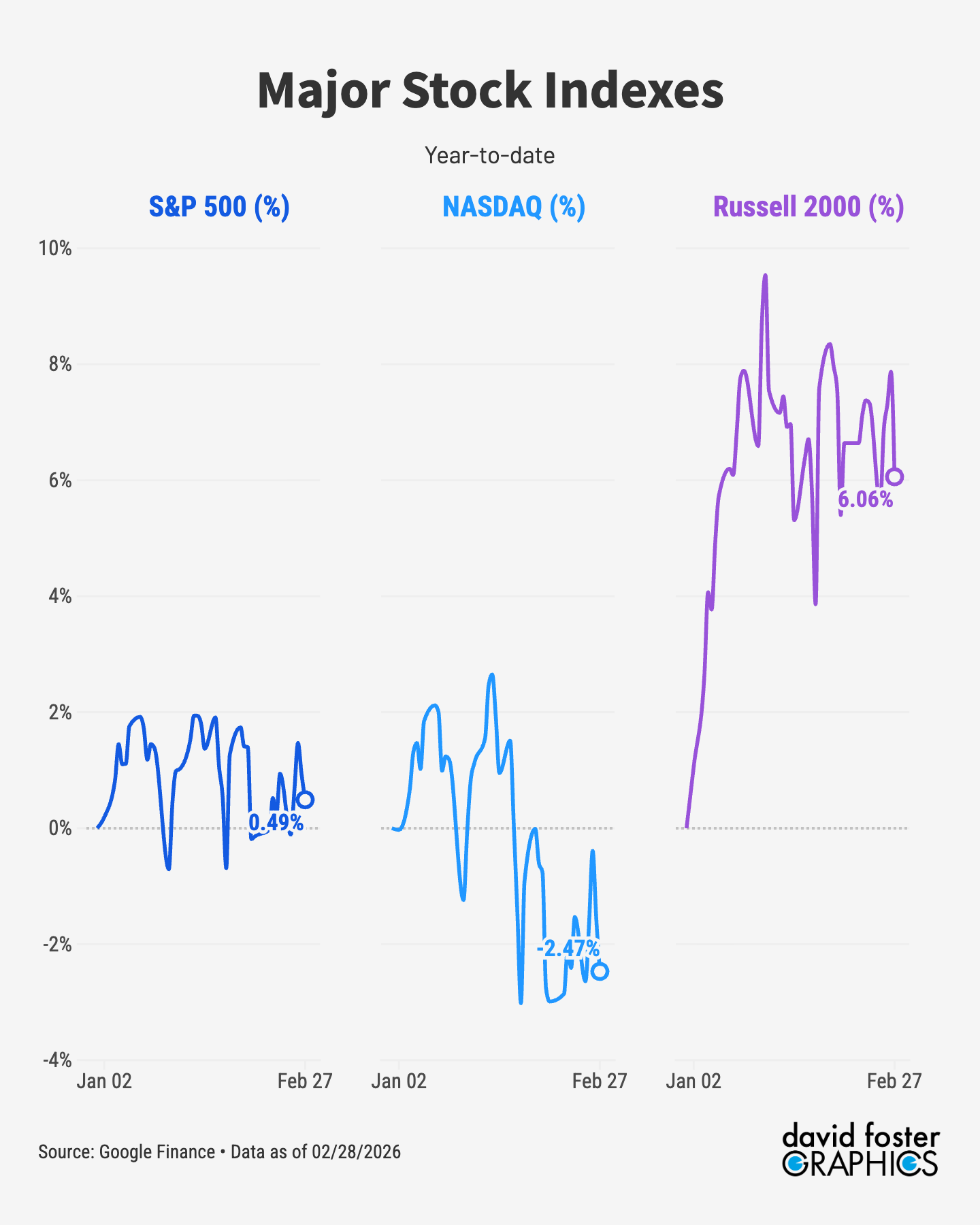
Or maybe not! Stocks recovered and were up for the week by Wednesday. Then the payment firm Block, run by Twitter cofounder Jack Dorsey, said it planned to lay off 40% of its 10,000 workers because “intelligence tools” will be better than the workers. And Dorsey predicted many other companies would do the same. So maybe Citrini is onto something. The on-and-off gloom pushed stocks down for the week. The S&P 500 fell by .51% with the NASDAQ down 1%. The small-cap Russell 2000 fell 1.3%.
Well worth noting: Many economists think fears of an AI apocalypse are overblown and expect AI to create more jobs than it destroys, which has happened with virtually every technology revolution in history.
Anthropic takes fire from the Pentagon. The purveyor of the Claude AI agent is on the outs with the government because it wants a say over how the US military uses its tools. Anthropic is a government contractor and the Pentagon used Claude to help execute the raid that snatched Venezuelan President Nicolás Maduro on January 3. Anthropic apparently raised some issues with that and said it wanted guarantees that its products would not be used for two things: mass domestic surveillance and fully autonomous weapons that can attack targets without human approval. The Defense Dept. said it couldn’t agree to use cases on a contractor-by-contractor basis, which to be fair, is realistic. Anthropic said it wouldn’t budge. So on February 27, President Trump ordered all federal agencies to stop using Anthropic’s technology.
[The Weekly WTF: Dept. of Drone Farce]
Trump’s Anthropic ban could be a negotiating ploy. But Anthropic positions itself as the good guy of AI, putting safety before profitability. So maybe it will be willing to forego its $200 million Pentagon contract and deal with the hassles of a government ban as a kind of branding exercise. The flap highlights the very problematic use of AI in military operations and in domestic security when a government might want to suppress public opposition. Not that that would ever happen in America! (RIP Alex Pretti and Renee Good. 😡)
If anybody wants to learn more, here’s a very listenable New Yorker podcast on Anthropic and its attempt to be human. If you really want to learn more, you can dive deep into the use of AI for military purposes in this Council on Foreign Relations essay. As usual, the technology is rapidly outpacing efforts to manage its use.
Trump’s empty words. Whatever you’ve read or heard about Trump’s State of the Union speech on February 24, it’s enough. Never have so many words delivered so few ideas. The Constitution requires the president to provide Congress an update on the country once a year, but it doesn’t say he has to deliver an endless television speech. For decades presidents gave the update in writing. We should go back to that.
More important was Trump’s implementation of a new 10% “global” tariff to replace the emergency tariffs the Supreme Court struck down last week. Trump wants voters to think he has a series of “affordability” plans, but the simple tell on this is that if Trump cared about affordability, he’d repeal all his tariffs because they raise costs for American businesses and consumers. If you ever bump into Trump and he tells you about his latest affordability plan, ask him if he plans to repeal all the new import taxes we’re all paying. Then you’ll know for sure.
[More: Beneath the chaos, Trump is losing on tariffs]
CNN invited me on this week to talk about Trump’s [lack of] affordability plans. I happened to be skiing in Vermont for a couple days, which explains my casual attire and the rustic setting, But we managed to make the connection work with an iPhone propped on a hotel ice bucket. Here’s the clip. 👇
The Trump-Epstein missing link. Bill and Hillary Clinton testified before a House committee this week on their Jeffrey Epstein connections. Hillary said she had no connection to the dead sex trafficker, and there’s no reason to think she did. Bill acknowledged his fraternization with Epstein, but said he “did nothing wrong” and “saw nothing” that clued him in to Epstein’s abuse of underage women. And there’s no known evidence against Clinton that proves otherwise.
Subpoenaing the Clintons was a distraction maneuver by Trump’s Republican allies in the House, who wanted to deflect attention from Trump’s relationship with Epstein. It didn’t work. As reporters and other sleuths go through millions of Epstein files released by the Justice Dept., they’re identifying culpable FOEs, friends of Epstein, one at a time. Axes are falling on some of those people, with one exception everybody is aware of: Donald Trump. Soon he will be one of the few, and maybe the only, FOE who hasn’t faced any accountability.
Journalists have now figured out that the Epstein dump excludes many references to Trump, including some that suggest he may have abused a minor. The Epstein files mention Trump thousands of times, but there are suspicious gaps in what the feds released. Suppressed Trump info does not mean Trump is guilty of anything. It does suggest a coverup and leaves wide open the question of whether Trump was an Epstein friend with benefits.
I’ve been saying all along that the Trump Justice Dept. will never release anything that incriminates Trump, because he runs his administration with more Nixonian ruthlessness than Nixon did. Here’s a question, though: Didn’t the Biden Justice Dept. vet the Epstein files? At least the ones that might have involved Trump? Wouldn’t somebody from that administration know what the files say about Trump? Couldn’t they plausibly testify before Congress now that it has required a full release of the files by law?
Trump says that if Democrats win one or both houses in this year’s midterms, they might try to impeach him again. But maybe what really scares him is they might get the real story on his connection with Epstein.
Here’s a terrific New Yorker conversation with Julie K. Brown, the dogged Miami Herald reporter who broke the Epstein story years ago and basically put the whole scandal into mainstream circulation. She summarizes the most important takeaways to date and offers some surprising insights, such as her belief that Epstein was most likely murdered in prison in 2019 and did not commit suicide. FWIW: Trump was president then. 🤔
Cable news nervousness. Most people don’t care who owns TV or movie companies, as long as the entertainment keeps coming. So there’s not a lot of dinner-table conversation about Paramount Skydance’s winning bid for Warner Brothers Discovery. They beat out Netflix’s $83 billion deal with a $111 billion offer. Netflix said, all yours.
The collateral damage could be CNN. If Netflix won the deal, it would have spun CNN into a separate company, keeping it journalistically independent. But Paramount will keep CNN, putting it under the control of Paramount CEO David Ellison, who’s the son of Oracle co-founder Larry Ellison. Both are Trump cronies. They gained control of CBS last year and immediately made controversial changes to the news division that may kneecap its independence.
CNN has many critics. Not me. My view is that the cable-news pioneer does terrific work between the laughable Fox News on the right and MS Now on the center-left. I’ve been on CNN many times (☝️), so call me biased. But I’ve reported for years on many of the topics CNN covers, and I know they work hard to get it right.
The deal will take 6 to 18 months to close. Then, watch closely.
~ ~ ~ ~ ~ ~ ~ ~ ~ ~
WHAT WILL MATTER NEXT WEEK:
Texas hold-em. The primary elections in Texas are March 3, and there are a couple key things to watch. First are the primaries for the Senate seat held by Republican John Cornyn. State attorney general Ken Paxton, an archconservative, is challenging Cornyn, and if he wins, Paxton could have a harder time defeating a compelling Democrat than the more traditional Cornyn. That could be a tantalizing pickup opportunity for Democrats.
On the Democratic side. Rep. Jasmine Crockett faces James Talarico, a state representative. Crockett is a firebrand, but some Democrats fear she is “unelectable” statewide in Texas, which Crockett says is code for the fact that she’s a black woman. Talarico gained national attention when Stephen Colbert had to interview him on YouTube because parent company CBS wouldn’t allow him to do it on his regular nightly broadcast. I wrote about that controversy in the Weekly WTF on February 19.
The other notable primary is for the House seat held by Republican Tony Gonzales, who’s embroiled in a dreadful sex scandal with a former aide who committed suicide last year. That really is WTF. I wrote about it here.
Jobs update. The jobs data for February is due March 6. The average expectation is 130,000 new jobs. That would be solid and would reverse a sharp slowdown in hiring at the end of 2025. But some economists think the 130,000 jobs gained in January was a statistical fluke that will be reversed in February. Whatever the case, job growth is still a lot slower under Trump than it was during Biden’s last year, in 2024.
Excellent summary/analysis on all topics! Also appreciated the reference tabs, that Citrini article is an eye opener! You keep us laughing while we grit our teeth...thank you Rick!
You’re safe. Not enough room in the jails for journalists
Forget bullion or Data Centers
Invest in Detention Centers