


Key takeaways: 😉
To see how the latest tariff developments affect ordinary people, skip to the bulleted list toward the bottom.
The Supreme Court eviscerated Trump’s trade war when it invalidated emergency tariffs on February 20.
Trump says other tariffs can do the same job, but they can’t.
His new “global” tariffs might be illegal and get struck down just like the emergency tariffs.
The economy and the stock market can probably withstand Trump’s tariffs for the rest of 2026.
But Trump could cause new levels of havoc after the midterm elections in November.
~ ~ ~ ~ ~ ~ ~ ~ ~ ~
President Trump responded with a thunderclap on February 20 when the Supreme Court invalidated the “emergency” tariffs that account for the bulk of the new import taxes he has imposed during the last year. Trump immediately said he would impose a “global” 10% tariff on most imports. And he cited a different law not yet challenged to justify the latest set of tariffs.
Take that, free traders!
Yet Trump is falling far short of his goals to remake global trade and raise meaningful amounts of new tariff revenue. He definitely has other ways to levy tariffs now that declaring an emergency is off the table. But some of those could lose in court, too. Congress could come to his rescue by passing legislation allowing all the tariffs he wants. But tariffs are deeply unpopular and that probably won’t happen.
The average tariff, meanwhile, is dropping, which means the added cost borne by American business and consumers will be less onerous than many feared.
“Peak tariff is behind us and rates are coming down,” Henrietta Treyz of research firm Veda Partners wrote in a February 23 analysis. “There are not 51 votes in the Senate or 218 in the House for higher tariffs on US imports.”
The following chart gives an idea of where Trump’s tariffs are likely to end up. The average import tax when Trump took office was 2.4%. Trump jacked that up to 28% last April, which prompted a major stock-market selloff. Trump backed down, lowering the average rate to around 16% by the end of 2025.
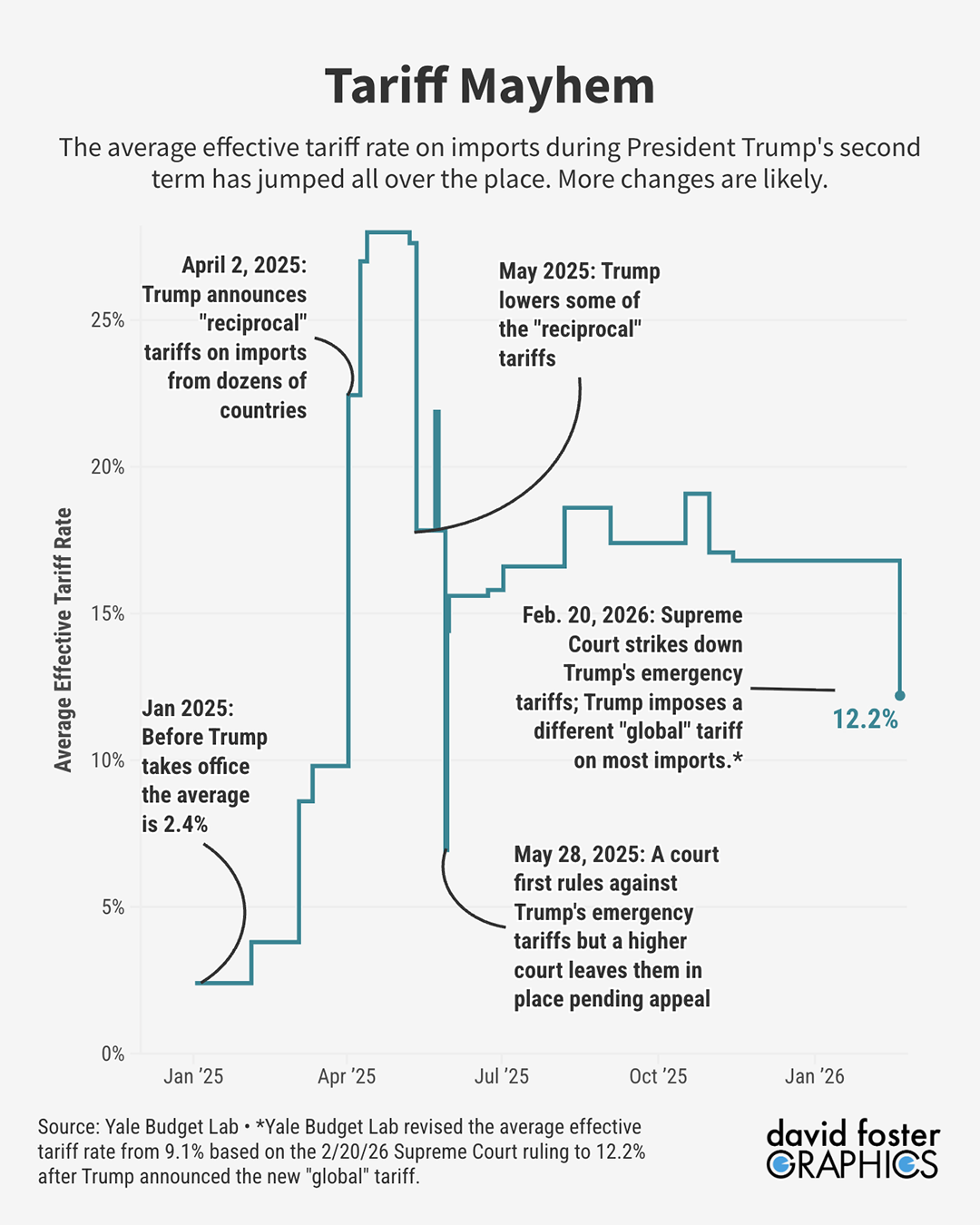
When the Supreme Court killed the emergency tariffs, the average import tax fell to 9.1%. Trump first said the new “global” tariff would be 10%. Then he upped it to 15%. But when it actually went into effect on February 24, it was 10%. Trump didn’t explain the missing 5%, but it’s probably necessary to keep the new total tariff rates in line with trade deals Trump has negotiated with the U.K., the European Union, and others.
All of this brings the average effective tariff rate to 12.2%, according to the Yale Budget Lab. In total, the Supreme Court ruling, combined with the new “global” tariff, lowered the average import tax by nearly 5 percentage points.
The average tariff probably won’t stay there. For one thing, the new law Trump is using only lets him impose a “global” tariff for 150 days. Congressional legislation would be necessary to go longer. But two-thirds of American disapprove of Trump’s tariffs, sussing out correctly that they raise prices and costs. Given that it’s an election year, there won’t be a majority in either the House or the Senate voting to raise voters’ costs.
Trump’s global tariff is also certain to draw legal challenges, and courts could rule it illegal, just as they did the emergency tariffs. For the “global” tariff, Trump is citing a 1974 law that says the president can impose the tariff if there is a “large and serious … balance of payments deficit.” The United States has no such deficit, and some experts say that makes Trump’s new global tariff just as suspect as the emergency tariffs.
The United States does have a large trade deficit, but that is only one component of the balance of payments, which includes all inbound and outbound economic activity, such as business and personal investment. That balance typically resolves to 0, as an accounting matter. So litigation could focus on the arcane but important differences between the trade balance, the current account balance, and the balance of payments. (Sorry for the brain pain!)
The 150 days will expire in late July, which will probably be before courts provide any clarity on the legality of the global tariffs. Without the global tariff, the average import tax would drop to 9.1% according to the Yale Budget Lab. That doesn’t include any other tariffs Trump could impose on the basis of national security or unfair trade practices, which are more legally proven.
Trump will try to use other authorities to impose tariffs, so let’s say the average tariff settles at around 10% or 11% within a few months. US markets can live with that. We know because the average tariff was around 16% from June until February 20, when the court struck down the emergency tariffs. Stocks rose during that time and the economy grew.
The bad news for ordinary Americans is that a lower effective tariff rate isn’t likely to mean lower prices, and the higher tariffs under Trump will still have a depressing effect on the economy. Here’s a short list of these effects:
Inflation under Trump, at 2.4% is still a bit higher than it would probably be without the tariffs. Thousands of businesses have raised prices because of the tariffs and they have no incentive now to lower prices.
American businesses have paid about $175 billion in tariffs that the courts ruled illegal, and they have the right to get their money back. But this is going to be a tortuous and lengthy process and if they ever do get those refunds, there’s no mechanism to pass them on to consumers months or years later.
Trump will continue to threaten more tariffs than he actually imposes, which will keep thousands of businesses that are exposed to tariffs off-balance for the foreseeable future.
The uncertainty caused by the Trump tariffs is probably contributing to the major slowdown in hiring. When businesses struggle to predict costs, they take fewer risks, and that means less hiring.
Remember the $2,000 “tariff rebate” Trump proposed for most Americans last year? It was never likely and now it’s out the window.
The November midterm elections will be another factor pressuring Trump to pare down tariffs. Trump isn’t running, but many of his Republicans allies in Congress are, and voters fault the whole party for tariffs that drive up costs. Before the Supreme Court decision, Trump was already easing up on some tariffs as part of an effort to address affordability concerns.
But once the midterms are over, Trump might come out guns blazing, as he did during the first few months of 2025. “After the midterm elections, all bets are off,” says Treyz. “Our low tariff thesis expires November 4, 2026.” Expect a lot more ups and downs on that tariff chart.
Paul Krugman put out an explainer video on "balance of payments" this morning... https://www.youtube.com/watch?v=VY6dZSseUY0
As you rightly say, given that (as I understand it) the US dollar is the global reserve currency, our annual balance of payments is. almost by definition, zero. The BOP term is more applicable to countries in some kind of currency distress (which may be caused by long-term financial problems) and is a phenomenon more prevalent among developing countries.
Expect there to be a suit filed on which prominent economists will surely file amicus briefs explaining the term. This new global tariff is almost certain to get knocked down in the courts and we all know Congress has zero appetite to extend them beyond the 150-day term they're allowed.
SCOTUS gave Trump & GOP elected officials / candidates a great gift on Friday. Talk about looking a gift horse in the mouth and insisting on shooting yourself in the foot, but I for one am happier for it.