


Some Americans feel great. They tend to be people who own stocks and are making money from a 25% gain in the market during the last year. The more you own, the better you feel.
If your main source of income is a paycheck rather than an investment portfolio, there’s less to cheer. Job growth is tepid, incomes are falling behind inflation, and housing remains unaffordable. President Trump’s approval rating is sinking because many Americans feel worse off since he took office, not better off.
[Why most Americans are missing out on an epic stock-market boom]
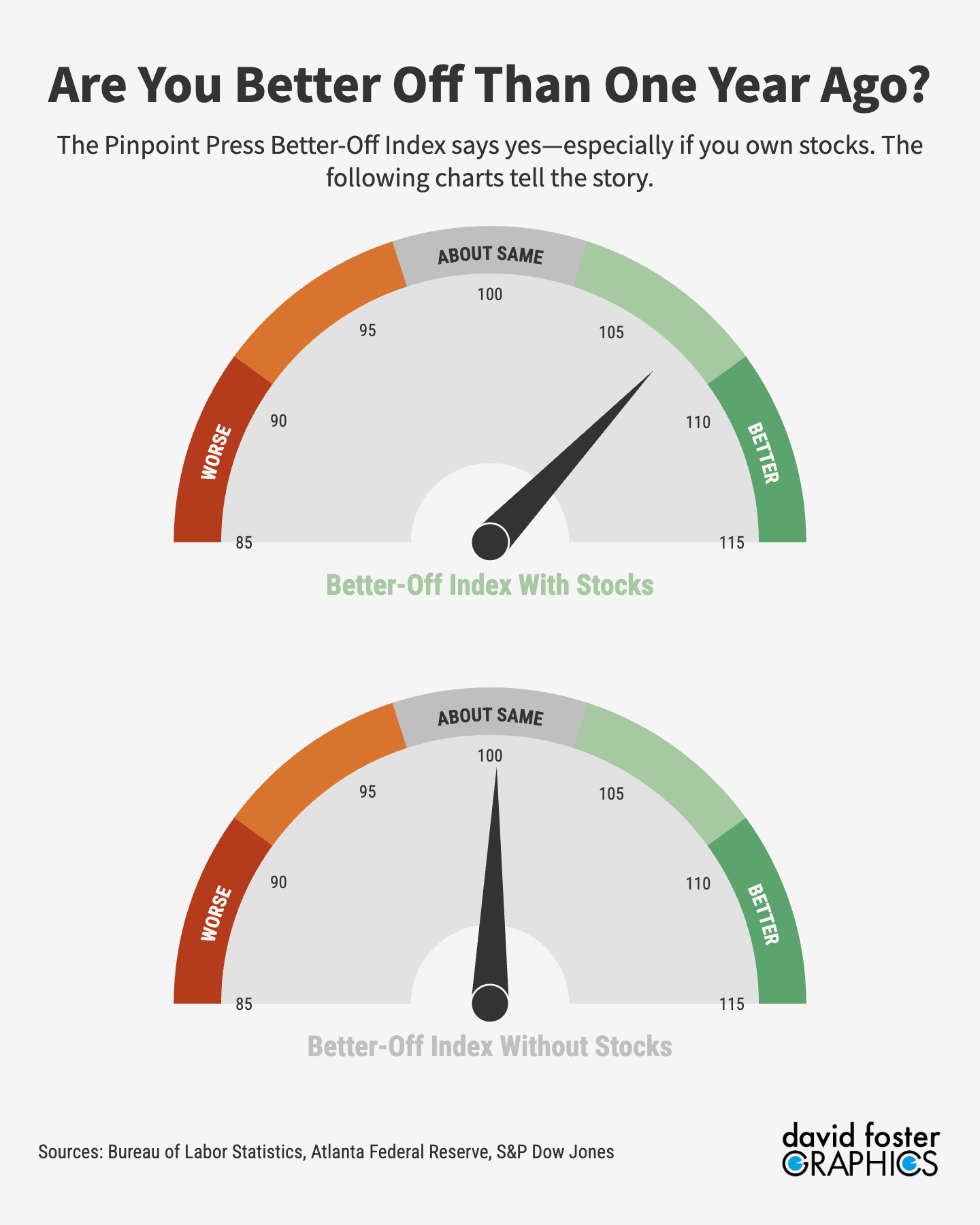
The Pinpoint Press Better-Off Index, which measures the economy compared with one year ago, neatly captures this dichotomy, often described as the K-shaped economy. The latest monthly index sits at 107.3, indicating a 7.3% improvement in a composite that measures changes in employment, incomes, housing affordability and stock values. The average index reading since 2006 is 102.9, so the current economy is better than average.
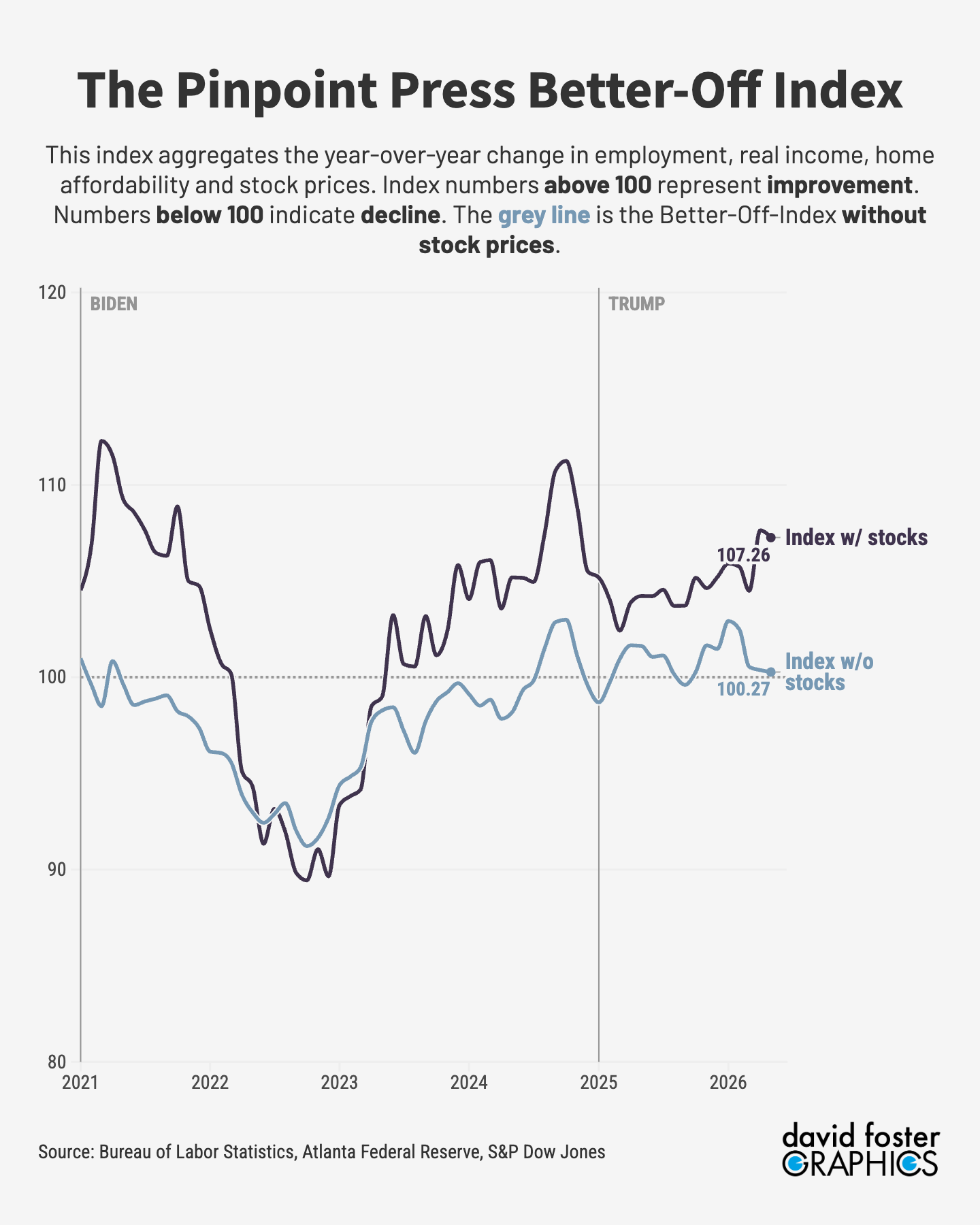
But stripping out stocks puts the index at 100.3, which is slightly below the long-term average. That indicates basically no improvement at all during the last year in what you might call the real economy. Given that a growing economy with improving productivity should always get a little bit better, this is a very weak performance.
Looking at each metric individually shows where the weakness is. The year-over-year improvement in stock values is robust. But real income, adjusted for inflation, is down during the last 12 months. That’s a combination of modest nominal income growth and inflation that has been rising because of the energy crisis caused by Trump’s war with Iran. Year-over-year inflation is now 4.2%, while income growth during the same period is just 3.5%. Falling real income means the typical paycheck buys less—and the typical worker is pretty aggravated.
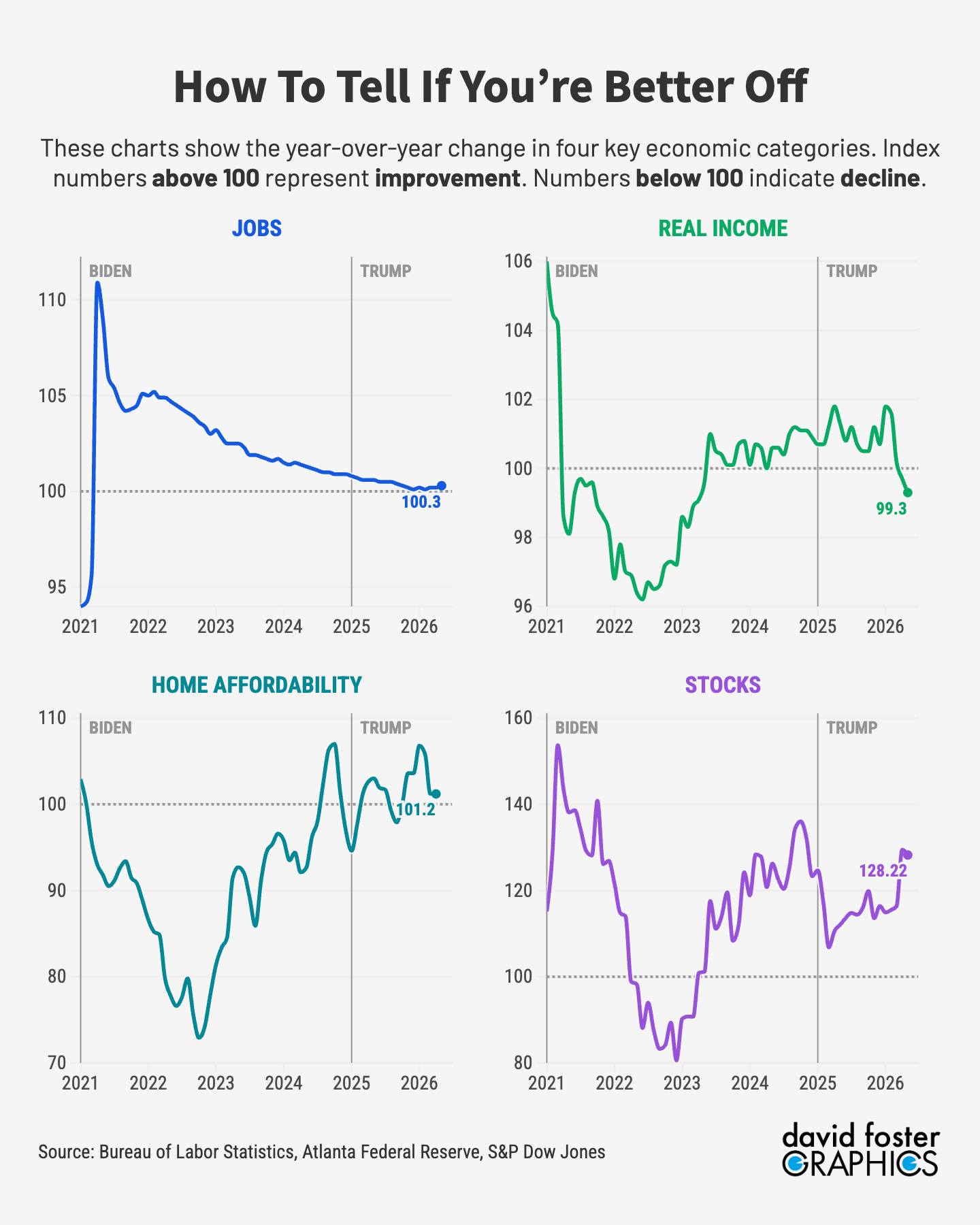
Job growth has been steadily slowing since it peaked in 2022. There was solid job growth in May when employers added 172,000 new jobs, following strong numbers in March and April. But there have also been five months of job losses during the last year. Put it all together and the labor market is growing at the slowest pace since the 2020 Covid downturn.
[How older Americans locked up the housing market]
Housing affordability, as measured by the Atlanta Federal Reserve, is slightly better than it was one year ago, mainly because mortgage rates have dropped by about four-tenths of a percentage point. But that’s not making many people feel better because housing affordability is still lousy.
It currently takes 43% of median income to pay for a typical house. The standard for affordability is 30%. Homes have been in the unaffordable range since 2021, mainly because of the huge run-up in home values during the Covid pandemic, when the Federal Reserve slashed interest rates, causing a buying spree. Overpriced housing has become a grueling national problem with no easy fix.
[The Weekly WTF: Trump 💖 inflation]
The economic pain of the Iran war, including soaring gasoline prices, has wrecked Trump’s approval rating. If the war winds down, as Trump clearly hopes it will, a resumption of energy flows through the Strait of Hormuz should gradually bring prices down and reduce overall inflation. So real incomes might turn positive again in two or three months.
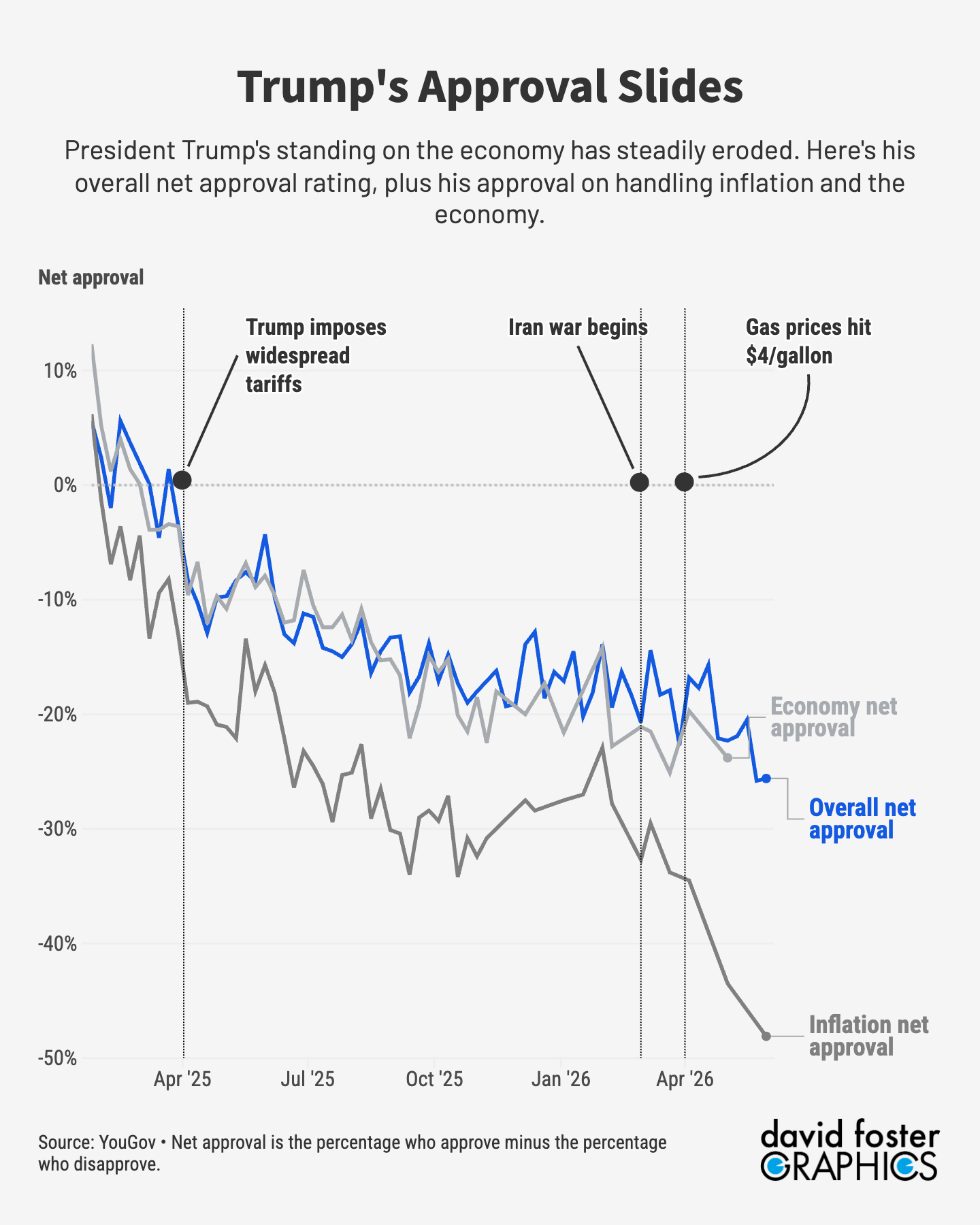
That doesn’t mean Trump’s approval rating will improve. When Joe Biden was president and inflation soared to 9% in 2022, his approval rating sank, too. Inflation gradually got better. Biden’s standing with the public didn’t.
[5 lessons from Trump’s Iran war]
What we learned then is that the sting of inflation and lost purchasing power lasts long after the data starts to improve. Voters have long memories, and presidents pay the price.
Member of the upper tine of the "K" here. I feel embarrassed, not to mention sad, that in a country that is overall as rich as ours, the lower tine of the "K" has been getting the shaft mostly due to our gov't policies & inaction (but also due to external events not entirely in our collective control) for at least a decade now. A sad commentary on our times.
And the recent update about the Social Security & Medicare situation past 2032 is downright scary. I hope & pray the new Congress and Administration taking over in Jan 2029 will have the guts to do the right thing - bite the bullet and fix these programs by raising revenue from and trimming unnecessary benefits for those who can most afford it and potentially by making some sound structural fixes. The last time this happened was 1983, I think... just before I came to the US for grad studies. About time now, don't you think? Unfortunately, spines, guts, and balls (and frankly hearts) are in short supply in the upper echelons of our federal gov't.
Upper tine. Solid phrase.
Asset inflation is not something I’ve given much thought to before.
Our $132,000 house is now likely worth 4x-5x.
Good for me. Not great for bottom tine