


If you could take the stock market gains of the last year and split them evenly among every US household, it would be a windfall of more than $100,000 apiece. That would alleviate most people’s affordability concerns and dramatically brighten the national mood.
But stock gains aren’t shared evenly, of course. By some measures, in fact, the stock market is less democratic than ever. Though many Americans have retirement plans that include stocks, the vast majority of financial wealth is concentrated among the wealthiest and oldest Americans. While America as a whole is richer than ever, most Americans aren’t enjoying the bounty.
Stocks have been on a tear since late 2022, with the S&P 500 index up 110% from its 2022 low. The artificial intelligence revolution has almost single-handedly driven those gains. And that followed a long boom in stocks after the 2008 financial crash, interrupted only briefly by a 2022 bear market as investors digested a burst of inflation.
That long period of gains has generated a financial bonanza. Data from the Federal Reserve shows the amount of stock market wealth soared from $2.1 trillion in 1989 to $57.7 trillion at the end of 2025. Based on gains so far this year, total stock market wealth has probably risen to around $63 trillion.
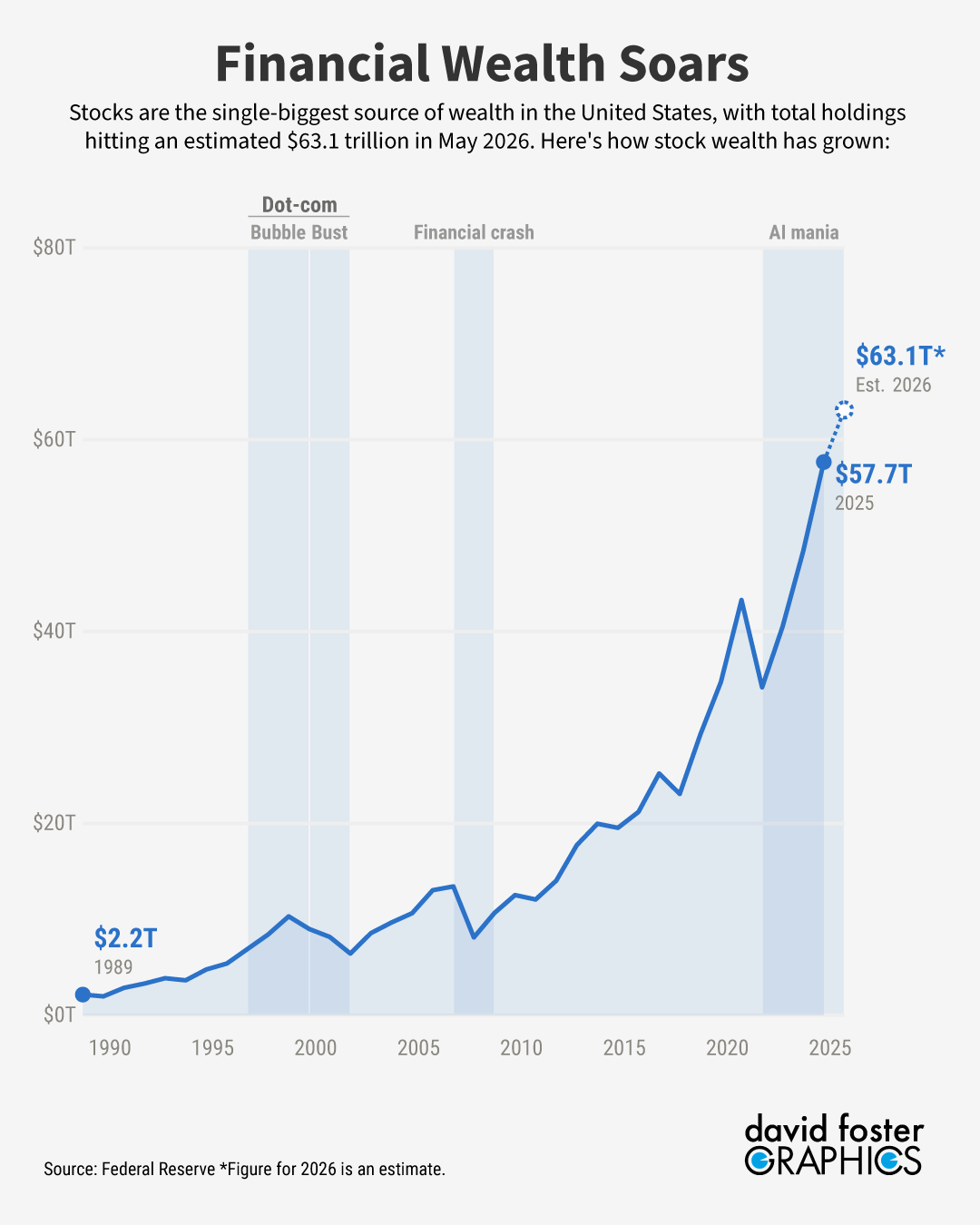
That’s an astonishing amount of created wealth. When the Fed started collecting the data in 1989, real estate was the largest category of household wealth, worth three times as much as all stocks combined. Real estate has appreciated handsomely since then. But stocks are now the single biggest source of wealth, worth about 20% more than all real estate. The total gain in stock wealth since 1989 is roughly 3,000%.
[Check out this interactive graphic on the growing prosperity gap]
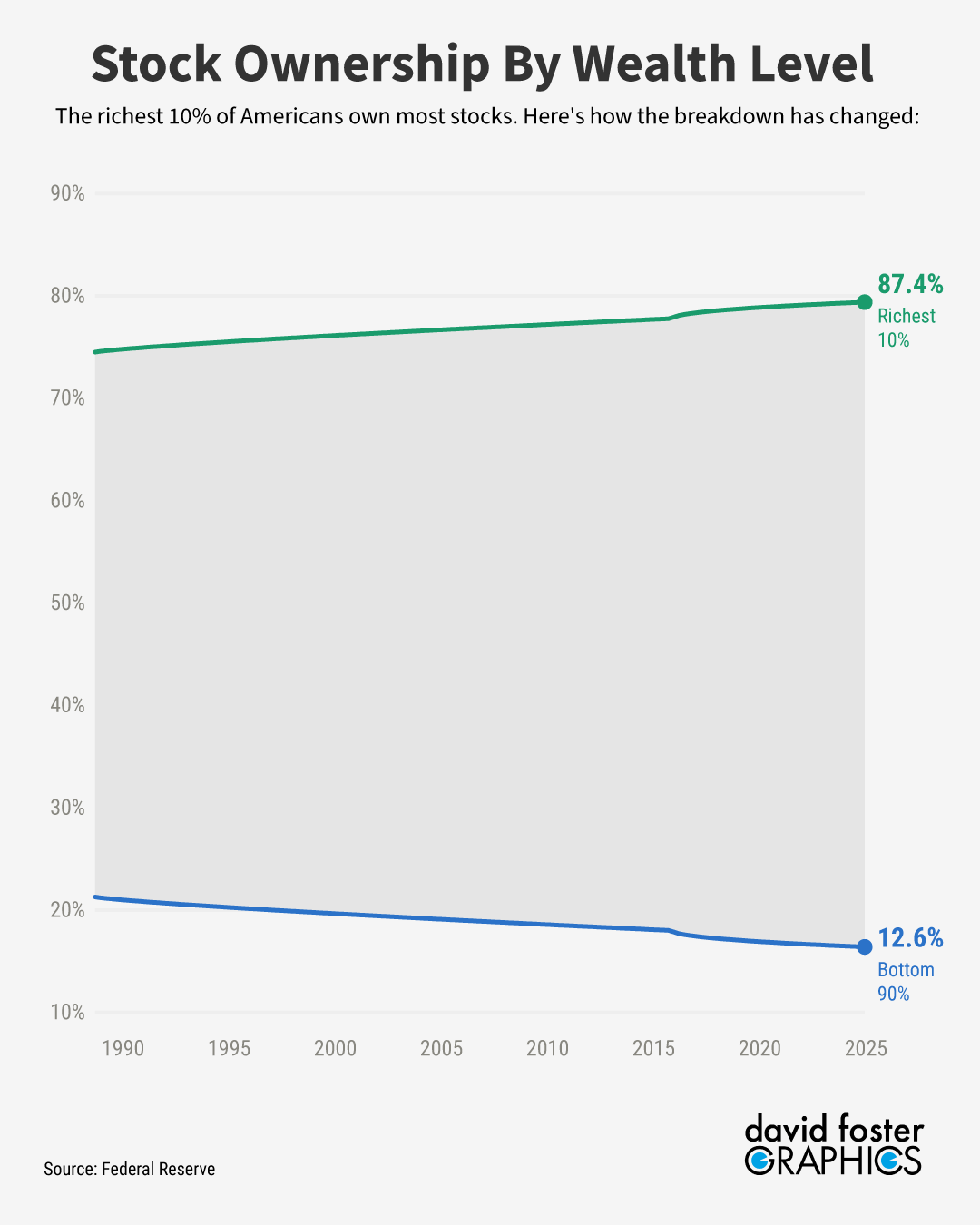
Stock ownership is highly concentrated among wealthy and older Americans, however, and getting more so, not less. The richest 10% of Americans own 87.4% of stocks, up from 81.6% in 1989. The bottom 90% own just 12.6% of stocks, down from 18.3%. The “K-shaped” economy—a thriving upper tier of Americans and a struggling lower tier—may be more pronounced in stock ownership than in any other aspect of American life.
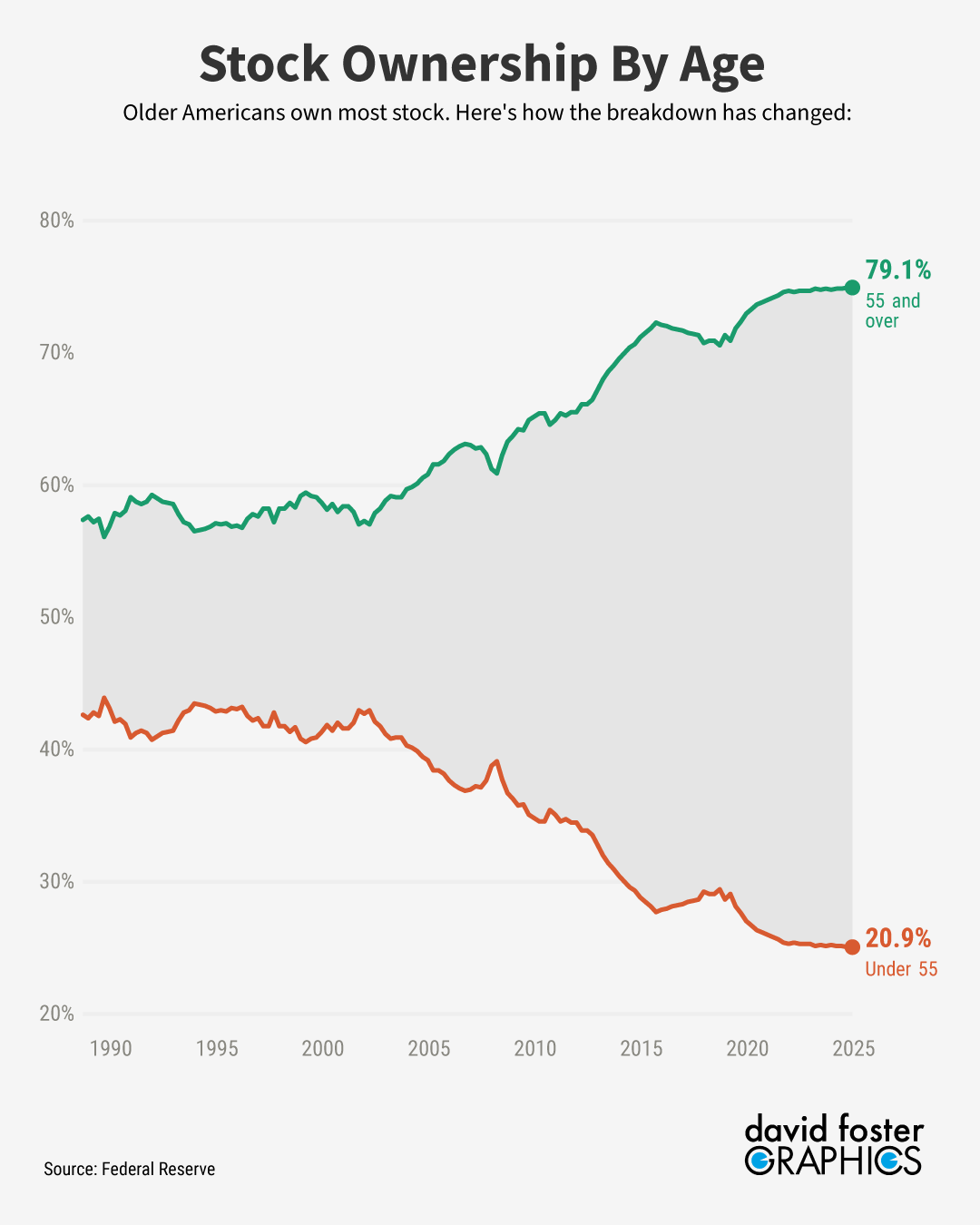
Stock ownership increasingly skews older, as well. Americans 55 and older own 79.1% of all stocks, up from 58.7% in 1989. Those under 55 own just 20.9% of stocks, down from 41.4% in 1989.
Gallup reports that 62% of Americans own stocks, so it sounds as if the majority of Americans benefit from a roaring stock market. But the lopsided concentration of stocks among the richest and oldest suggests otherwise. Most Americans own stocks in their retirement plans. A soaring market will help pad retirement for those folks, but it won’t necessarily make them better off today.
[See how older homeowners have locked up the housing market]
This growing wealth disparity now shows up regularly as a large gap in confidence between those who own stocks and those who don’t. While confidence is depressed overall, it is lowest among Americans who own no stocks and highest among those with the most stocks.
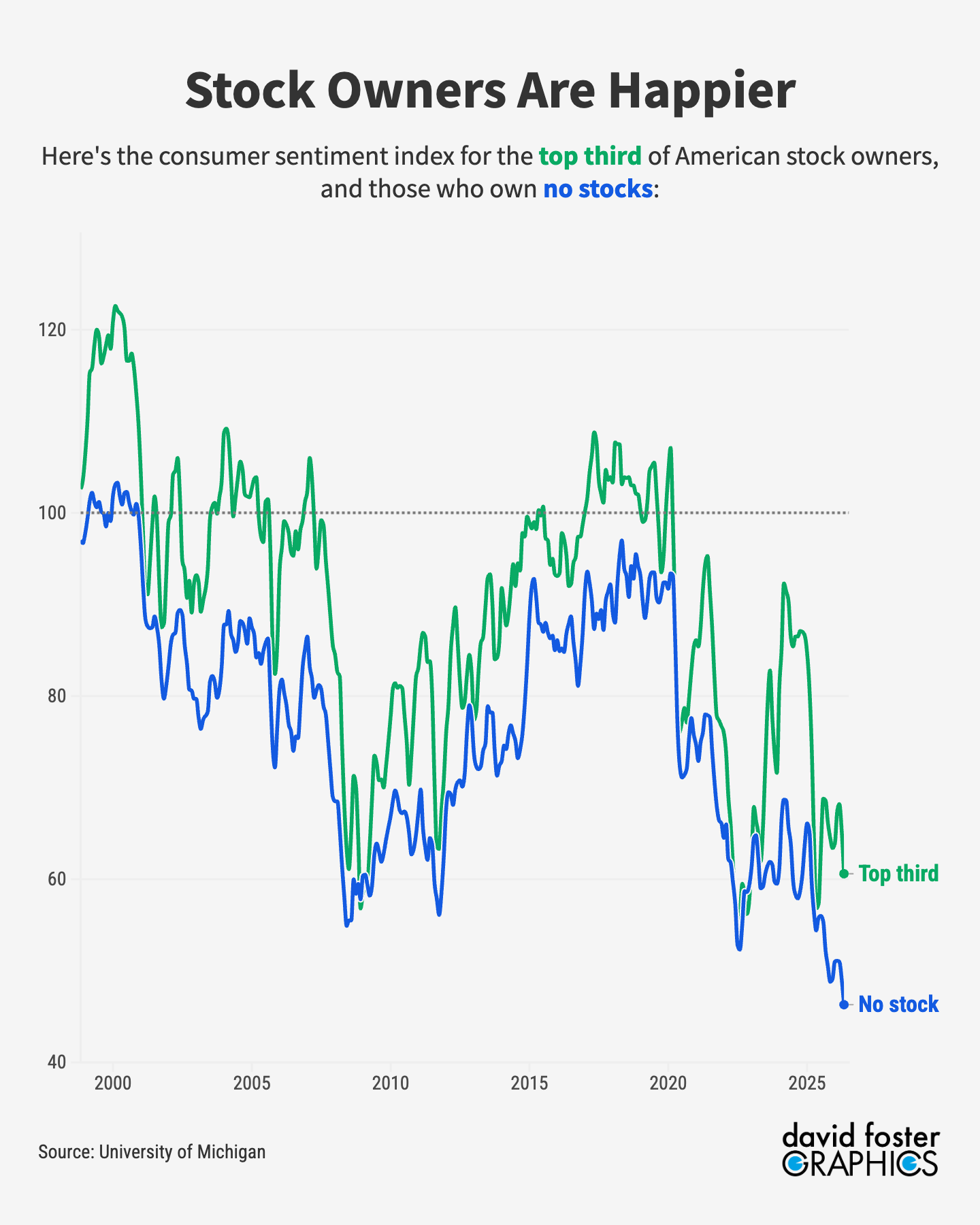
That confidence gap might be unsurprising, but it reflects ominous long-term changes in the US economy. For the last 25 years, labor income has been declining as a share of GDP, while corporate profits have been rising as a share of GDP. That means a smaller share of total income is going to workers and a higher share is going to investors. It’s harder for workers to get ahead through raises and promotions and a continually improving career.
Workers are losing ground because of globalization and a tech-driven economy that provides revolutionary new efficiencies without corresponding worker protections. It’s a complex problem with no easy solutions. Liberals want more policies that protect workers, such as a higher federal minimum wage and stronger union protections, plus higher taxes on the wealthy. Other researchers argue that workers need more relevant skills allowing them to cash in on a technology-driven economy. Some combination of all of the above is probably the best mix.
The AI revolution will probably make these disparities worse. But it may also bring new attention to wealth inequality and force some action. Meanwhile, anybody who can buy a share or two probably should.
Enjoy a cartoon.
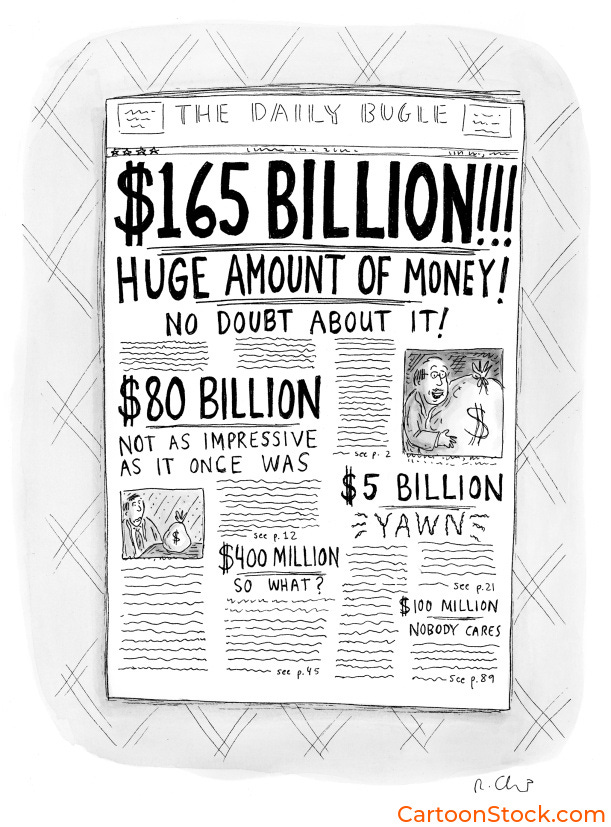
You can order this cartoon ☝️ or others like it, plus merch featuring cartoons, at CartoonStock.com.
Well-stated, Rick.
When charted events start with 1989, please remember that as the year Congress was finally forced by virtually all financial experts to adopt “FIRREA.” It was enacted to properly fund losses from the incredible damage caused by policies that generated the Great S&L Crisis that began in 1982 with a policy to let insolvent thrifts “borrow and lend their way out” of the impact of earlier inflation on the value of accumulated portfolios of low rate long term residential mortgages that had built up since the Great Depression.
While other excesses began to develop, US capitalism rose on the initial impact of “CMOs” (developed by homebuilders in 1985) and a capacity to overcome a bank monopoly on short-term commercial lending by allowing access to money market funds using “exemptions” from outdated SEC rules (created by a series of “no action letters starting in 1985).
Yes, the U.S. has been required to adjust as “holes” in the system are resolved (e.g., the 1987, 1998, 2000, 2008, 2020, 2022 and 2025 crises). Moreover, looming imbalances in distribution of wealth need to be addressed to balance our fiscal and monetary policies. However, it is certainly easier to address our needs after a 3,000% increase in our aggregate net US aggregate net worth.
I knew the system was rigged in favor of folks like me (an immigrant from Asia who came here as a foreign grad student and had a successful multi-decade corporate career), but this write-up with the numbers and charts was quite the eye-opener! Disparities in wealth and wealth-creation resources should one of our top priorities to address as a nation, partially bc we really don't want a French Revolution here, but much more so because it's the right thing to do by any moral standard.