


There’s a longstanding problem in the United States that probably began around the start of the 21st century, got substantially worse during the housing bust that led to the 2008 financial crash, and enabled the hostile populism of Donald Trump’s two presidential terms, starting in 2017. Nobody has done a thing about it, and the problem may now be intensifying as artificial intelligence becomes an unstoppable economic force.
Wealth inequality has been worsening since digital technology became widespread, China became a manufacturing powerhouse, and much of the American working and middle class started falling behind. It’s a complex trend with no single cause. But the chief hallmark is living standards that are declining for a majority of Americans, prompting widespread gloom and in some cases fury.
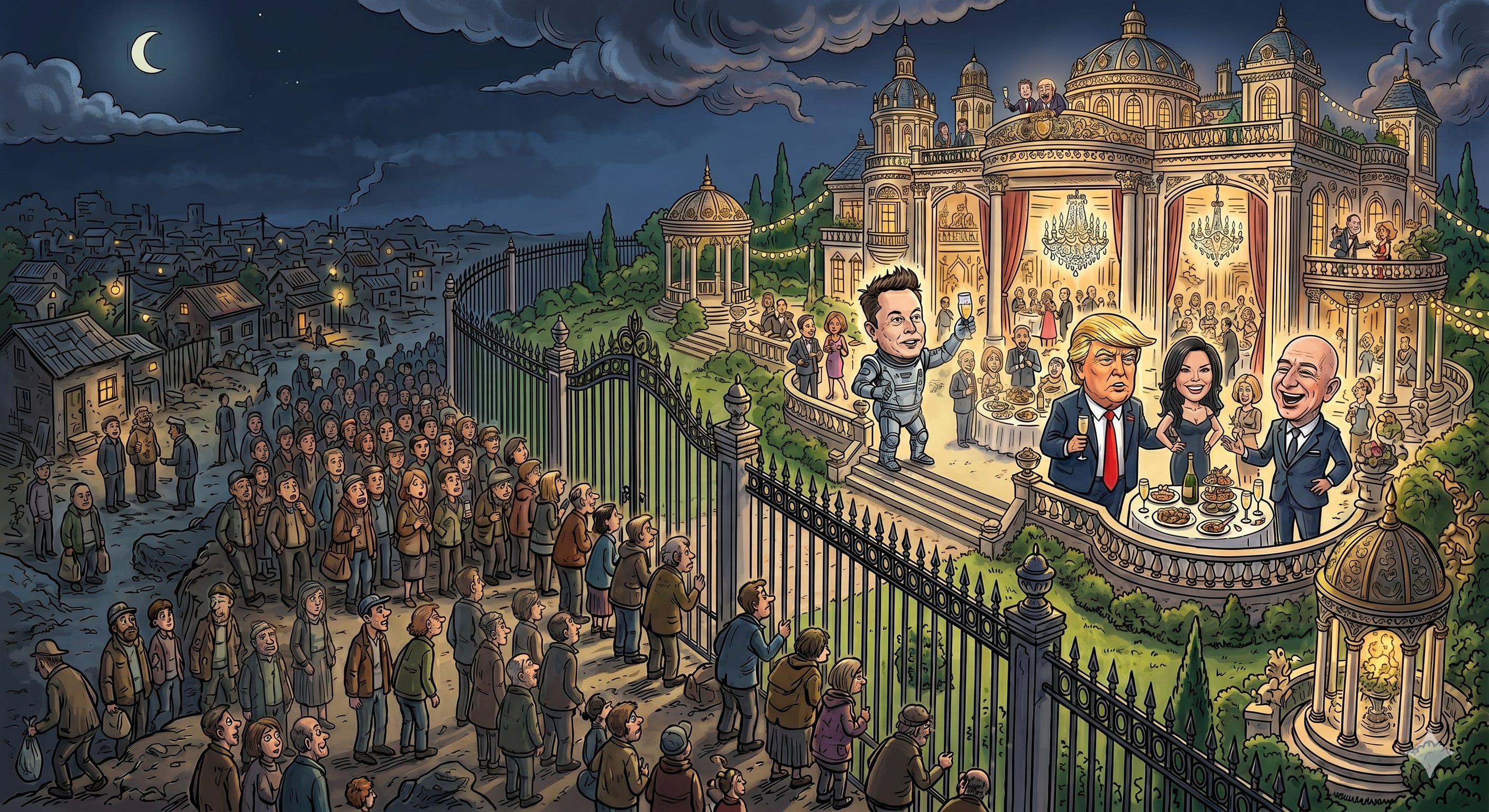
Economists puzzle over consumer confidence readings that are dismal, even as the economy looks healthy on paper. But worsening wealth inequality goes a long way toward explaining why so many Americans are pissed off.
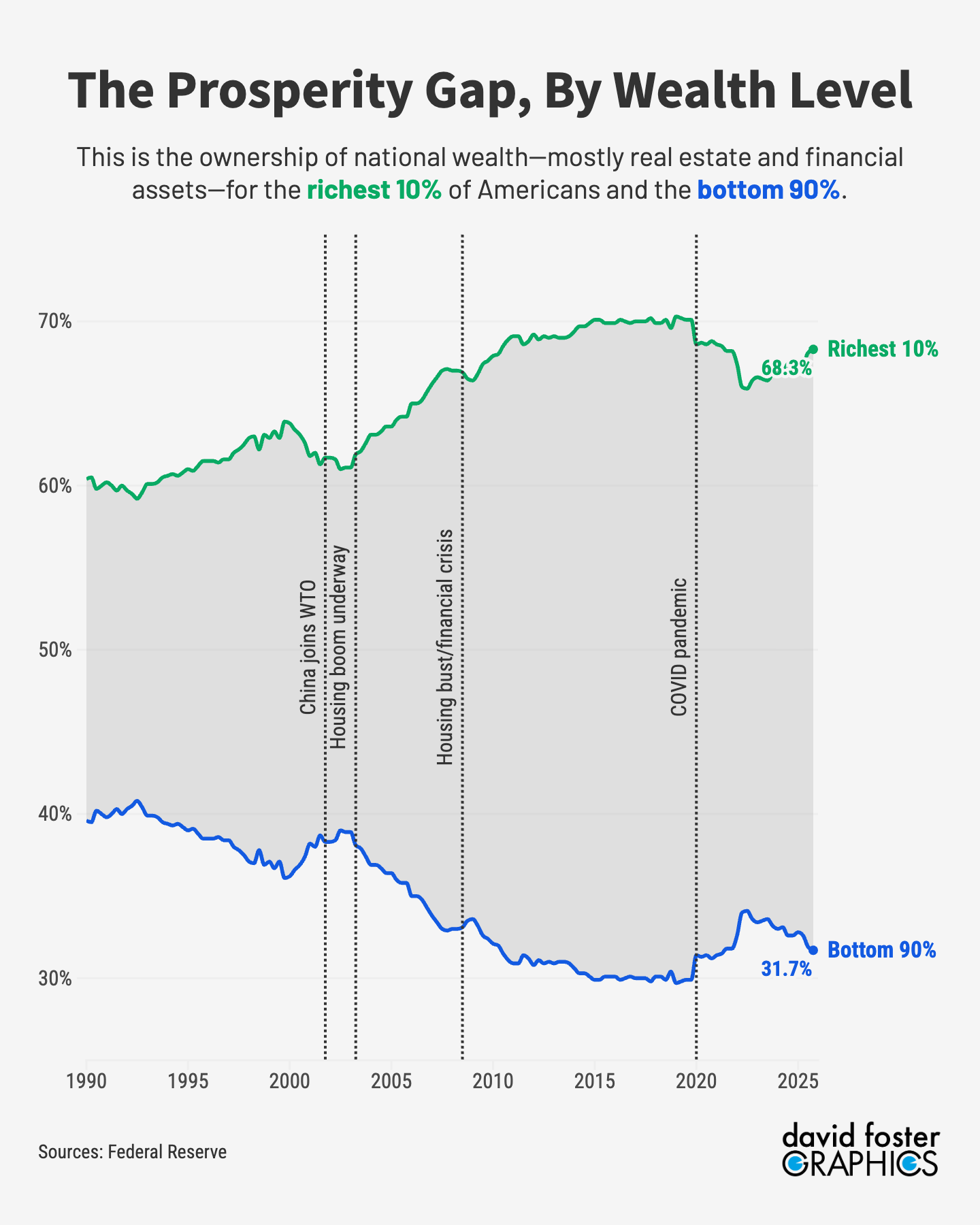
The following two charts show what may be the most important and dangerous trend in the US economy. The portion of national wealth—mostly real estate and financial assets—controlled by the working and middle class has been declining since the mid-1990s, according to Federal Reserve data. The sharpest drop-off has occurred during the last 20 years.
The richest 10% of Americans now own 68.3% nation’s assets, up 8 percentage points from the levels of 1990. The other 90% own just 31.7%, down from 40% in 1990.
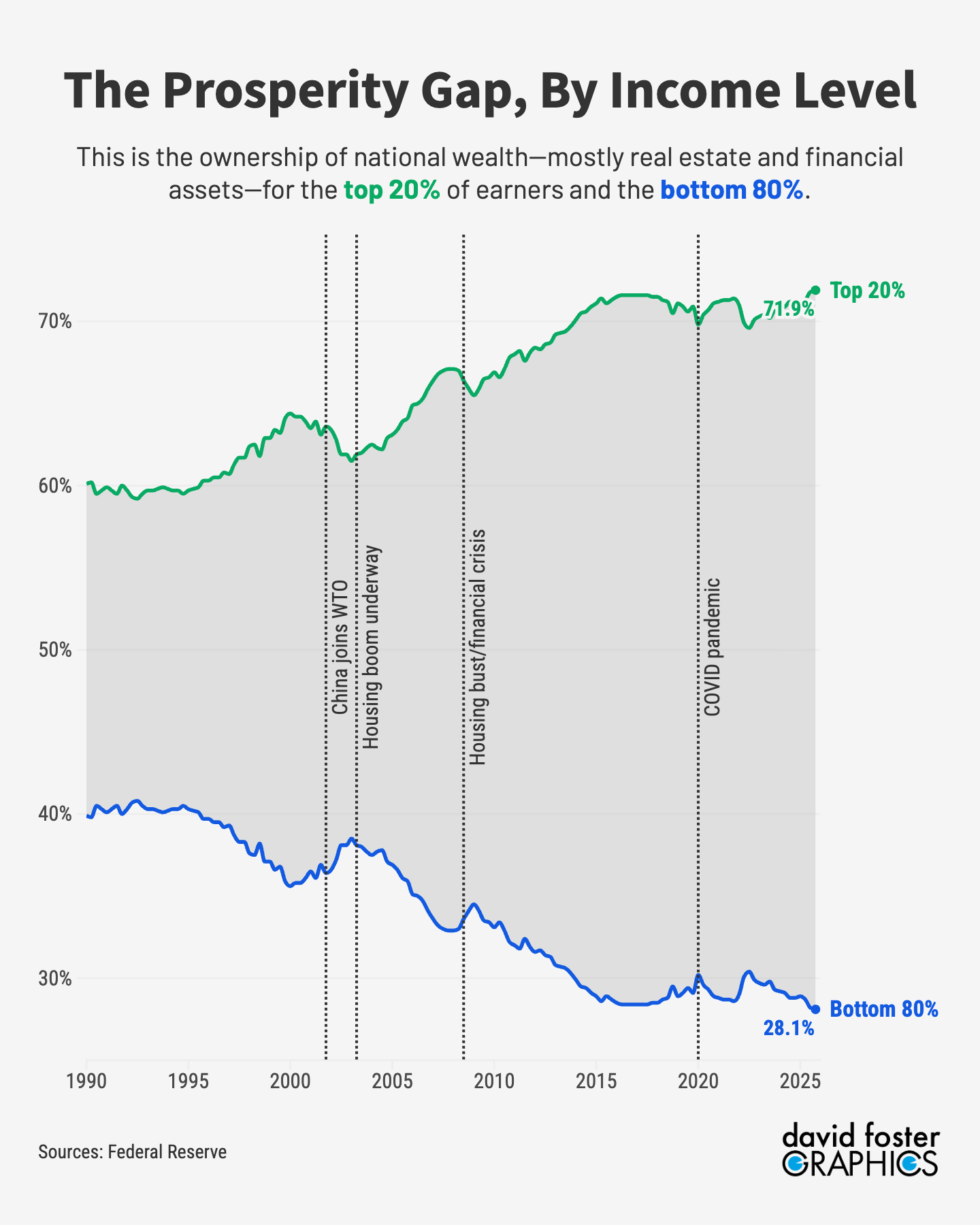
The second chart shows the distribution of wealth by income level rather than wealth tranche, with slightly different thresholds. But the trend is the same. The portion of wealth owned by the top 20% of earners has jumped from 59.5% to 71.9%. The portion owned by the bottom 80% of earners has dropped from 40.5% in 1990 to just 28.1% now.
There’s nothing wrong with rich people in a capitalist society. The problem is that too few people are benefiting from a dynamic economy that is generating huge amounts of wealth. It’s popular to bash billionaires, as if they’re deliberately plundering the rest of us. But the real problem is a system that rewards breakneck innovation while doing little to help workers who get caught in the gears of change.
[Stock owners are pulling away from most other Americans]
Rising student debt loads and a lack of entry-level opportunities hold some younger workers back right out of the gate. Elevated real estate prices and a shortage of starter homes in many areas keeps lower-income Americans from building wealth through home ownership. More than half of Americans own stocks, mostly in retirement accounts. But the richest 10% of Americans own 87% of all stocks, which means a roaring stock market doesn’t do much to help the majority of Americans. The compounding wealth of the top 10%, meanwhile, fuels much of the spending that keeps the US economy growing.
Trump encapsulated the problem better than most politicians when he minted his trademark phrase “Make America Great Again” during his first presidential run. That harkens back to some unspecified time in the past when things were better. In 2016, Trump promised that “the forgotten men and women of our country will be forgotten no longer,” a direct appeal to blue-collar Americans who have watched their communities crumble as globalization sent millions of jobs overseas.
But Trump has done nothing to aid the working and middle class during more than five years on the job. The bottom 90% share of wealth hit the lowest level on record during Trump’s first term. It rebounded a bit after Joe Biden became president in 2021. But that was mostly driven by stimulus checks and other types of aid Congress passed amid the Covid pandemic. That largesse wasn’t sustainable, and once it ran out, the downward wealth trend for most Americans resumed. It is now headed for a new record low during Trump’s second term.
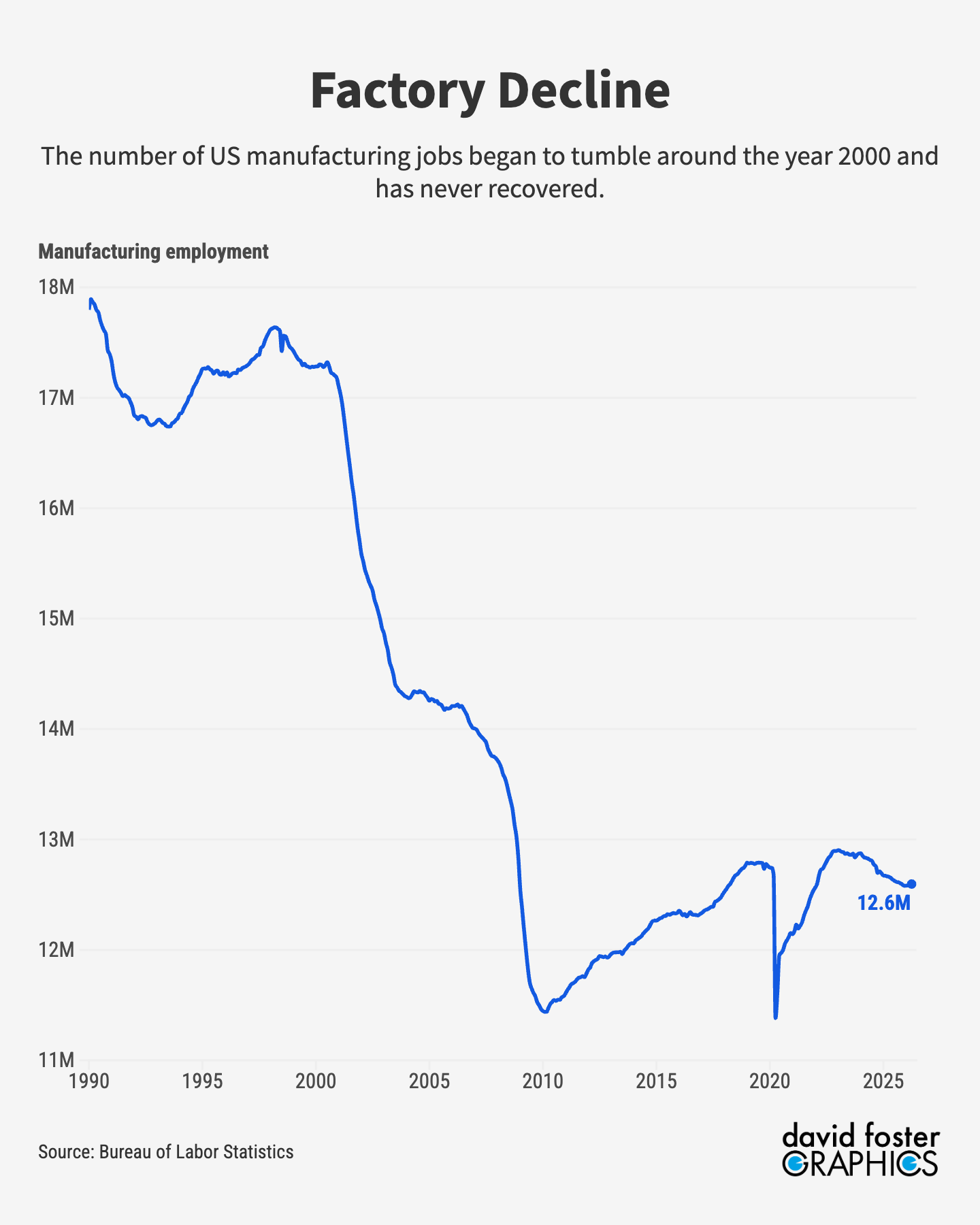
Trump’s focus on manufacturing jobs has been a total bust. There are nearly 5 million fewer manufacturing jobs now than there were in 2000, and those were once the good-paying jobs younger workers counted on to put money in the bank and save for the down payment on a home. Trump has raised tariffs and herded migrants out of the country, on the premise that better-paying jobs for Americans will somehow materialize. But they haven’t.
What Trump has really done is pursue pet causes while facetiously claiming they’ll help blue-collar workers. He loves tariffs because they let him micromanage the economy, and he doesn’t seem to care that they raise prices for Americans and reduce growth. He hounds migrants because it pleases the nationalists among his base, while peddling the fiction that Americans are going to step in to clean hotel toilets and pick fruit once the foreign workers are gone.
[The middling Trump economy, in 9 charts]
Did Biden do better, in between Trump’s two terms? You might think so, because he signed bills meant to stimulate factory construction, green energy production and other types of infrastructure. But it didn’t move the needle. Once the Covid aid was gone, the wealth gap continued to widen in 2023 and 2024.
The barriers to getting ahead are now generating self-defeating populism defined by tribal warfare among interest groups that does nothing to make anybody better off. Trump and other feral opportunists wage culture wars because their group needs to blame some other group for being stuck in a rut. But culture wars don’t boost paychecks or living standards, and trolling isn’t a skill most people can build a successful career around.
What is artificial intelligence going to do to wealth inequality? Probably make it even worse. The technology revolution contributes to the gigantic wealth gap because it creates a chasm in the economy. Technologists have all the latest tools and a constant edge. They will own the AI economy and capture the wealth it generates, which could be unimaginably huge. The analog sector will look in from the outside, as it has for most of the digital era, and wonder what went wrong.
[5 things to know about this year’s midterm elections]
What to do? One step would be a presidential administration with one priority above all others: Bringing more wealth to the massive majority and shrinking the wealth gap while protecting growth. Social and cultural causes, which tend to get canceled out when control of the White House changes parties, should be on the back burner.
There are many ideas for how to shrink the wealth gap. For starters, we should learn the lessons of the China Shock instead of repeating it with an AI Shock. It’s now well understood that the rapid outsourcing of manufacturing to China in the early 2000s ravaged many American communities and contributed to the growing wealth gap. The government could have managed that in a way that slowed the transition and provided better protections for displaced workers and their families.
There are a lot of people thinking about how to prevent AI from doing something similar. It will require a bigger safety net, including better tools to help more people find a place in the AI economy. History now proves this would be a lot better than simply letting workers flounder.
There should probably be higher taxes on the richest Americans, but they don’t need to be punitive. Top tax rates have been much higher in the past, when the wealth gap was more reasonable, and they didn’t stop America from being the world’s most innovative nation. New tax proceeds would be best spent on training and teaching, so that more workers have the skills for the economy of the future and don’t get stuck in the past.
We need more affordable housing. There’s a bill in Congress now that might help, but as is often the case, there’s a hostile minority faction standing in the way.
It might also help to stop fetishizing manufacturing as a cure-all for workers who don’t have a college degree. There’s no rule that says old industries must remain lucrative forever, and America’s industrial production remains steady even as payrolls have dropped. That’s efficiency, which we shouldn’t try to reverse. Better to funnel workers into the fastest-growing industries, at all levels.
Democrats got one thing right when they passed the Affordable Care Act in 2010. That law went from being unpopular to very popular because it lowered health care costs for millions of Americans. It also brought the nation closer to universal coverage, which ought to be an economic prerequisite allowing people to work where they can be most productive, not where they can get health insurance.
Republicans recently let some ACA subsidies expire, which is a step backward. It would benefit the entire economy if health care were something everybody could count on instead of a perk of working for a big organization. In addition to universal coverage, the other health care priority should be lowering costs throughout the system.
There’s a rich assortment of other ideas for how to better share the wealth at universities, think tanks, and even Wall Street investing firms. America has never lacked brainpower. But we sorely need fixers able to do what’s necessary instead of what is convenient.
Enjoy a cartoon:

You can order this cartoon ☝️ or others like it, plus merch featuring cartoons, at CartoonStock.com.
Rick. This is one of your better diatribes. Absolutely agree with most. You need to go back further in time to start your evaluation though. Ronald Regan (aka Ray-Gun) started this all with the concept of “Supply Side Economics”. He got a lot of credit for taming inflation in the early 80s , despite Paul Volker, and maybe deserved a little bit. Opening up markets to foreign competition and breaking unions were his big contributions, but the tax breaks to the wealthy were his lasting impact. The changes in tax structure were probably deserved at the time, but piling on under both Bush administrations and twice under Trump have just gone overboard to the detriment of the national deficit. I’m not sure why he is so revered, but we need to go back and analyze this deflection in economic and political thinking. Over the past 45 years, this is probably the biggest contributor of today’s K shaped economy.
I certainly thought your article hit it out of the park.At my age i do not worry for myself but my family . I just hate to see so many people left behind because it does not take a genius to figure out were that lead's.If our government think that thirty percent of the public can effectively the other seventy percent then though wrong.There will be another American Revolution.So like you said Rick we need some thinker's out there to work this out.