


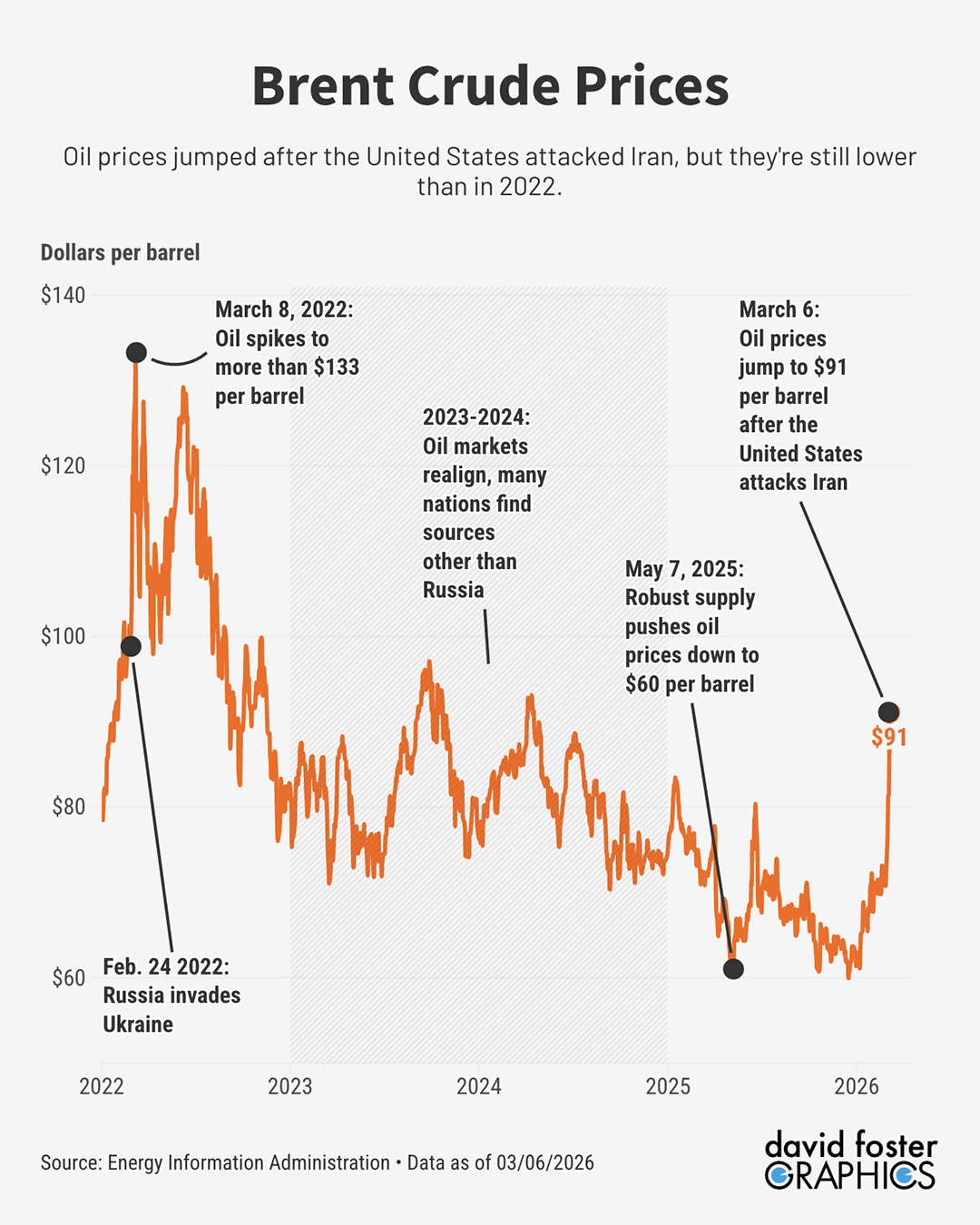
I’ve been sanguine about oil prices since President Trump kicked off the Iran war on February 28, because price increases were fairly modest. An initial jump of about $10 per barrel reflected a risk premium but not any actual shortage. Traders were betting on a short war with minimal impact on oil.
But the price of Brent crude, the global benchmark, has now jumped to around $90 per barrel, which is about $16 above pre-war levels. That’s not the $125 range prices hit after Russia’s invasion of Ukraine in 2022. But traders are clearly getting nervous. Three things have put new upward pressure on oil prices during the last few days:
1. Retired Adm. Jim Stavridis, who served as the top NATO commander and is now vice chairman of private equity giant Carlyle, wrote a March 5 article for Bloomberg pointing out that “Iran can turn the Persian Gulf into a minefield.” Stavridis wrote that Iran probably has at least 5,000 naval mines it can lay with small boats, submarines or aircraft, turning the entire gulf into a no-go zone for weeks or longer. “Just one hit,” he wrote, “can severely damage a thin-skinned tanker.”
This is not news to anybody who has paid attention to Iran’s military capabilities over the years, including experienced oil traders. But it seems to have surprised some Wall Street analysts, who started mentioning Stavridis’s warnings in their research reports. Word quickly got around: Wow, Iran could do a lot of damage.
[More: Why the Iran war might be worth it]
2. Qatar’s energy minister told the Financial Times on March 6 that Persian Gulf nations may have to halt energy production within days if they can’t transport it through the Strait of Hormuz. The problem isn’t production. It’s storage. There’s simply no excess storage space for oil, natural gas and other types of energy if producing nations can’t move it. The Qatari minister said prices could hit $150 if transport through the strait isn’t restored quickly.
3. Then some big producers did halt energy production. Iraq has reportedly cut oil output by about 50%, while Kuwait seems to be dialing back as well. Traders are bracing for other possible shutdowns.
Iran has threatened to attack tankers passing through the Strait of Hormuz, the 21-mile-wide chokepoint abutting southern Iran at the mouth of the Persian Gulf. About 20% of the world’s oil passes through the strait, making it the world’s most important oil passageway.
Iran has not physically blocked shipping through the Strait of Hormuz, or mined any nearby waters, as far as anybody knows. It has attacked some oil assets in the region, with minimal success. There’s no shortage of oil.
[More: How Trump gets out of the Iran war]
The problem is that much of the region’s oil is stuck on ships that can’t get where they’re going because maritime insurers won’t cover ships sailing into a war zone. So ships are clustered on either side of the strait, waiting to get out with oil or in to pick it up at Persian Gulf ports.
Trump said on March 3 that the United States government would offer insurance and military assistance to tankers, to get the oil flowing again. But that hasn’t yet materialized. Shipping companies will insist on ironclad legal contracts, which could take time to negotiate. There are political complexities, too: US insurance for oil exiting the Persian Gulf would be a de facto subsidy for China and other Asian nations that are the principal buyers of the region’s crude. The US Navy also lacks enough ships in the region to escort every tanker.
There’s one other way to get the oil flowing: Degrade Iran’s military capabilities as fast as possible, which US and Israeli forces seem to be doing. They can fly unchallenged over most of the country and are systematically destroying Iran’s ships, missiles, drone facilities and many other types of weapons.
At some point, Iran won’t have much left to threaten oil tankers with. Prices will probably fall back below $70 per barrel at that point. But Iran wants to push oil prices as high as it can, for as long as it can, to cause Trump and much of the rest of the world economic pain. As is often the case, the economic war in the Middle East is just as important as the military one.
Yogi Berra apparently said something to the effect of: "If you don't know where you're going, you'd better be careful, 'cuz you might not get there." So much wisdom in that.
Goals that are unclear, sometimes conflicting, and often changing from day to day, the absence of clear metrics as to what a "win" entails, new demands thrown out every day ("I must have a say in who their new big guy is" or "I want an unconditional surrender"), etc... are all a recipe for a classic fubar shitshow in the making.
Let's, however, hope we end up very soon in a better place for our armed forces and all the people in the region.
The hits keep coming.