


President Trump has a fresh problem, thanks to his war with Iran: American drivers will now see gasoline prices starting with a 4, not a 3.
The war Trump launched on February 28 has sent pump prices soaring by more than a dollar per gallon in a single month. At the end of February, gas prices averaged $2.98 per gallon, according to AAA. They’ve now hit $4 per gallon and will probably go higher. The spike is entirely due to Iran’s de facto closure of the Strait of Hormuz, transit point for 20% of the world’s oil.
Gas prices have an outsized effect on consumer psyches, probably because filling stations display them in foot-high numbers and drivers pay for 10 or 20 gallons all at once. But $4 gas in 2026 isn’t as painful as it was in 2008, the first time prices passed that eye-popping threshold. And it’s possible that $5 per gallon, not $4, is the real pain point Trump has to worry about.
This chart shows gas prices during the last 20 years, adjusted for inflation and reflected in 2026 dollars. Many people forget, but the most severe gas-price shock in recent times occurred in 2008, when there was a brief speculative bubble in oil markets that sent the nominal price of gasoline to a peak of $4.16 per gallon. That would be more than $6 per gallon today. That spike was very short-lived, however. The financial crash occurred later that year and the Great Recession sent prices plummeting.
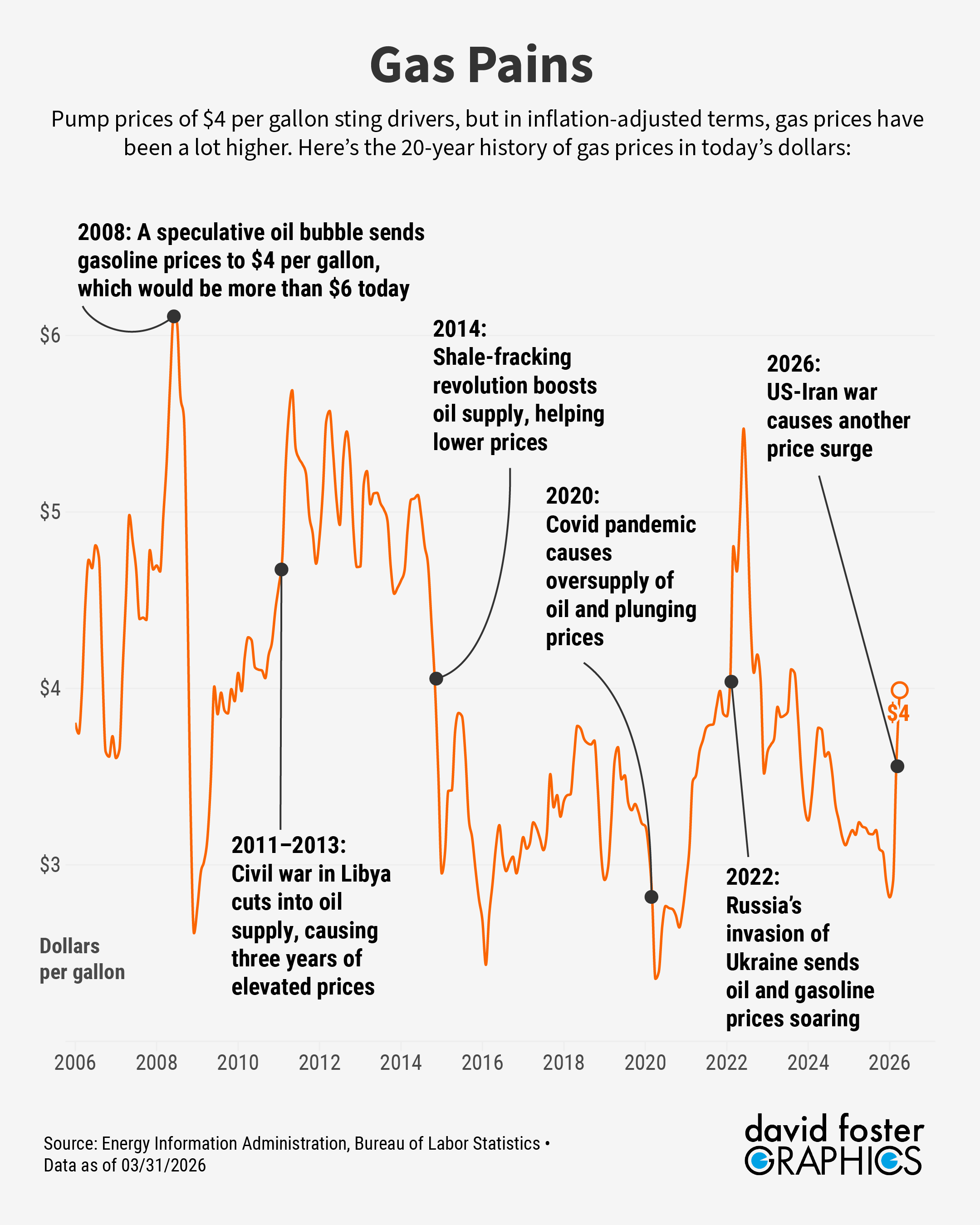
By the middle of the 2010s, the shale-fracking revolution was supercharging US oil production. The boost to world supply kept oil and gasoline prices relatively low. When the Covid pandemic hit in 2020 and economic activity collapsed, there was so much oil that storage became a problem. That produced the lowest gas prices in modern times: Nominal prices fell below $2 per gallon, or $2.35 in today’s dollars.
[More: Shaky wartime president sinks stocks]
US and global energy firms tightened production after Covid, and prices gradually rose. Then came Russia’s invasion of Ukraine in 2022, which led to widespread sanctions on Russian energy. Oil prices jumped and gasoline hit $5 per gallon for the first time in June of 2022. That would be about $5.50 in 2026 dollars.
By the time Trump began his second presidential term in 2025, gasoline prices had retreated to around $3.10. They dropped a bit more during the following year, and right before Trump ordered the attacks on Iran at the end of February, gas prices were at a five-year low. Trump bragged often about cheap gas.
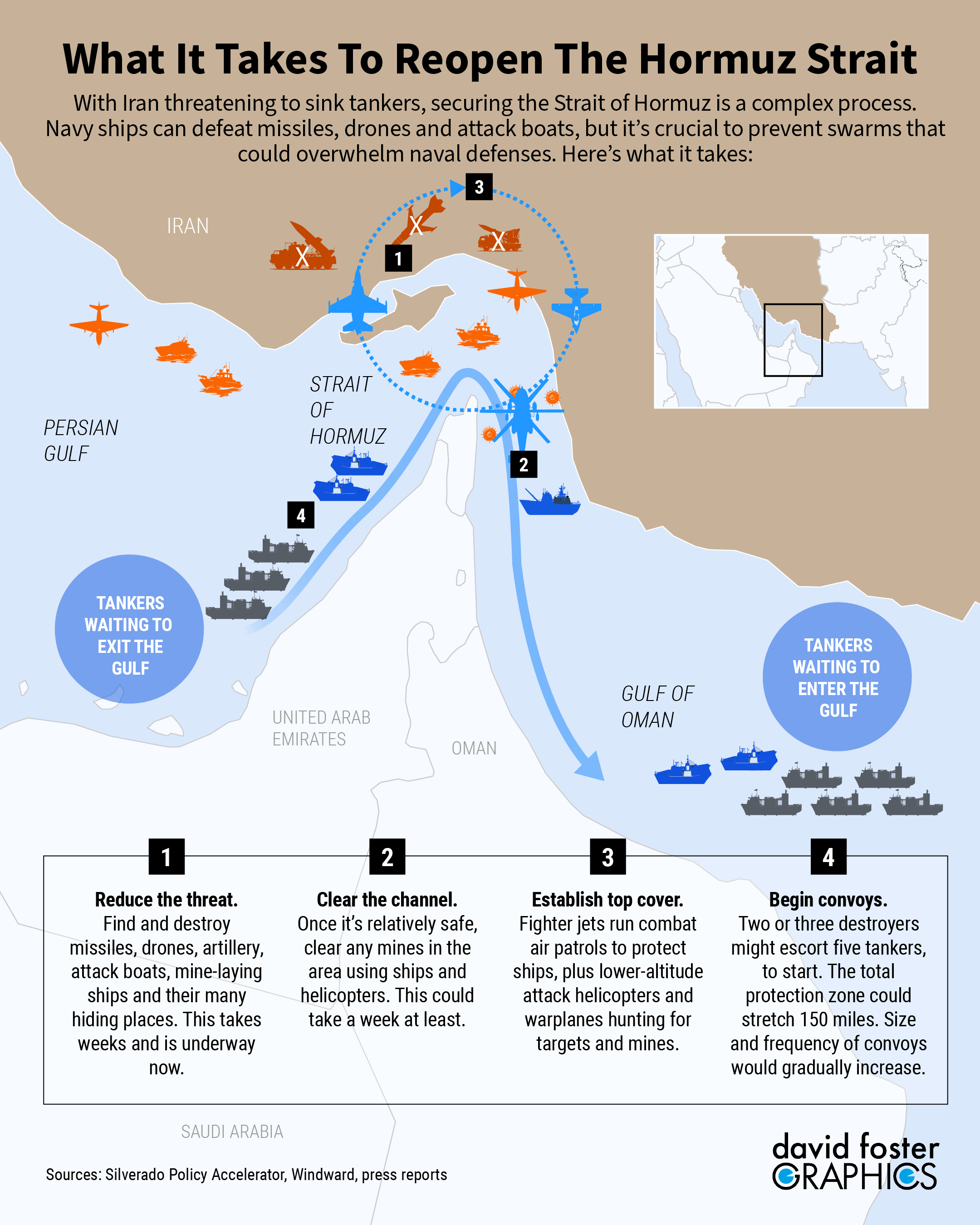
Those days are gone, at least for a while. While the US and Israeli attacks have devastated Iran’s military capabilities, they haven’t eliminated its ability to strike oil tankers with drones or missiles, or mine the Strait of Hormuz. The only oil tankers Iran allows through the strait are its own or those belonging to friendly countries. The hit to oil supply has sent prices up by 50%.
A majority of Americans oppose Trump’s war with Iran, and $4 gas could stiffen the opposition. But the real danger point for Trump may be $5 gas. Henrietta Treyz of Veda Partners has developed a “gas price anxiety index” that characterizes gas between $4 and $4.50 “uncomfortable.” Gas prices closer to $5 would be “painful,” while prices above $5 would be “excruciating.”
[See what it will take to reopen the Strait of Hormuz]
“We continue to view [a] main lever of political pressure to be $5 per gallon gasoline (up from $4 prior to the pandemic),” Treyz explained in a March 30 analysis. “This points to weeks if not months of continued war in Iran.”
However American consumers react, Trump can’t be happy about the surge in gasoline prices, and numerous press reports suggest he’s looking for a way to end the war and lower energy prices. The question is whether he can. Iran’s war strategy is to force energy prices higher and test how much discomfort the American president and his constituents can tolerate. It might be working.
Rick can you answer a question for me about Iran. Do they have a economy other than oil. Do they have bills to pay other countries.How is it that they can throttle another country and not slow down their on. If these leaders think that the other country will back off do you think that is wise on not. God Bless!