


President Trump seems to think that if he yells loud enough or threatens sufficient mayhem, interest rates will do what he wants. His latest threat is to stop trade with 90-some countries if the Federal Reserve doesn’t lower interest rates soon. That’s an absurd proposition that will tank markets if Trump gives it a shot.
Trump isn’t likely to get the lower rates he demands, or he thinks the United States deserves. CNN recently invited me on air to discuss why. Here’s the clip. Takeaways follow.
Trump doesn’t even seem to know how interest rates work. The Fed, for the most part, only sets short-term rates that affect banks. Under normal conditions, market forces set long-term rates such as those on mortgages and most other types of loans. Long-term rates are the ones that matter to most consumers and businesses. So why is Trump blathering on about the Fed?
One reason long-term rates are rising is because investors are worried about inflation. When bond buyers think future inflation will be higher, they demand higher rates to compensate for the eroding value of money.
Trump has personally made inflation worse, not better. His tariffs on imports are taxes that push the cost of many prices higher. That’s inflation. The Iran war he launched in February has obviously sent energy prices soaring, another source of inflation. Trump’s own actions are helping push rates higher.
[The ugly math roiling the bond market]
Another factor behind rising rates is the massive amount of borrowing by the US government, which now borrows around $2 trillion per year to fund deficit spending. That’s $2 trillion in Treasury debt hitting the market every year, competing with debt from many other governments and thousands of corporations. If there’s more debt on the market than investors want, the market pushes rates up until higher returns finally persuade buyers to commit their money.
The Fed does have tools for lowering long-term rates, which it normally only deploys in a crisis. And those only work if inflation is contained, which it is not right now. Lowering rates is a form of stimulus that stokes demand, making inflation worse. If the Fed lowered rates while inflation was high, it could backfire by creating more upward pressure on rates and trashing the Fed’s credibility.
One thing Trump could do to tamp down rates is develop a plan for reining in all that federal debt. Crickets.
Rates aren’t unusually high right now. They’re only around historical averages. But in the past, when rates were at similar levels, the US debt burden was far lower and net interest payments were a far smaller share of federal outlays. Interest payments now total more than $1 trillion per year and block other types of spending. That’s a problem.
The bottom line: It’s time to start dealing with the federal government’s massive debt load, which will only go higher if nobody does anything. It isn’t a crisis yet, but the market is saying now’s the time to do something.
[Three lessons from Trump’s six bankruptcies]
Don’t expect Trump to do anything. His attitude toward debt is that it’s somebody else’s problem. He declared business bankruptcy six times, mainly because his companies took on too much debt and couldn’t pay it back. He has said many times that declaring bankruptcy is a standard business procedure. Only problem: For the federal government, it’s not an option.
Enjoy a cartoon.
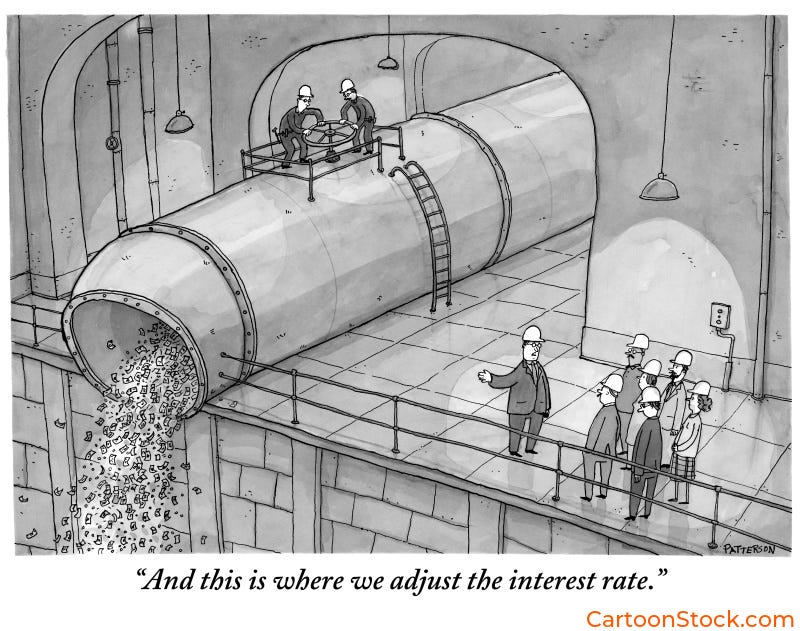
You can order this cartoon👆 and play cartoon-themed puzzles and word games at CartoonStock.com.
Loved the cartoon of course! But you shouldn't be spilling such secrets, Rick!
Another cockamamie scheme last night with the $5K Trump promised per taxpayer or household at his (un)convention(al) in Dallas... you can call it a bribe or look at it as a sophisticated way to rob your wallet and take credit for returning it to you. I'm gonna get my own money back - yay! I guess enough stupid or apathetic or cynical or cruel voters put him back in the WH in 2024 after having known him for 8 years, so maybe they'll believe him this time too (I'm hoping not).
Trump seems to think like i said that debt is just part of business. Like i said to much federal debt will cause our country to fail.P.T. Barnum reborn.