


Hello, friends. For the next five days, I’ll be in Maine attending “Camp Kotok,” an annual retreat for financiers and economists, plus a few journalists, originated by David Kotok of Cumberland Advisers more than 20 years ago. I hope to publish a series of dispatches with insights from the gathering. You won’t see The Weekly WTF this week, but the jackasserry isn’t going anywhere and WTF will resume around August 14.
~ ~ ~ ~ ~ ~ ~ ~ ~
Economists have been warning for years about a debt crisis caused by too much federal borrowing. It’s finally arriving.
But it’s not a rapid cataclysm, as some may have expected. Instead, the debt crisis is unfolding slowly and almost deliberately, in plain view for everybody to see.
The first manifestation of the debt crisis is rising interest rates. There are two types of interest rates. The Federal Reserve sets very short-term interest rates, which mostly affect banks. The last time the Fed changed those rates was last December, when it lowered them slightly. That’s not where the debt crisis is showing up.
Long-term rates on mortgages, car loans, and most other consumer and business loans are set by the market. And those rates have been rising since March. That’s the warning sign.
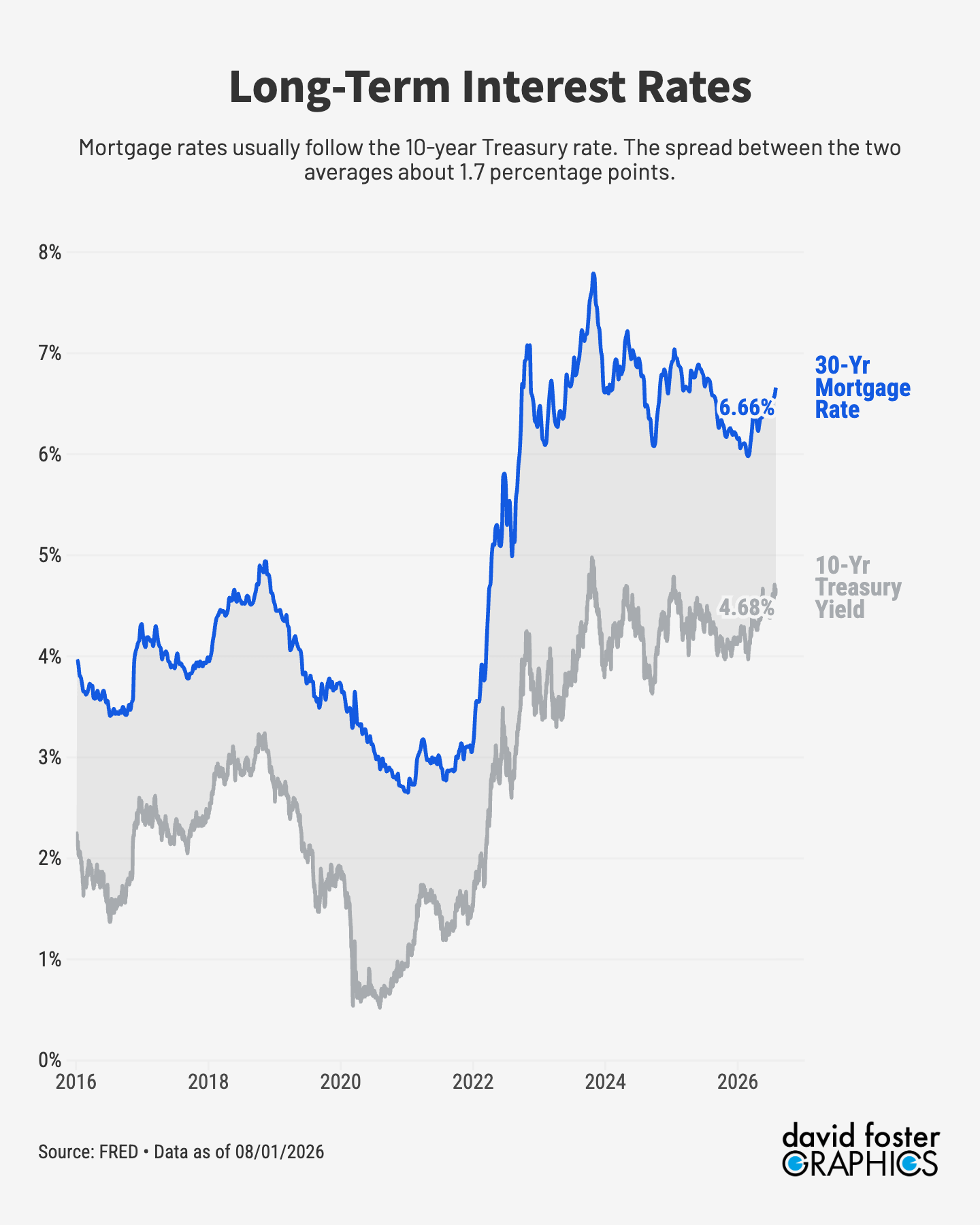
Rates are not in a danger zone. If they were, stocks would be falling and economic worries spreading. But economists think they’re higher than they would be if the US government weren’t borrowing roughly $2 trillion every year.
[Check out The Weekly Matterboard, “Nudification” Edition]
“The government is running these large deficits, and debt is so high that investors are demanding higher interest rates,” Natasha Sarin, president of Yale University’s Budget Lab, said recently. “That trickles down to the rest of the economy.”
The debt crisis is generating some weird developments. The Treasury Dept. recently helped Japan stabilize its currency, the yen, which has been falling in value against other currencies. The Treasury got involved because one way Japan could have stabilized the yen would have involved selling large amounts of Treasury securities. More supply hitting the market would have forced interest rates up.
Treasury—led by former currency trader Scott Bessent—helped Japan accomplish the maneuver using euros rather than dollars, which prevented a rise in US rates. The unusual move worked, for now. But it was an extraordinary intervention revealing deep concern in the Trump administration about rising rates and their effect on the economy.
[What to know about Trump’s new insider-trading scheme]
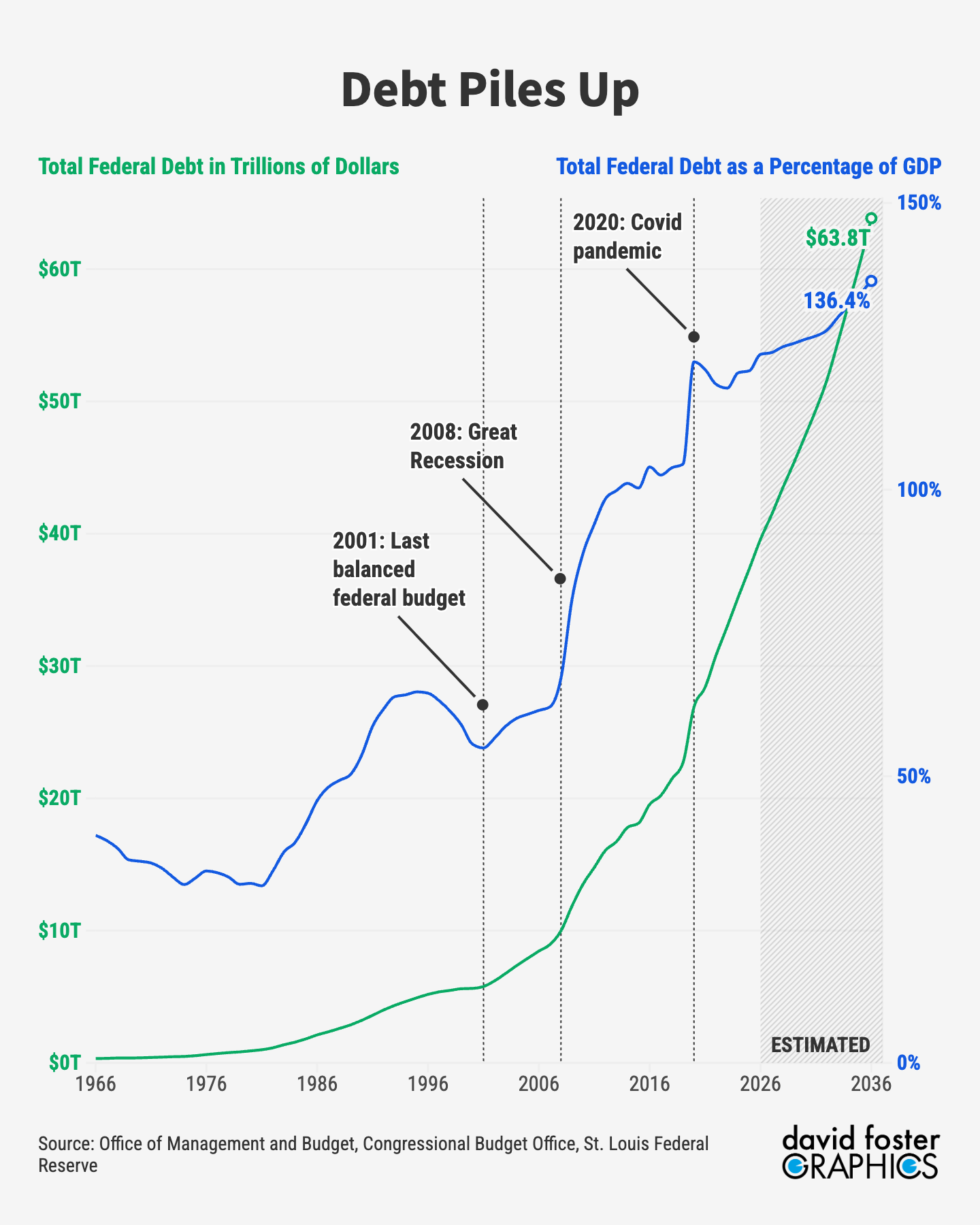
As everybody knows, the national debt is humongous, and due to hit $40 trillion near the end of September. Federal debt now competes for investor money with hundreds of billions of dollars worth of corporate bonds being issued by tech firms to finance the artificial-intelligence buildout. There’s always a mix of government and corporate debt in the market, but investors don’t automatically scoop up infinite amounts of it. If there’s more supply of debt than there is demand, rates have to rise to juice the return to investors and persuade them to buy.
Another complicating factor is the Iran war, because soaring energy prices have reignited inflation. When investors think future inflation is likely to be higher, they demand higher rates to lock in their money with bonds, to compensate for the eroding value of money.
So several factors are forcing rates up, not just runaway government borrowing. But rates might not be rising if there weren’t so much government debt.
Treasury has been subtly managing the problem for at least three years. Since 2023, Treasury has been issuing more short-term debt than usual to meet the government’s borrowing needs. Short-term debt is less likely than 10- and 30-year bonds to push up the interest rates consumers and businesses pay.
[Why markets are manic right now]
In 2024, when Bessent was an advisor to presidential candidate Donald Trump, he criticized the Biden Treasury Dept. for relying too heavily on short-term debt. But Treasury has continued the practice under Trump and Bessent. Excessive short-term funding becomes risky if short-term rates suddenly rise, because the debt rolls over quickly and the government has to pay more to borrow, on short notice.
While Bessent is busy swatting rates down, nobody in Washington is dealing with the core problem, which is too much government borrowing. Everybody is responsible for the $40 trillion debt. Republicans have cut taxes without cutting spending to match. Democrats have raised social spending without raising taxes to match. Wars added several trillion dollars to the tally. Voters getting more than they’re paying for punish any elected official who dares propose benefit cuts or tax hikes.
America doesn’t need to pay off its entire $40 trillion debt. What it does need to do is reduce annual borrowing enough to stabilize the debt relative to the size of the economy. That is going to require a painful combination of benefit cuts and tax hikes, and it will entail brutal political combat.
Yet it’s doable. Budget analyst Jessica Riedl of the Tax Policy Center has drawn up a plan with “something for everyone to hate,” because it would require sacrifices by liberals and conservatives and everybody in between. There are many other such plans. Where there’s brainpower, however, there’s no political will.
So we will continue to bear the cost of too much debt. First it will be marginally higher interest rates that punish borrowers. At some point, higher rates will ding stocks, slow the economy, and maybe cause a recession. The process has begun, and it’s now up to us to decide how long to watch the water rise before we start bailing.
Deficit spending adds net financial assets to the economy. The balance sheet of the government is the contra balance of the non government sector. Ever wonder why cash for you is an asset but it's listed as a liability for the government? You are out of your league here in this discussion im afraid.
The real problem isn't high interest rates or even government borrowing. It's the fiat-money machine behind them. Credit expansion and central-bank manipulation of interest rates allow governments to borrow and spend on a scale that genuine saving could never sustain.