


Key takeaways: 😉
The Supreme Court disallowed Trump’s favorite type of tariff but he imposed new and different ones.
Tariff turmoil continues and consumers probably won’t see any price declines from the Supreme Court ruling.
Trump convened the “Board of Peace” while threatening a huge military attack on Iran. 🤔
The housing market has nearly seized up.
Can you guess who gives the longest State of the Union speeches?
~ ~ ~ ~ ~ ~ ~ ~ ~ ~ ~
Old tariffs out, new tariffs in. On February 20, the Supreme Court invalidated the “emergency” tariffs President Trump has imposed on imports from dozens of countries during his second term, wiping out the biggest source of new tariff revenue Trump has been bragging about. The 6-3 decision found that the 1977 law Trump has been citing to justify just about any tariff he wants doesn’t actually allow the president to tax imports. For one thing, the law doesn’t even mention tariffs. Trump blasted the court for wrecking his trade agenda, but Trump built the whole plan on a flimsy foundation to start with. Many trade experts predicted from the beginning that courts would strike down the emergency tariffs. Trump gambled that wouldn’t happen, and now has a busted trade agenda as a result.
So now what? Three things to watch:
Rebates. American importers have paid about $175 billion in what the courts have now ruled to be illegal taxes. They have a right to get their money back. The Supreme Court told a lower court to figure that out. It’s going to be a messy battle and some analysts think there will never be any meaningful rebates. Budget hawks also point out that even if the tariffs are unpopular, they do produce a meaningful amount of revenue for a government drowning in debt. So the already grim US fiscal situation could get a little worse.
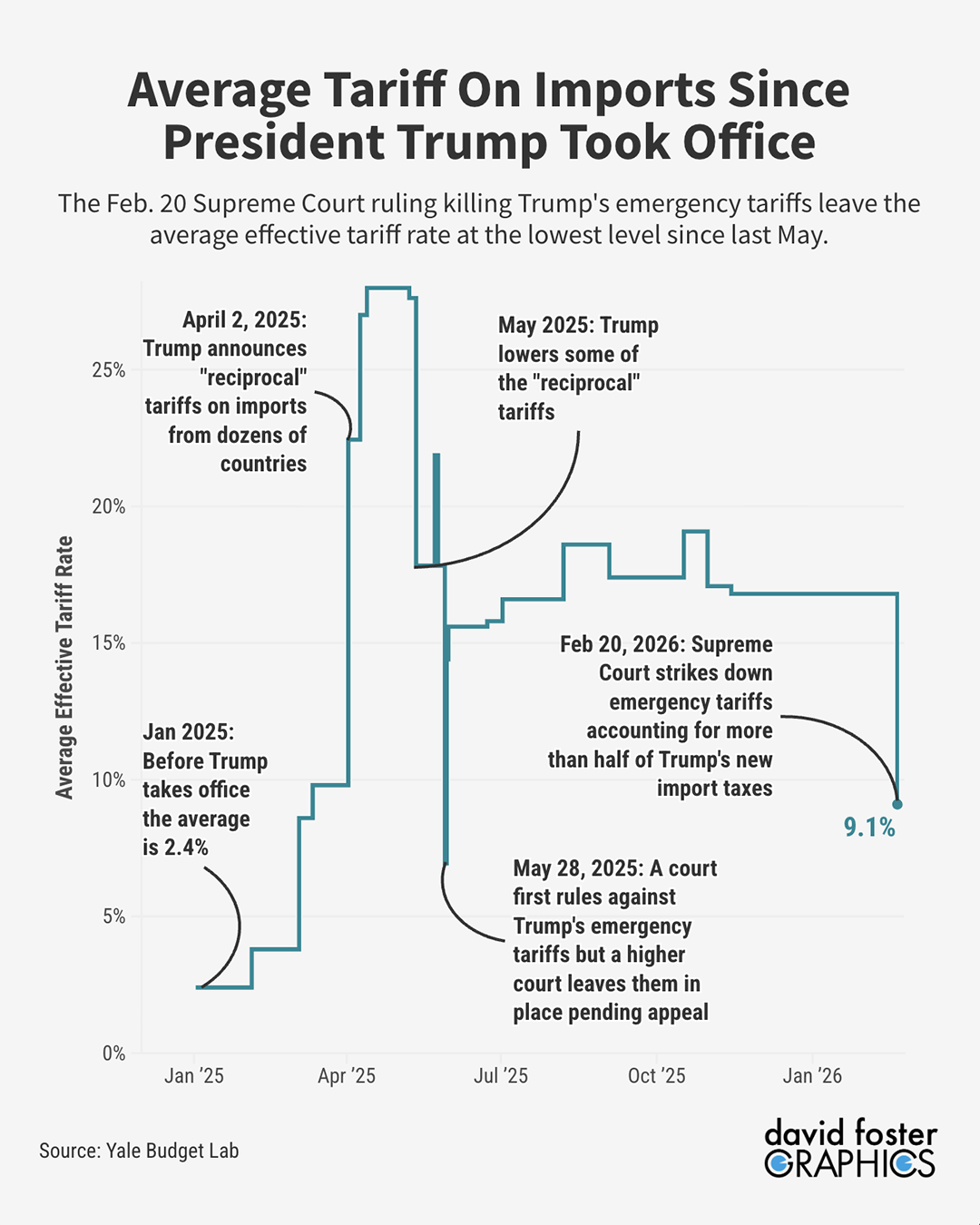
Replacement tariffs. With his emergency tariffs gone, Trump imposed a new 10% tariff on most imports to the United States that’s set to go into effect February 24. The he raised it to 15%. A different law gives Trump that authority, but these tariffs expire after 150 days unless Congress extends them. The new 15% tariff will be in addition to other tariffs that remain, such as product-specific taxes on imported aluminum and steel. But expect legal challenges to the new 10% tariff, as well.
[More: The Supreme Court did Trump a favor by killing his emergency tariffs]
Really? During an election year? Multiple studies find that Trump’s tariffs raise costs for businesses and consumers, depress hiring, and lower GDP growth. The full suite of tariffs, including the emergency ones, cost the typical household around $1,200 per year in higher costs and lost economic opportunity, according to the Peterson Institute. Trump evidently doesn’t care. But members of Congress fighting for their political lives in a midterm election year might have a hard time raising voters’ cost once Trump needs Congressional action.
[The latest market buzzword you might want to know]
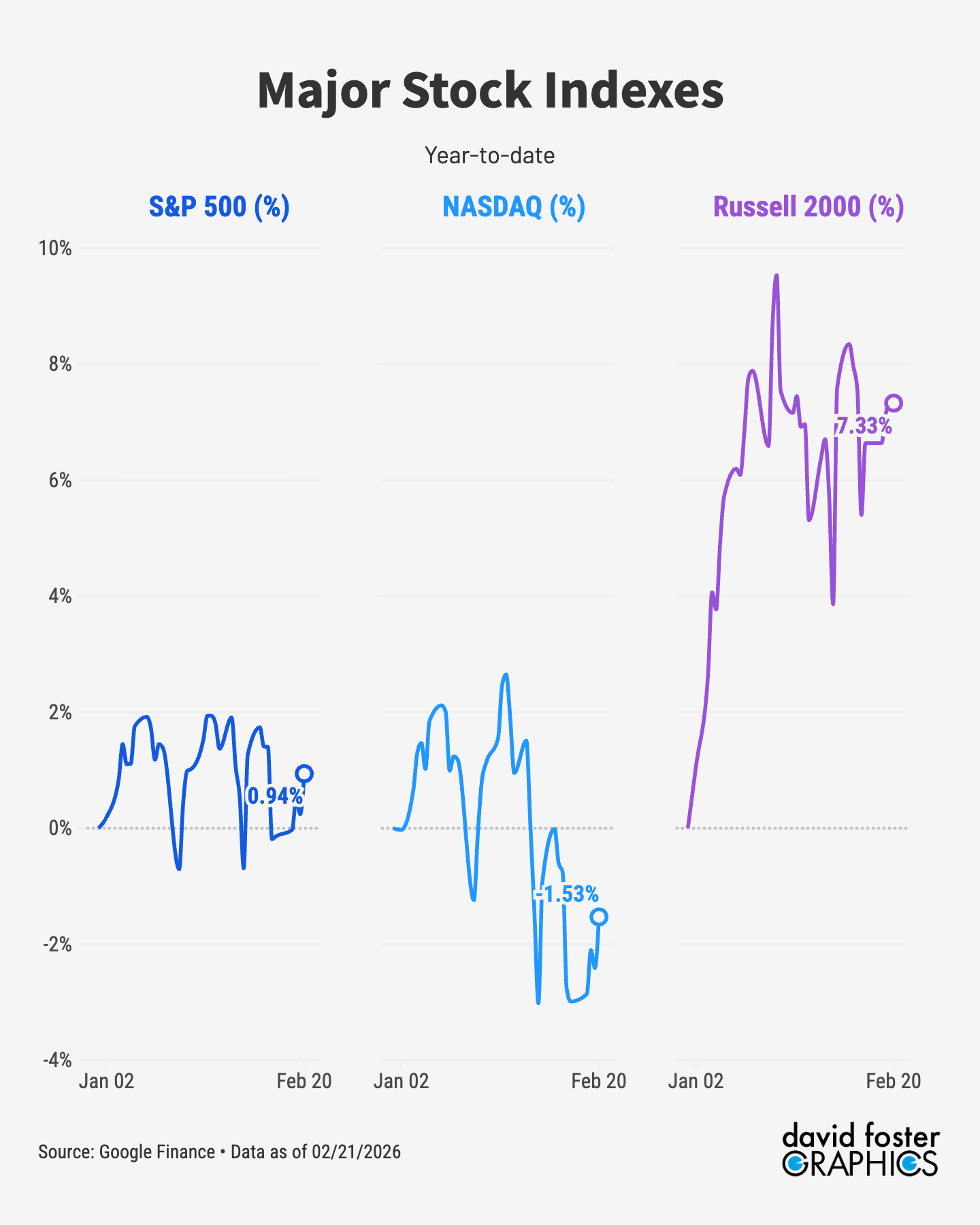
Markets jumped a little on the tariff news, but wobbled around the time Trump said he was ready to roll out new tariffs. For the week, the S&P 500 rose about 1%, with the NASDAQ up 1.5%. Both indexes are still having a weak year, with the NASDAQ down about 1.5% and the S&P up slightly less than 1%. The small cap Russell 2000 is doing better, up about .8% for the week and 7.3% for the year.
Peace, man. Trump’s “Board of Peace” had its first meeting on February 19, to kick off efforts to rebuild Gaza. This ad hoc group has a scammy feel, since member countries have to pay to belong, and some of them may just be coddling Trump, to secure favorable trade deals or other perks. But experts who follow these types of things say it might be able to do some good. Nearly 30 countries have amassed $6.5 billion, including some Middle East petrostates that could help with Gaza, if they wanted to. Trump said the United States will donate $10 billion, prompting the question, from where? Trump doesn’t have a slush fund, and will have to get the money from Congress, or reappropriate it from someplace else and face possible litigation.
Trump seems to view the Board of Peace as a more effective alternative to the United Nations, which certainly has its flaws. But fixing Gaza is a profound challenge that will take dogged action on the ground interacting with locals, not just poobahs meeting in Washington, DC ballrooms. Trump appointed himself the group’s lifelong chairman, but the group might lose all relevance once Trump is no longer president.
If you want to know more, the Eurasia Group has a nice explainer and the Atlantic Council outlines the pitfalls these kinds of groups tend to face.
Economy slows, so what. GDP growth in the fourth quarter was an anemic 1.4%, about half the pace economists expected. But the 7-week government shutdown last fall accounted for much of the weakness, and a rebound in the current quarter is likely. This is backward-looking data that rarely moves markets unless there’s a huge surprise. This isn’t one.
[The weekly WTF: Spank the economists!]
More important, inflation data came in a bit hot on February 20, suggesting price gains may be accelerating. The Federal Reserve watches that data closely, and higher inflation means lower odds of interest rate cuts. Trump, who wants aggressive interest rate cuts, could be railing at a noncompliant Fed for many months.
An index that measures pending home sales hit the lowest level on record, in data that goes back to 2001. Economist Peter Boockvar noted that “We have the pace of existing home sales at the lowest level since the mid 1990s when the US population was 70 million people smaller.” This is bad news for home buyers, even though mortgage rates are now near a three-year low, at an average rate of around 6.1%. The biggest problem with housing is there isn’t enough of it, with the scarcity pushing prices to historically high levels. Owners don’t want to sell and builders face a thicket of obstacles to creating new units.
Long war. Russia’s diabolical war in Ukraine is now in its fifth year. When Vladimir Putin’s forces invaded Ukraine on February 24, 2022, he expected a quick triumph. Instead, Ukraine has held on to most of the terrain it held four years ago and the aggressor has suffered staggering casualties, with estimates of 1.2 million total Russian casualties, including 325,000 dead. The Russian death toll in Ukraine is nearly six times the number of American dead during the Vietnam War, in less than half the time. Ukrainian casualties could be as high as 600,000, including as many as 140,000 dead.
Russia is a declining state, now subservient to China, and its economy is stagnant. Yet Putin presses on. I’ve argued for the last four years that it is in America’s self-interest to help the Ukrainians do whatever it takes to boot the Russians out. President Biden did a lot, but not enough. Trump has fantasized about a peace deal that Putin doesn’t want, unless Ukraine broadly capitulates. The best move for the United States and Europe is still to arm Ukraine to the teeth and provide all other aid, short of troops on the ground, to get the job done. Humanity frustrates!
The think tanks CSIS offers this excellent primer on the status of the Ukraine war.
~ ~ ~ ~ ~ ~ ~ ~ ~ ~
WHAT WILL MATTER NEXT WEEK:
Congress weighs in on Iran. Some members of Congress are pushing a measure that would require Trump to get Congressional approval before attacking Iran. Congress can’t seem to do much to rein in Trump, and he’ll probably avoid any new constraints. But one theory is that Trump could order a strike against Iran before Congress returns from a recess next week, to avoid having to face any Congressional limitations.
Faithful readers will know I think Trump is bluffing on Iran and will announce some sort of deal, whether there’s any substance or not.
[More: Why Trump is not going to attack Iran]
Trump stemwinder. Trump will deliver the annual State of the Union speech to Congress the night of February 24. He’s likely to outline a lot of “affordability” programs meant to cheer voters in the runup to this year’s midterm elections. But there’s not all that much Trump can do on his own, and the Republican-controlled Congress has already let health insurance subsidies lapse, raising costs for millions.
Trump’s speech last year lasted 1 hour and 40 minutes, the longest in modern times. The shortest annual address to Congress since 1980 was Ronald Reagan’s speech in 1986, at around 31 minutes. This list of presidential speech times is oddly interesting. Trump is the wordiest.
Counterprogramming. Many Congressional Democrats say they will skip Trump’s speech and attend other events meant to highlight the failure of Trump policies on immigration, trade and other things. Eh. The Dem rebuttal will come from newly elected Virginia Governor Abigail Spanberger. She’s a sensible moderate who won by focusing on affordability concerns, and she probably has presidential ambitions. So maybe worth watching. TV Guide says other counterprogramming options include Shark Tank, Family Guy and a new episode of Vanderpump Rules.
It’s always reassuring to hear your thoughts Rick. I am not alone in this world.
It just seems to get easier to follow what the man in the White House is doing every day.I hope that bunch at the Supreme Court or ready because, there will be more decision's .So many problem's.