


America was built on the idea of homesteading, and home ownership has been the centerpiece of the American Dream since for nearly 80 years.
But if your goal is to build wealth—regardless of the form—there’s powerful evidence that stocks are the way to go. Financial assets are far more liquid than real estate. You can buy small amounts without saving up for a five-figure down payment. You don’t need to take out a loan to buy stocks (and you shouldn’t!)
But most of all, the return on stocks during the last 35 years has obliterated the return on real estate.
In 1990, Americans held more than three times as much wealth in real estate than in stocks. The old adage was true: For most families, their home was their biggest asset.
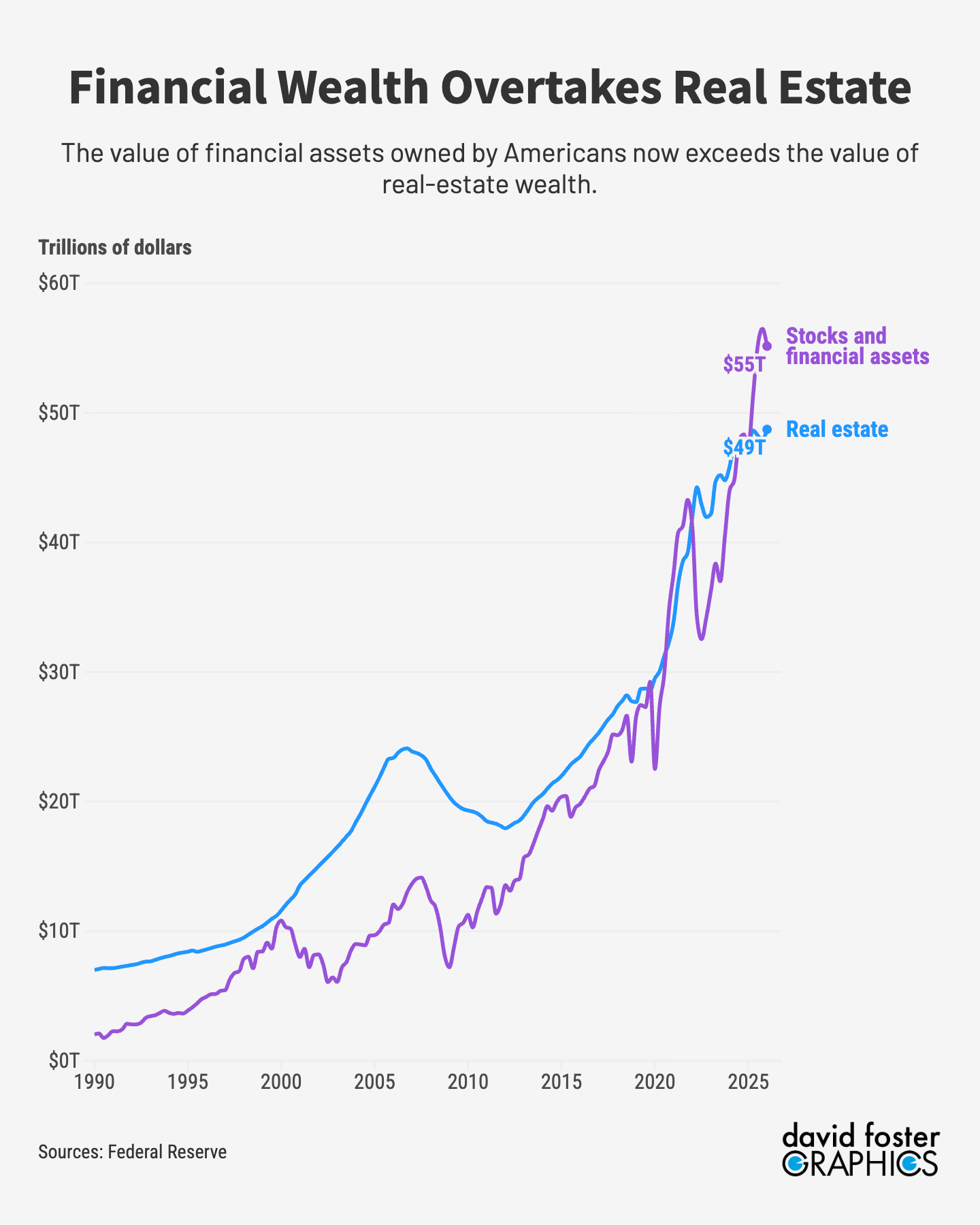
The amount of financial wealth almost caught up during the dot-com boom of the 1990s. But the dot-com bust corrected that. A long rally in stocks began in 2009, at the nadir of the Great Recession, and stock wealth surpassed real-estate wealth for the first time in 2021. Today, Americans hold $55.1 trillion in stocks, compared with $48.7 trillion worth of homes and other properties, according to Federal Reserve data.
An important statistical note: That stock-market wealth doesn’t include retirement plans such as IRAs and 401(k) plans or stocks held by traditional pension plans. It’s just the amount people hold in individual shares, mutual funds and exchange-traded funds at brokerage firms. Adding stocks held in retirement plans pushes the amount of financial wealth substantially higher.
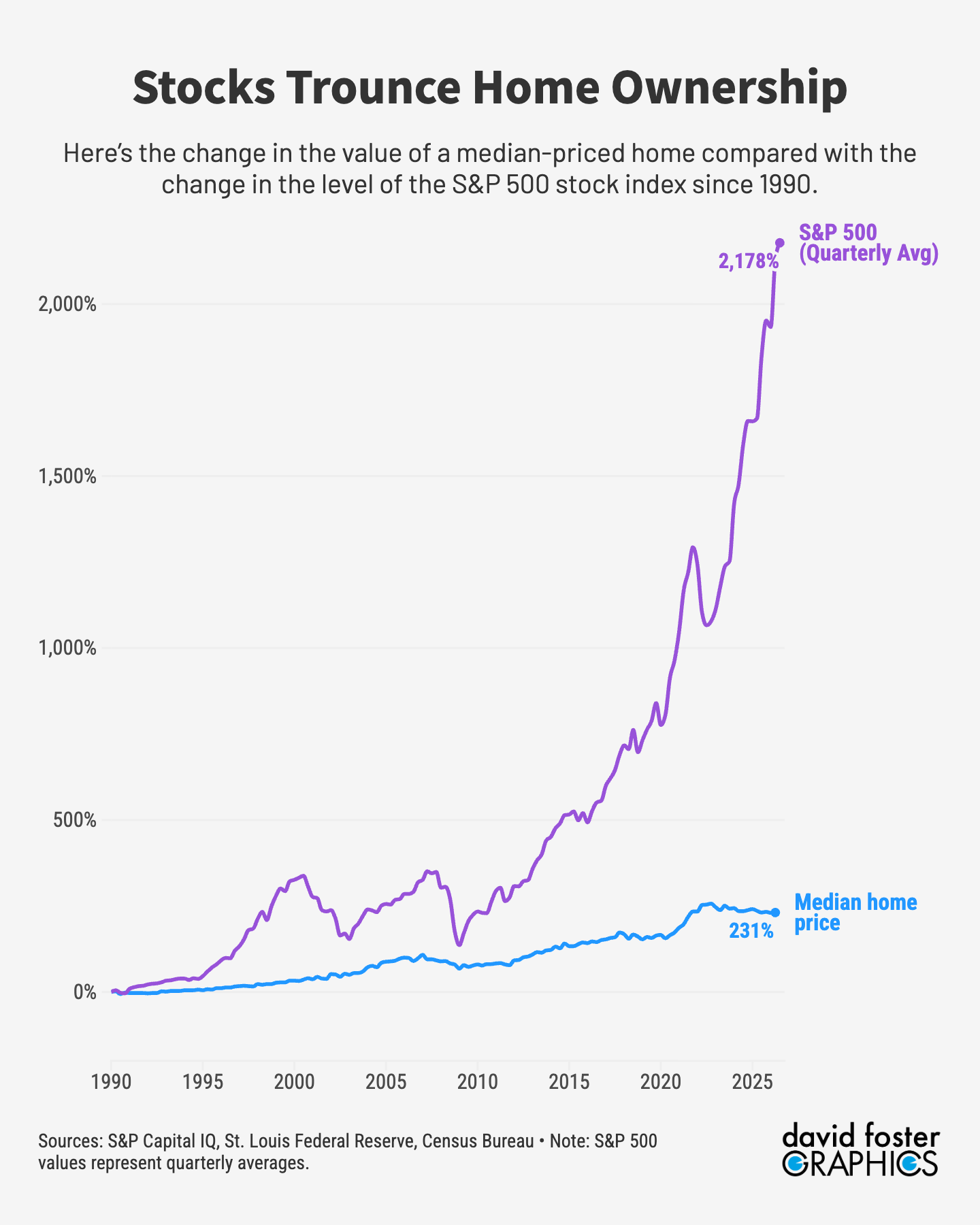
The case for stocks is even more stark when looking at appreciation. Since 1990, the median sales price of a home in the United States has risen from $123,900 to $410,700, according to Census Dept. data. That’s a nifty 231% gain.
But stocks have vastly outperformed that. The S&P 500 stock index has risen from 334 at the beginning of 1990 to 7,600 in 2026. That’s a 2,178% gain since the beginning of 1990, or 9.4 times the return on real estate. And that does not include reinvested dividends.
Stocks can be volatile, of course. There can be long periods when the return is negative. But real estate doesn’t always go up, either. Starting in 2007, home values fell by 19%. They didn’t regain 2007 levels until six years later.
Stocks can fall by a lot more than 19%, so I fed the data on home and stock values to the Gemini AI agent, and asked it to give me 5- and 10-year returns for both asset classes. Gemini found that since 1990, on a quarterly basis, stocks registered a larger 5-year gain than home values 74% of the time. On a 10-year basis, stocks outperformed homes 82% of the time.
Stocks had two major skids during that timeframe: the dot-com crash of the early 2000s and the Great Recession in 2008, which led to poor 5- and 10-year returns down the road. Homes had lousy 5- and 10-year returns following the housing bust that ran from 2006 to 2013. The takeaway is that both asset classes involve risk, but you’re likely to be okay with stocks as long as you can ride out downturns.
None of this is an argument for day trading in and out of stocks, margin trading, or other complicated strategies that raise risks and transaction costs. This analysis assumes a simple buy-and-hold strategy, which most people can do these days by investing in stock index funds. Abide by the old advice: invest fixed sums at regular intervals and don’t try to time the market based on “stock tips” or something you see on TV or r/wallstreetbets.
This isn’t a screed against home ownership, either. There are many great reasons to own a home: Stability, control over your primary residence, the ability to customize your living space. And real estate can be a good investment over time, as long as you don’t blow too much money on extras including maintenance, property taxes, realty commissions, mortgage insurance, and other side expenses.
But home affordability stinks these days, and it has become notoriously difficult for younger buyers and other first-timers to muster the down payment for homes that have been selling at elevated prices since the Covid pandemic in 2020. Mortgage rates that dipped below 3% in 2021 are now resetting higher, approaching the longer term historical average of around 7%. We may never see 3% mortgage rates again.
It has become easier than ever to invest in stocks, meanwhile. Just about anybody can open a brokerage account with $1,000 or less and invest online. If stocks were once just for rich people, they aren’t any more.
Could there be another multi-year crash in stocks? Unhappy surprises can always happen, and there are at least a couple significant risks to future stock returns. One is the massive amount of deficit spending by the federal government, which now faces a $40 trillion national debt. Markets are finally beginning to signal that’s too much debt, with interest rates rising. That could destabilize markets at some point, and higher rates tend to draw money out of stocks and into bonds.
[Could 1929 happen in the 21st century? Probably not]
There’s also been an unusual amount of monetary stimulus in financial markets since the Great Recession in 2008. The Fed has been unwinding that slowly, but if had to do so faster, it could weigh down stocks.
Even so, it still makes sense to disconnect the American Dream from home ownership. The American Dream, a phrase coined in 1931, draws on ideals dating to the Declaration of Independence in 1776: That the United States is a meritocratic place where people can improve their lives through effort and hard work, regardless of the social class they were born into. The concept has morphed over time and only became tightly connected with home ownership after World War II, when the government rolled out numerous programs to encourage and subsidize home purchases.
Yet you can get ahead without owning a home, or without owning a home on the same schedule your parents and grandparents did. Prudent investing in stocks, in fact, might be the ultimate path to home ownership.
Click here to see more from The Pinpoint Press