


There’s a lot of drama in the Trump economy: On-and-off tariffs, an artificial intelligence bubble that might burst, immigration raids that are straining the labor force.
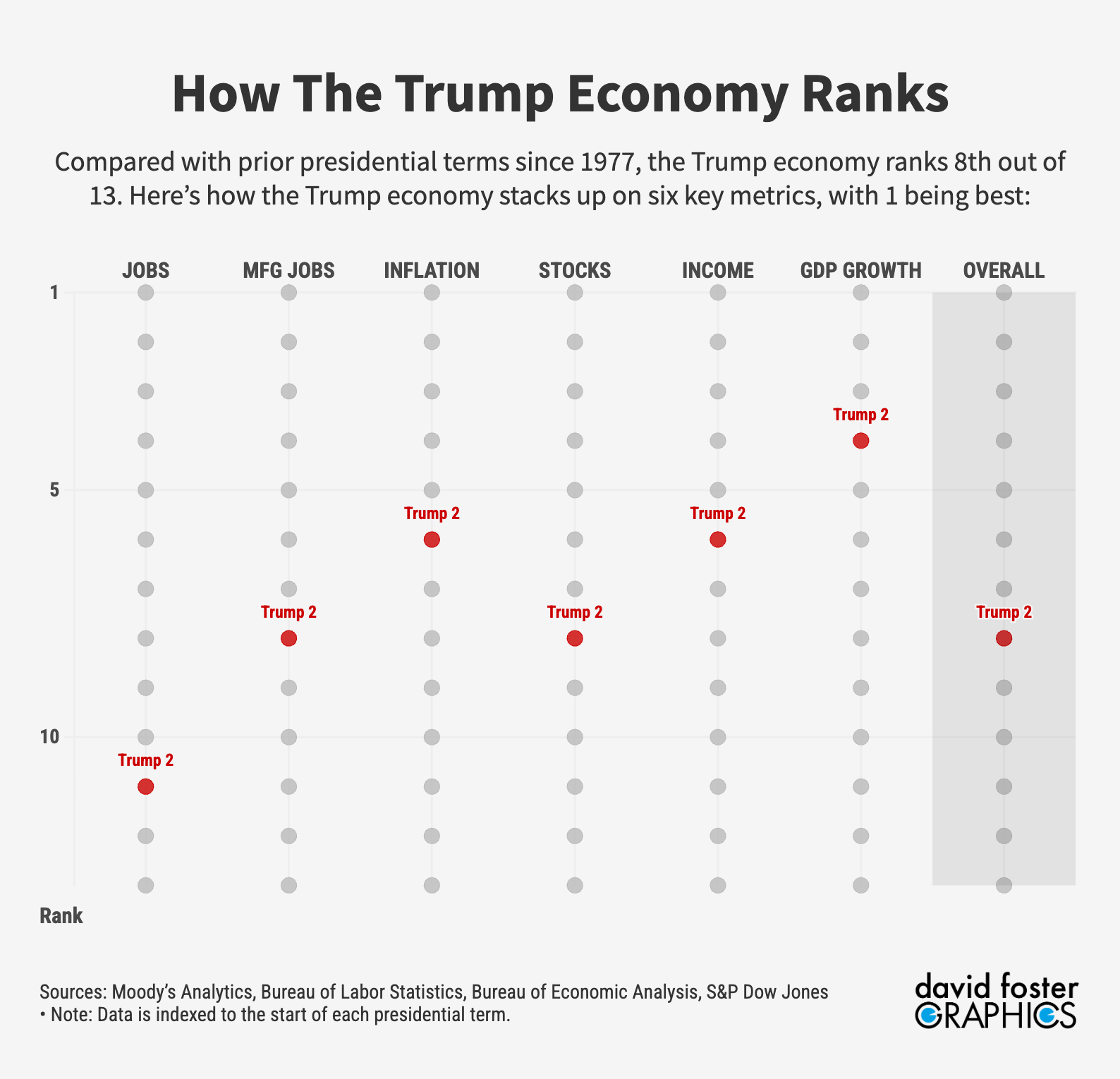
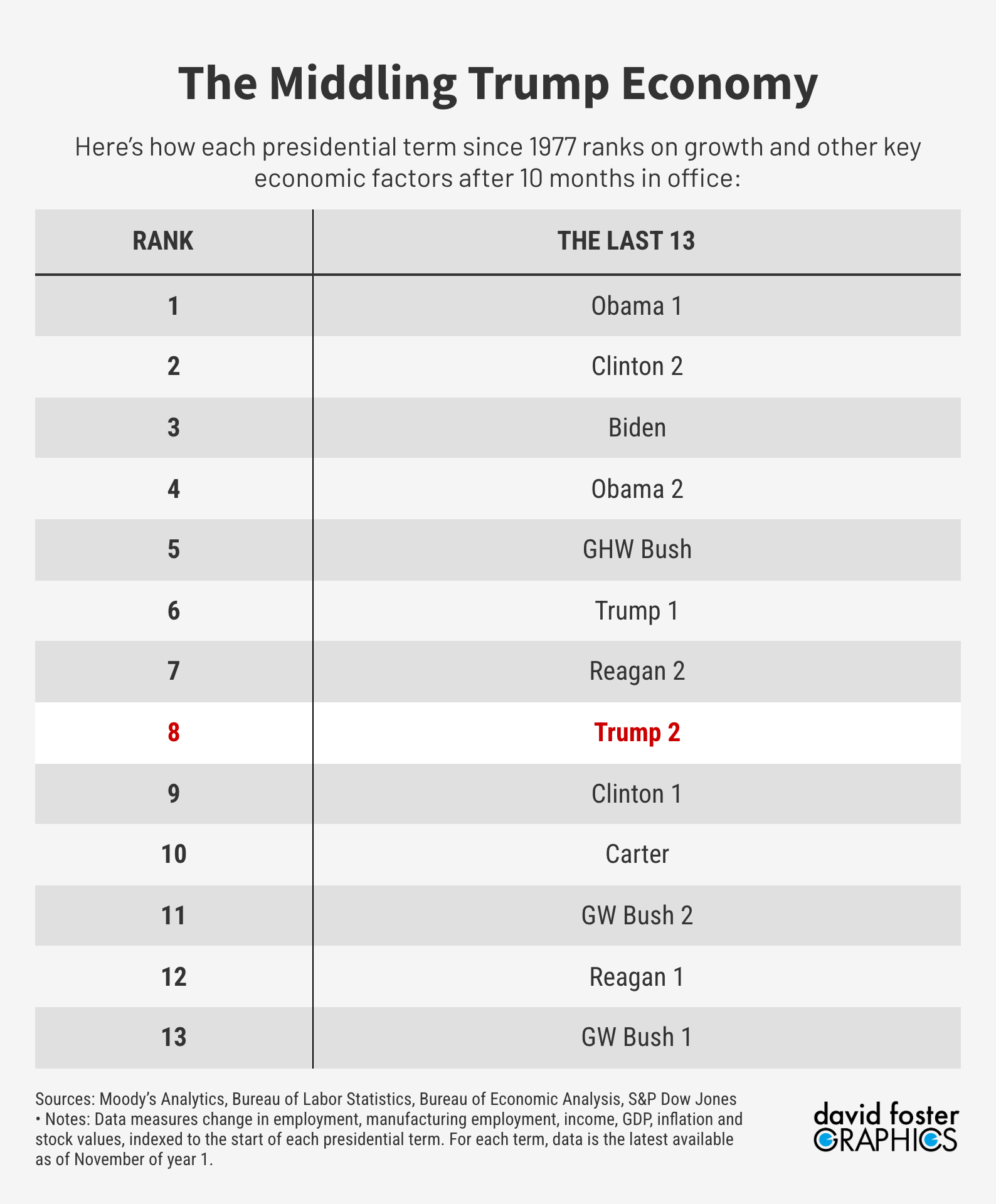
But the Trump economy itself is underwhelming. The Pinpoint Press is tracking the Trump economy compared with 12 prior presidential terms going back to Jimmy Carter in the 1970s. Of those 13 presidential terms at November of the first year, the 2025 Trump economy ranks 8th.
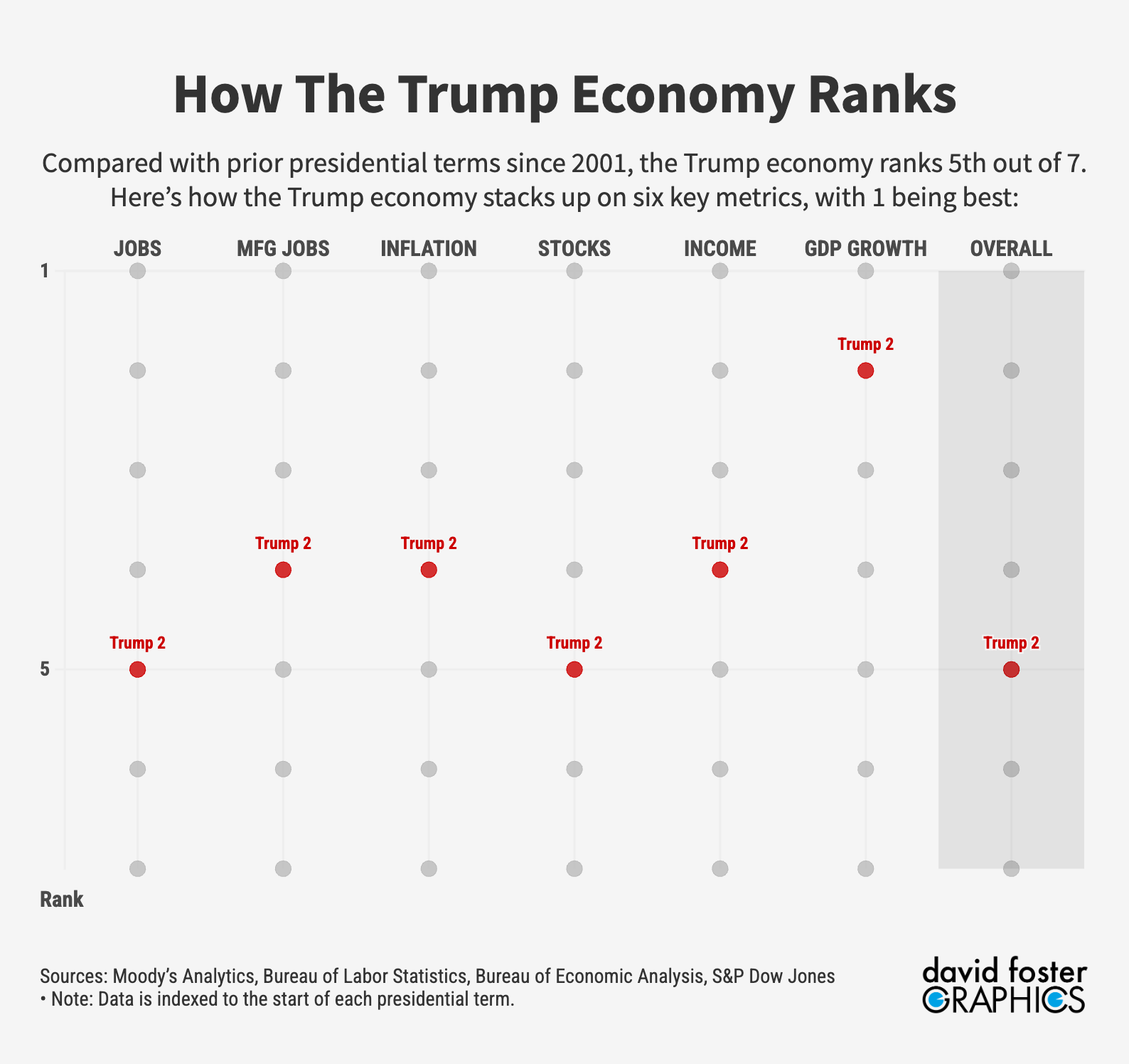
Of the 7 presidential terms of the 21st century at the same point, Trump 2025 ranks 5th. In each timeframe, the Trump economy ranks below average.
President Trump obviously doesn’t see it this way. He says the United States is “rich” and “strong,” with a jobs boom underway. He touts a roaring stock market as if it’s fattening everybody’s paycheck. He recently claimed that “this is the golden age of America, because we are doing better than we’ve ever done as a country.”
A straightforward assessment of the data refutes that. The Pinpoint Press tracks data going back to the 1970s on changes in overall employment, manufacturing employment, income, GDP, inflation and stock values. Moody’s Analytics provides the data, indexed to the start of each presidential term. That allows apples-to-apples comparisons on the direction of the economy at the same point in each of the 13 presidential terms since 1977.
At the 10-month point, Trump ranks near the bottom on job growth, as the following grid shows. He’s above average on GDP growth, and in the average range on the other four metrics. (You can see more details on how the Trump economy stacks up at our Trumponomics Dashboard.)
We also measure Trump against his 21st century peers, and he scores below average there, as well. Of the seven presidential terms since 2001, Trump ranks 5th. He ranks second best on GDP growth, but average or below average on the other five metrics.
Our indexing technique is meant to measure momentum from the point each president took office, rather than absolute levels of economic activity, which for most things naturally rises over time due to population and economic growth. By focusing on the direction and degree of change, we approximate whether ordinary workers feel like they’re getting ahead or falling behind, which is generally how they judge the effectiveness of a president.
Who had the best performance since 1977, at the 10-month point? Barack Obama during his first term, which started in 2009—mainly because he took office just as a deep recession was about to bottom out. Next best was Bill Clinton’s second term, which began in 1997, when the first digital technology boom was gathering steam.
The worst start was George W. Bush in 2001, during the dot-com bust. These rankings will change as we get deeper into Trump’s second term and the comparative timeframe changes.
Trump’s subpar rankings in our data mesh with what’s been happening in absolute terms this year. Job growth, for instance, has slowed sharply in recent months. The pace of job growth in 2024 averaged 168,000 new jobs per month. That has dropped to 76,000 this year and an average of just 44,000 new jobs during each of the last four months.
Trump brags repeatedly about a roaring stock market. But stocks normally go up, and under Trump the S&P 500 index is doing a little worse than average.
The direction of inflation under Trump is another disappointment. Trump’s overall standing on inflation is average, but the inflation rate has ticked up from 2.3% in May to 3% now. Again, that’s going the wrong direction, and it comes after three years of punishing inflation under Joe Biden that helped Trump beat the incumbent Democrats in last year’s presidential race.
GDP growth is the one relatively strong metric under Trump, thanks to a 3.8% gain in inflation-adjusted output in the second quarter. That was the best quarterly growth since 2023 and it could continue into the third quarter. But aggregate growth is skewed by robust spending among the wealthiest, whose financial and real-estate assets have soared during the last few years. That masks backsliding among millions who represent the downward slant in the so-called K-shaped economy.
Trump’s approval rating has sunk into the low 40s, and his approval on the economy is lower than that. By both measures, he’s at the low point of this second term, so far. The economic data explains why, even if Trump himself wants to believe something else.
His head is in the "Clouds". Mostly it is just his ego. The way he handles the hard workers in this economy it will not be long before this country is in trouble.
Is any president really responsible for the economy in his/her first year of office? It seems to me that it is more or less what they inherited. Though these tariffs do seem to be having some impact.