


In the perverse ways of Washington, DC, every scandal generates frothy headlines while actual accomplishments go underreported. So you might be unaware that Congress, broadly loathed for its partisan bickering, has actually passed a bipartisan housing bill that will help address the affordability crisis that is one of the nation’s biggest economic problems.
You can be excused for missing the news, because President Trump himself buried it. Congress passed the Road To Housing Act on June 23—but Trump never signed it. Trump held out in protest because Congress won’t pass the SAVE America Act, the election bill that would make it harder to vote. Trump called the housing bill a “big yawn,” as if it was too inconsequential for him to bother signing.
But Trump didn’t veto the bill either, and it became law on July 11 without his signature. And housing experts think Trump is completely wrong. Instead of a big yawn, the Road To Housing Act is “the most significant housing legislation in a generation,” according to the Terner Center for Housing Innovation at UC Berkeley.
Anybody trying to buy a home knows that in much of the country, lack of supply has jacked up prices. Home affordability is close to the worst levels since 2005, when the housing bubble temporarily inflated home values.
[How older homeowners have locked up the market]
Affordability is a combination of price levels, income levels, and mortgage rates. Economists consider homes “affordable” if the cost of a mortgage is no more than 30% of income. At the national level, it currently takes 43% of median income to cover the mortgage on a median-priced house. That’s a painful stretch for many.
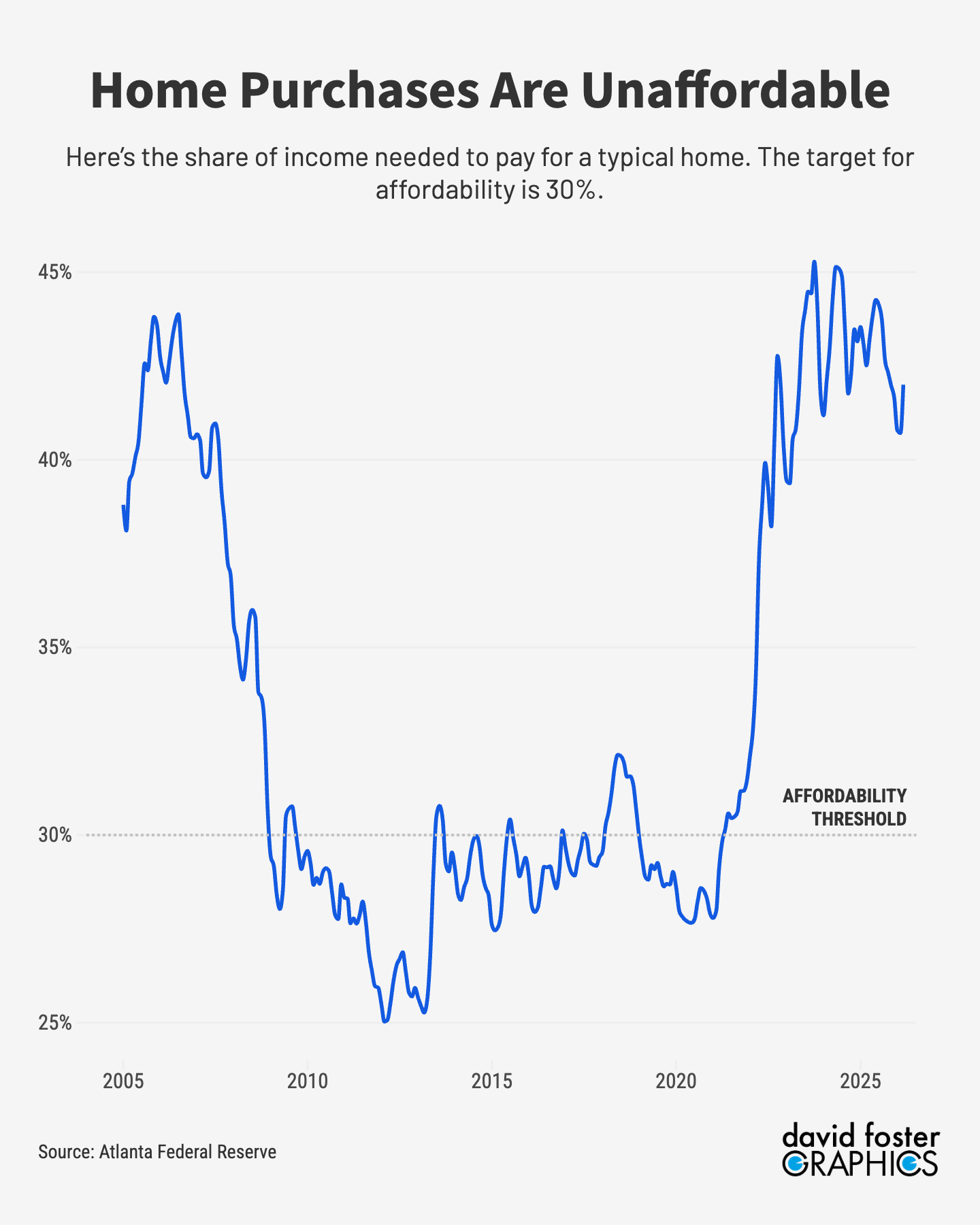
The home market is now bifurcated between those who bought before the 2020 Covid pandemic and those who bought after, or are trying to. Families who bought before were able to refinance mortgages at record low mortgage rates in 2020 or 2021. That was a gift to homeowners from the Federal Reserve, which slashed rates as a form of monetary stimulus.
[The new stock-market trade worth knowing about]
Rates jumped back up starting in 2022, and they’re now nearly 4 points higher than the record lows of 2021. Owners who locked in lower rates are reluctant to sell, since they permanently lowered their housing costs. Strong demand and a shortage of homes hitting the market have pushed prices about 27% higher than they were at the start of 2020. Many would-be buyers are simply locked out.
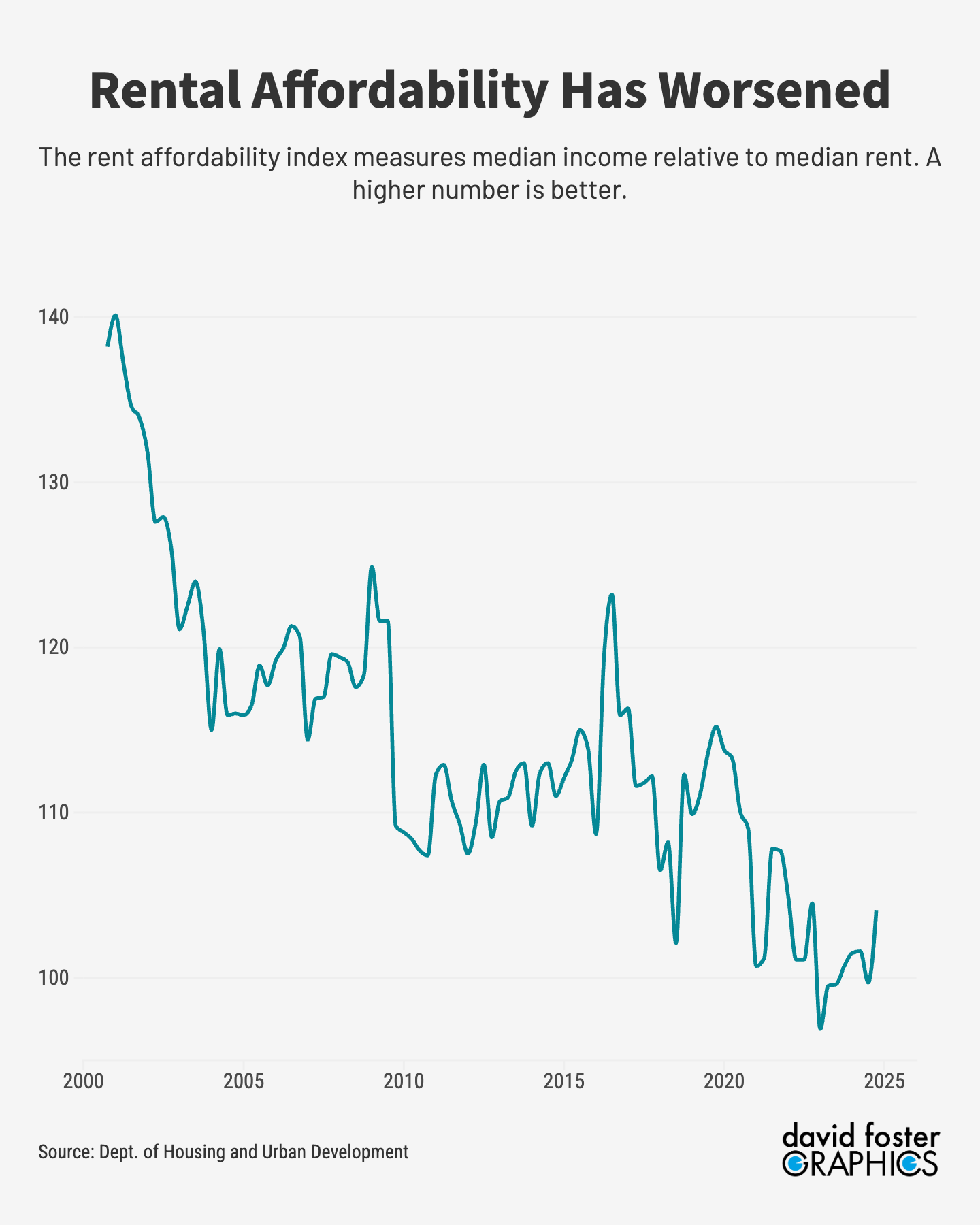
Rentals are expensive, too, with rental affordability close to the worst levels in data going back to 2001. The index in the chart below measures median income relative to median rent, assuming rent is 30% of income. A higher number means the typical renter has more income relative to the cost of rent, and vice versa.
The biggest problem in the US housing market is that there’s not enough housing, especially new construction for lower-income workers. Local zoning restrictions make it hard to build in many areas. Builders make more money on expensive homes and are disincentivized to build cheaper units. Trump’s tariffs have raised the cost of building materials, and his immigration crackdown has hollowed out construction crews in some parts of the country.
[The double-haters’ guide to the midterm elections]
The Road to Housing law doesn’t contain any silver bullets, but it does include numerous measures meant to address these problems one-by-one over time.
It eases the requirements for manufactured housing and modular homes, for instance, which should make it easier and cheaper to build some of the most inexpensive structures available. New federal grants will create incentives for municipalities to ease zoning restrictions. Environmental rules will loosen, cutting some red tape for builders.
One provision that got some attention is a new limit on the institutional purchases of homes by investors who rent them out for a profit. That was a politically popular provision because it’s easy to blame fat-cat investors for gobbling up real-estate, cornering the market, and raising rents. In reality, institutional buyers don’t distort pricing all that much, and the new restriction might have a modest impact at best in areas where there’s a relatively large portion of investor-owned homes, such as Phoenix and Dallas.
The bipartisan nature of the law stands out in a political environment characterized by what seems like never-ending warfare between Republicans and Democrats. Key sponsors included progressive Democratic Sen. Elizabeth Warren of Massachusetts and Republican Sen. Tim Scott, a Trump ally. Democrats had to swallow the easing of environmental regulations, anathema to many environmentalists in their ranks. Republicans agreed to new funding for low-income housing even though the White House lobbied to get that removed.
[More Trump tariffs are coming 🙄]
The law relies on the executive branch to implement many provisions, so foot-dragging by the Trump administration could neuter the law. The Urban Institute points out that at least three dozen new programs will have to be run by the Dept. of Housing and Urban Development, which endured deep staff cuts last year as part of Trump’s “DOGE” ransacking of the federal bureaucracy. “Massive staffing cuts have already limited the agency’s functions, and the bill contains no additional money for staffing and operations,” the institute says in an analysis of the law.
Trump’s lack of enthusiasm obviously suggests that his priorities are elsewhere. Trump calls the affordability crisis a “hoax” and pursues policies that push prices up, not down. He’s busy raising tariffs anew, with a fresh round of import taxes that will replace the emergency tariffs the Supreme Court killed earlier this year. The Iran war has sent gasoline prices back above $4 per gallon and pushed many other prices higher.
All this is happening with the midterm elections less than four months away, and Trump’s fellow Republicans fearing a wipeout. Any other president would be taking credit for trying to get housing costs down. If the legislation ever works, maybe he’ll become a believer.
Enjoy a cartoon.

You can order this cartoon👆 and play cartoon-themed puzzles and word games at CartoonStock.com.
I do not think it will matter much because, Trump is Trump.The cost of living is not going down while he is in office.My main concern now is sending troop's into Iran . Of course we will have to see how thing's progress after they bomb the mountain.Hegseth Secretary of War want's to make sure the boy's testosterone is good and high.