


New York magazine recently ran a 4-part cover story on “the fight for the future of the Democratic Party.” Here we go again, I thought.
The cover package did a solid job framing its thesis and probing different ways to fix the enfeebled political party that voters stomped in the 2024 elections. But there was a glaring omission: What about Independents? Why devote a cover story to Democrats in the first place? Where’s the wall-to-wall coverage of moderates who actually outnumber both Democrats and Republicans?
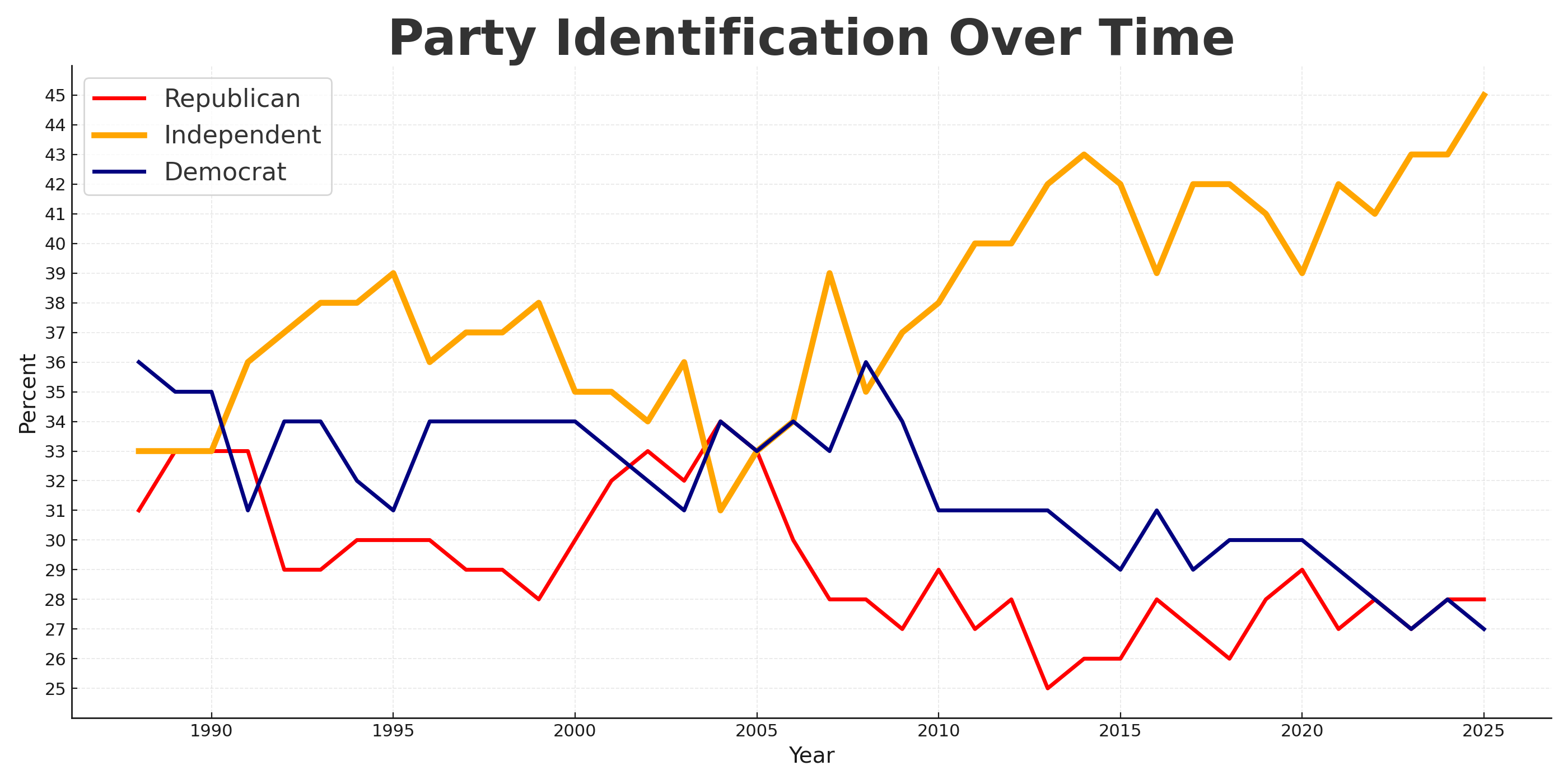
The portion of Americans who identify as Independent now stands at 45%, the highest level in Gallup polling that dates to 1988. Republicans account for just 28% of voters, Democrats 27%.
It’s no secret why sensible Americans are rejecting both parties. Democrats are a feckless coalition of liberal interest groups divorced from the realities most Americans face. Republicans are a cabal of corrupt jerks. Careerists obsessed with perpetuating their own power dominate both parties.
If you want to know how the economy is doing, follow the Independents. The University of Michigan has been tracking consumer sentiment by party affiliation since 2017, and Independents have become the most reliable barometer of economic health.
Optimism among Democrats and Republicans rises and falls based on whether their party holds power. Independents are less impressionable and more stable. Since 2017, the views of Independents have hewed remarkably close to overall economic sentiment, according to a new analysis of the Michigan data. As go Independents, so goes the nation.
President Trump’s approval rating has been sliding because he’s losing Independents, especially on the economy. The portion of Independents who approve of Trump’s handling of the economy fell from 40% in March to 24% in November, according to YouGov. His overall approval rating among Independents fell from 43% to 28%. Trump’s approval among all voters in those polls fell from 50% to 40%, largely driven by disaffected Independents.
These are the same Independent voters that candidates court in every presidential election and many Congressional ones, because they’re the swing votes candidates need to put them over the top. Only in very partisan districts can candidates win with the votes of their base alone. In competitive races, winning candidates need a majority of the middle.
Democrats, for once, exploited this truism to win key 2025 governors’ races in New Jersey and Virginia. Those candidate tacked to the center and addressed pocketbook issues important to moderates, rather than leftist idealism or cultural ideologies.
Yet Independents are politically homeless most of the time, with no party to represent them and no media to profile them. How did the most important bloc of voters end up so disenfranchised?
It’s a long story, not fully relatable here, but over time the corrupting power of unlimited campaign donations by the wealthy, combined with the advantages of incumbency, have enhanced the power of party elites and made the political system less responsive to the will of the sensible middle. The sensible middle also tends to be a plurality rather than a majority, making it potent but less than half of the total. As a bloc, that group can fall into a political black hole if it doesn’t fit into one of the two buckets assigned by our two-party system.
Some centrists root for a third party that could disrupt the entrenched duopoly. Alas, this has poor prospects, starting with the electoral college, which is a winner-take-all vote in most states and requires a majority vote nationally to win the White House.
If nobody wins a majority of the electoral vote, the House of Representatives chooses the president among the top three vote getters. Since power in the House is always split between Democrats and Republicans, whichever party has a majority at the time is likely to choose its own candidate. Dim prospects at the top slash third-party odds lower down and basically entrench the two-party structure.
It’s not hopeless. At least 14 states have open primary elections allowing Independents to vote in either the Democratic or Republican primary, whichever one they choose. More moderate voters tend to elect more moderate candidates and chase off the fringier kooks who sometimes win primaries. Party acolytes argue that open primaries could game the system by allowing Independents to gang up for or against a given Democrat or Republican. But this argument overlooks the reality that the current system is already badly rigged. Every state should look into adopting open primaries, at every level.
The media can also better represent the middle. I started by picking on New York magazine, but the whole media establishment basically abides by the two-party structure in its coverage of politics and the important issues that politics is all about. Some people think the mainstream media has a liberal bias, but there’s a more important bias. Journalists and commentators want to be influential. They want attention. They want to make a difference. They gravitate toward power because that’s how to accomplish what they’re after.
Most political power resides within the two parties. If there were a credible third party, the media would cover that too. Instead, there’s a void. Millions of people are in the void, and they share many common values. But they’re leaderless and not organized for success the way our two-party system demands. For much of the media, that means there’s nothing to cover.
Part of the mission of The Pinpoint Press is to advocate for the sensible middle, the millions of pragmatic Americans abandoned by political parties that have both moved to the extremes. Maybe in the future there will be a Pinpoint Seal of Approval or some other way to identify candidates and causes that truly put public interest above the self-interest of the office holder.
For now, the ranks of Independents are steadily becoming more numerous, and with that will come more influence. Politicians need the sensible middle on Election Day, and will increasingly have to heed them the rest of the time, too. The system remains broken, but the sensible people are moving in the right direction.
I used to be a Republican but, not anymore and never will never be one again. I am now a bonafided independent. Trump took care of that.I have to try to keep my promise on stopping my comment's on Trump but,here is one more.