


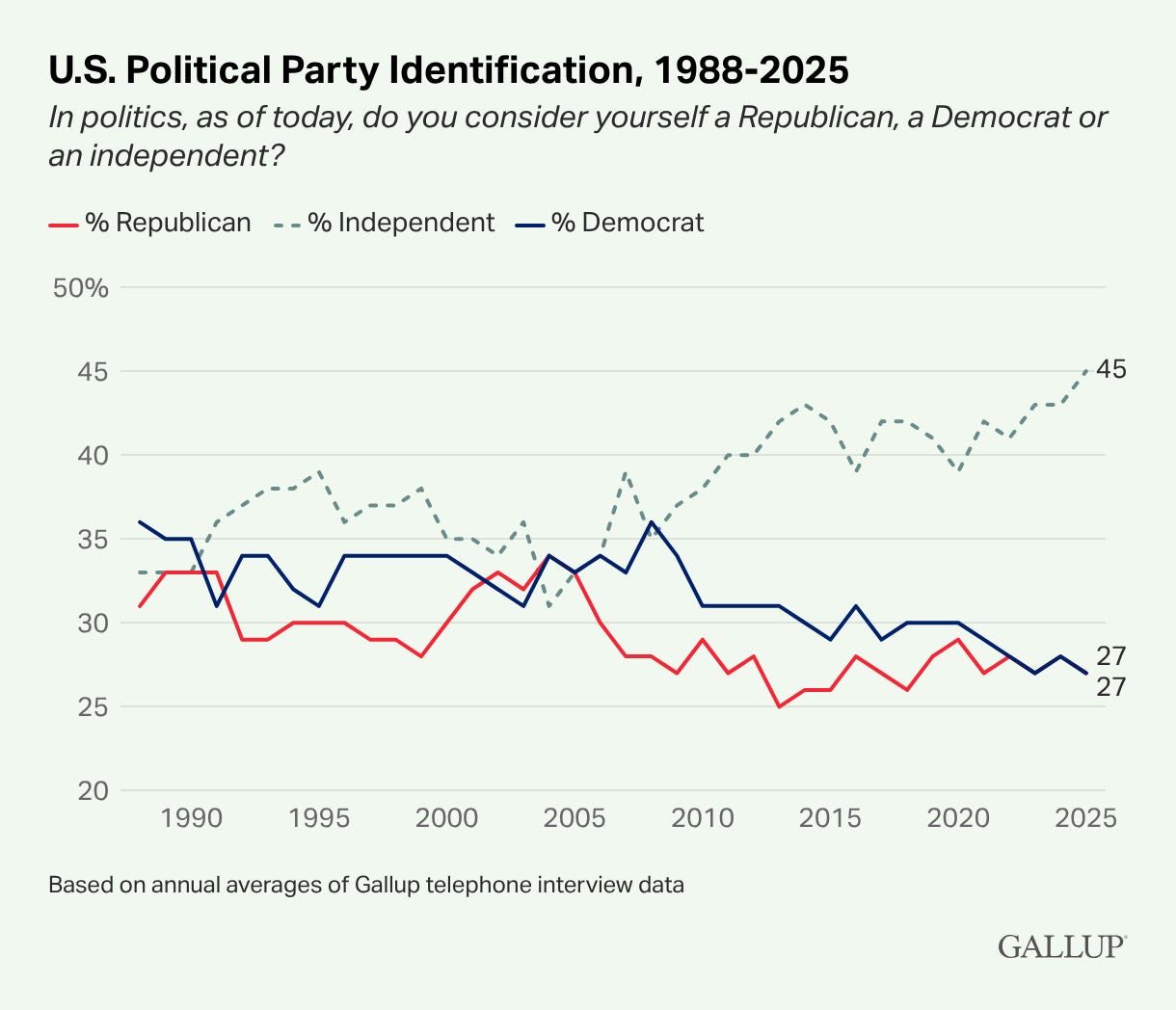
The share of voters saying they consider themselves Independent hit the highest level ever in 2025: 45%. Each political party—Democrats and Republicans—gets a 27% share.
The rise of Independents has been underway for about 20 years, according to Gallup’s annual voter-affiliation surveys. The share identifying as Independent broke out of the historical range around 2010, during Barack Obama’s presidency. So it’s not a Trump-era phenomenon.
The portion identifying as Independent hit 43% in 2023 and 2024, as voters dealing with high inflation soured on Joe Biden’s presidency. The new high of 45% comes with the Republican party completely captive to President Trump and the Democratic party aimless and divided.
As controversial as Trump is, Democrats have lost more market share than Republicans. The high-water mark for Democrats was 2008, when 36% of voters identified as a member of the party. Dems’ market share has slid by 9 percentage points since then.
Republicans peaked in 2004, with a 34% share. They’ve lost 7 points since then.
Young Americans seem to be the ones most fed up with the two parties. A majority of voters under age 44 say they’re Independents. Maybe they look at the Republicans, led by 79-year-old Trump, and the Democrats, marshalled by 75-year-old Senate Minority Leader Chuck Schumer, and feel like the whole political establishment is a geriatric ward.
There’s an obvious gaping hole here: the largest bloc of voters has no political home. To sensible, moderate Americans, Republicans are a corrupt cult and Democrats are effete boobs. The bottomless flow of money from billionaires and corporate interests keeps incumbents entrenched way past their prime. Everybody’s a careerist and voters only matter for a few weeks each cycle, around election time.
If this were a market problem, innovators would address the unmet need by giving millions of dissatisfied voters what they want: Better political parties. Alas, we are stuck in a duopoly where the duopolists make and enforce the rules, to their own advantage. A meaningful third party would face monumental challenges breaking the two-party chokehold state-by-state, where elections for federal office take place.
It’s not all gloom. Independents have tacit power by virtue of their sheer numbers. They’re the swing voters that candidates must win in competitive elections, since neither party can win with its base alone. It’s true that many Independents lean toward one party or the other, and may not be truly up for grabs. But it’s also true that Americans are epically pissed about the direction of the country, with extremely low regard for both parties. Polarization has zapped the bonds many voters once felt with their favored party.
As normies have given up on both parties, the views of those who stick with one or the other have become more extreme. In Gallup surveys at the end of 2025, for instance, 63% of Republicans thought economic prosperity would improve in 2026. Only 7% of Democrats thought so. Polarization now drives a massive gap in people’s basic understanding of the economy.
The views of Independents may be closer to reality—and they’re pretty gloomy. Only 27% of Independents expect prosperity to improve this year. That’s 13 points worse than a year ago. Independents are also downbeat about inflation and the stagnant job market.
Could the ranks of Independents reach 50% of voters and become an outright majority? Why not. Both parties stink, but they can always get worse. Maybe they’ll get a little better if they start to notice the voters who matter most are tuning them out.
Why do authors say voters want more from their parties. I want common sense and economic prosperity from my parties. That why I support Republicans on the economy, a border closed to rapists, murderers, pedophiles, carjackers, shoplifters and deporting illegal alien criminal immigrants and drill baby drill. I vote with Democrats on laws promoting access to birth control and access to abortions. Why wouldn’t I want my tax dollars to pay hundreds of dollars for an abortion rather than spend hundreds of thousands of dollars raising a fatherless, crime prone, drug prone, shoplifting prone, young person whose role models are street gang members instead of fathers. Is this really a question for intelligent voters? Stop the anti abortion virtue signaling Extremism. If people are against abortions for penniless single mothers they can start GoFundMe sites and support higher taxes to support these fatherless children. Most families struggle to pay bills for their own children. Why would they vote for higher taxes to support illegitimate and illegal babies when they can’t afford to raise their own children? Why? W. Manion, MDPhDJDMBA
I agree with you. I will vote though for my people to be elected. I want step aside an not do my duty for my country. I have to say this are i would be remiss and, so i will. This so called country that M.D. Manion lives end was built by immigrants and people who are looking for a better life and shoveling them off to foreign country's will not help our economy.Yes it want be a Democrat or a Republican but i will vote.One other thing i still like due process.