


As the first year of Donald Trump’s second presidential term draws to a close, Trumpism is at its peak. Trump got off to a frenetic start in 2025 and pushed his agenda more forcefully than any president in decades. It changed America.
Now, however, Trump’s approval is slipping, even within his own party. Some voters think he’s gone overboard, while others deplore what he’s done. A prominent question on many voters’ minds is whether the next president can undo Trump policies that are objectionable, unpopular or self-defeating. Here’s some handicapping, issue-by-issue.
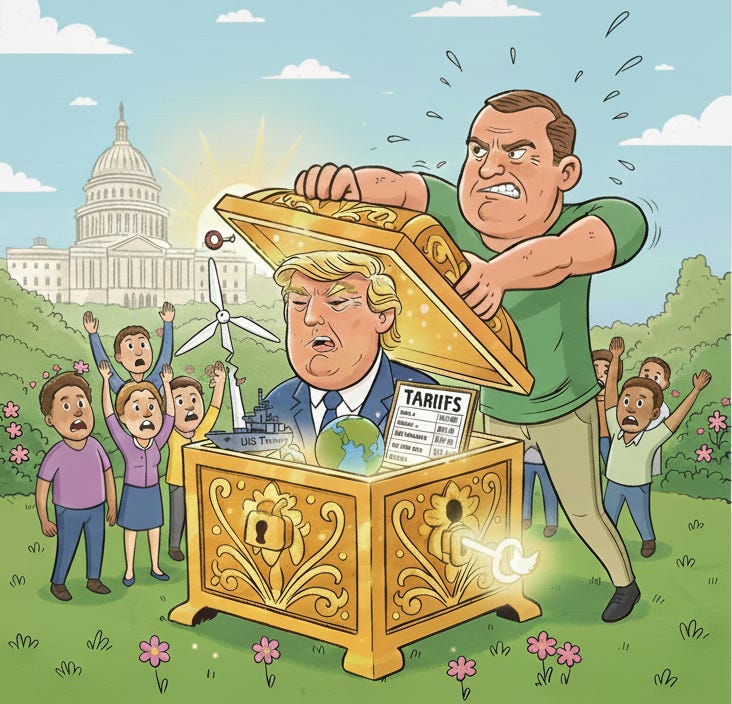
Tariffs. Trump has raised the average tax on imports from 2.5% to about 17%, and virtually all of those new tariffs were one-person decisions requiring no action by Congress. Since Trump imposed those tariffs unilaterally, the next president could simply cancel them. Even a Republican president might do that. The Trump tariffs are a tax that raises costs at a time when voters are raging about affordability. Rolling back Trump’s tariffs would give the next president a quick way to take credit for lowering costs.
Deportations. Trump has deported at least 2 million undocumented migrants, and it’s hard to imagine a future president allowing any of them back into the country. Polls show that a slight majority of Americans think Trump is too aggressive on deportations. But President Biden totally flubbed this issue by allowing migrants to pour into the country, one of his biggest mistakes. Only an extreme liberal might try that again, and that type of candidate couldn’t get elected president. The next president will, however, stop the ritual roundups of suspected migrants by masked federal agents resembling an amateur Gestapo. That’s one thing voters generally think Trump has overdone.
[More: 10 things that will matter in 2026]
Reduced immigration. In addition to deportations, Trump has also aggressively limited legal immigration to the United States by making it harder to apply for asylum, ending various refugee programs, suspending an immigration lottery and imposing other restrictions. That will lead to the biggest decline in the nation’s legal immigrant population in decades. A future president will very likely reverse that, though perhaps gradually and quietly. Legal immigration is a key contributor to economic growth, and America needs more young workers paying taxes to support retirement programs that are running short of money. Business leaders and many policymakers in both parties realize that a well-managed influx of legal immigrants is essential. This will swing back.
Trump’s name on everything. The Kennedy Center, the US Institute of Peace, a new class of warships: All the things Trump has named after himself will be renamed something else the next time there’s a president who’s not a Republican. The “Trump Accounts” established in the tax law Trump signed over the summer will probably get a new name whenever Democrats retake control of Congress.
Green-energy cutbacks. These will be harder to reverse. Trump has slashed and burned just about every green-energy mandate or incentive he can find, while Congress passed new legislation ending many of the green-energy tax breaks Biden signed into law. A Democratic president could cancel the many Trump executive orders that favor fossil fuels, but changing these rules can take months or years. It would take full Democratic control of Congress plus the White House to reinstate tax breaks for renewable energy. The outlook for green energy isn’t totally bleak, however. There’s a natural market for it as costs come down, even without federal support. And many states are still promoting green energy.
[More: 18 things that mattered in 2025]
Aid to Ukraine. Trump hasn’t cut off all US aid to Ukraine as some feared, but he has clearly favored Russia in “peace talks” that will probably not end the war. A Democratic president would probably stop that immediately and beef up military aid to Ukraine, possibly going well beyond the cautious approach of the Biden adminstration to allow strikes on Russian forces with American weapons. If the next president is a Trumpy Republican, he or she might lean toward the anti-Ukraine wing of the MAGA movement. But there is bipartisan support for standing up to Russia, if Ukraine makes it to the end of the Trump presidency.
Whatever Trump is doing on Venezuela. This is another one-man policy decision, with Trump ordering deadly attacks on dozens of boats supposedly departing from Venezuela with cocaine and other drugs, plus at least one bombing on Venezuelan territory. If Trump manages to oust the hated Venezuelan dictator Nicolás Maduro, his successor might continue some sort of pro-democracy policy toward Venezuela. But the boat bombings would probably stop. And if Trump’s Venezuela campaign becomes some sort of quagmire, a future president would promptly end it.
War footing with Iran. Perhaps the biggest surprise of Trump’s first year was his decision in June to green-light the US bombing of Iranian nuclear facilities. Many critics derided that as a reckless, trigger-happy move. But there’s been no blowback, and history may deem the attack a shrewd, pre-emptive strike. The next president might continue Trump’s bellicose stance toward the nasty Iranian regime, which lacks legitimacy with its own people and has long been the biggest troublemaker in the Middle East.
[What the heck happened in 2025? Take the Pinpoint Quiz]
Gutting the federal bureaucracy. A Democratic president would probably rebuild or reconstitute the functions of many of the agencies Trump dismantled by executive order, including the Agency for International Development, Voice of America and others that were never really controversial. But Trump has cut the federal workforce by 270,000 positions, and many of those people are experienced professionals not waiting for Uncle Sam to call them back in a few years. Staffing these agencies back to meaningful levels could take years.
Tax cuts. Some provisions of the big tax law Trump signed in July are temporary. The tax breaks for some tip income, overtime pay, Social Security benefits, and car-loan interest payments expire at the end of 2028. Those will be gone when the next president’s term begins. Most of the other tax cuts are permanent. So are cuts to some food aid and Medicaid programs that Republicans included in the bill to help offset the revenue lost by cutting taxes. Any changes would require Congressional action.
Soaring deficits. Legislation signed by Trump will add about $4.1 trillion to the national debt during the next 10 years, on top of deficit spending that was already baked in. By 2029, the total national debt will have risen from $36 trillion when Trump took office to at least $45 trillion. That’s well into the danger zone. Some president soon is going to have to deal with a debt crisis characterized by rising interest rates and other problems. Trump will be lucky if that doesn’t start within the next three years. If it doesn’t, Trump’s successor might get the honors. There’s no way to address this problem without painful tax hikes and spending cuts that Congress will have to pass.
Vaccine rollbacks. Trump was never known for medical quackery until he put vaccine-skeptic Robert F. Kennedy, Jr. in charge of much of federal health policy. RFK Jr. has canceled scientific research, rolled back vaccine recommendations, axed thousands of federal health-related jobs and promoted quack theories that real public-health experts say are dangerous. The next president could reverse much of this, but scientific expertise can’t be reassembled overnight, and research projects can’t be turned on and off like a light switch. RFK Jr. is also fueling skepticism of medical science that will likely persist long after he’s gone. We could still be assessing the damage RFK Jr. caused a decade from now.
The imperial presidency. Trump has harnessed the vast powers of the executive branch to punish personal and political enemies, enrich himself and his family, and give his political movement an inside edge in elections. Courts have stopped some of his power grabs, but allowed others. Will a successor—assuming there’s a fair presidential election in 2028—use these expanded powers of the presidency much as Trump has?
Democrats will probably campaign on exactly the opposite: Eliminating autocracy and bringing responsible government back to America. But Biden and other presidents have used presidential power to block pipelines, cancel student debt, and, yes, restrict immigration. By pushing the boundaries so much further, Trump has actually garnered new powers for future presidents to use. Some will probably find it irresistible.
Your Welcome! I really do like you Rick. That is why i shared that with you.God Bless!
Rick listen to this!It's a about my daughter who lost her husband about twenty years ago.I truly feel for this women who was gunned down recently on the street's in Minnesota.Here it goes:If tears could build a stairwell And memories a lane we would walk right up to heaven and bring you back again No farewell words were spoken no time to say goodbye you were gone before we new it and only God knows why.Our hearts will ache in sadness and secret tears still flow what it means to lose you no one will ever know.But now we know you want us to mourn for you no more to remember all the happy times. Life still has much in store.Since you will never be forgotten we pledge to you this day a hallowed place within our hearts in were you will always stay. My youngest daughters pledge.