


Economists these days scour every bit of data for signs that President Trump’s tariffs are pushing up inflation. There are plenty of those signs. The overall inflation rate hit a four-year low in April, at 2.3%, but has now bounced back up to 2.9%. The cost of some products subject to Trump’s new import taxes, such as furniture, electronics and coffee, is now rising by more than average as importers pass the higher cost onto consumers.
Yet inflation under Trump remains subdued, compared with price gains under all prior presidents of the 21st century. I’m tracking the Trump economy on six metrics—inflation, employment, manufacturing employment, earnings, stock market gains and GDP growth—compared with prior president going back to Richard Nixon in the 1970s. Moody’s Analytics provides the data, which is indexed to the start of each president’s term to allow apples-to-apples comparisons.
The inflation numbers under Trump are relatively tame compared with inflation at the eight-month point under six prior presidents. Graphics guru David Foster put the numbers into this chart:
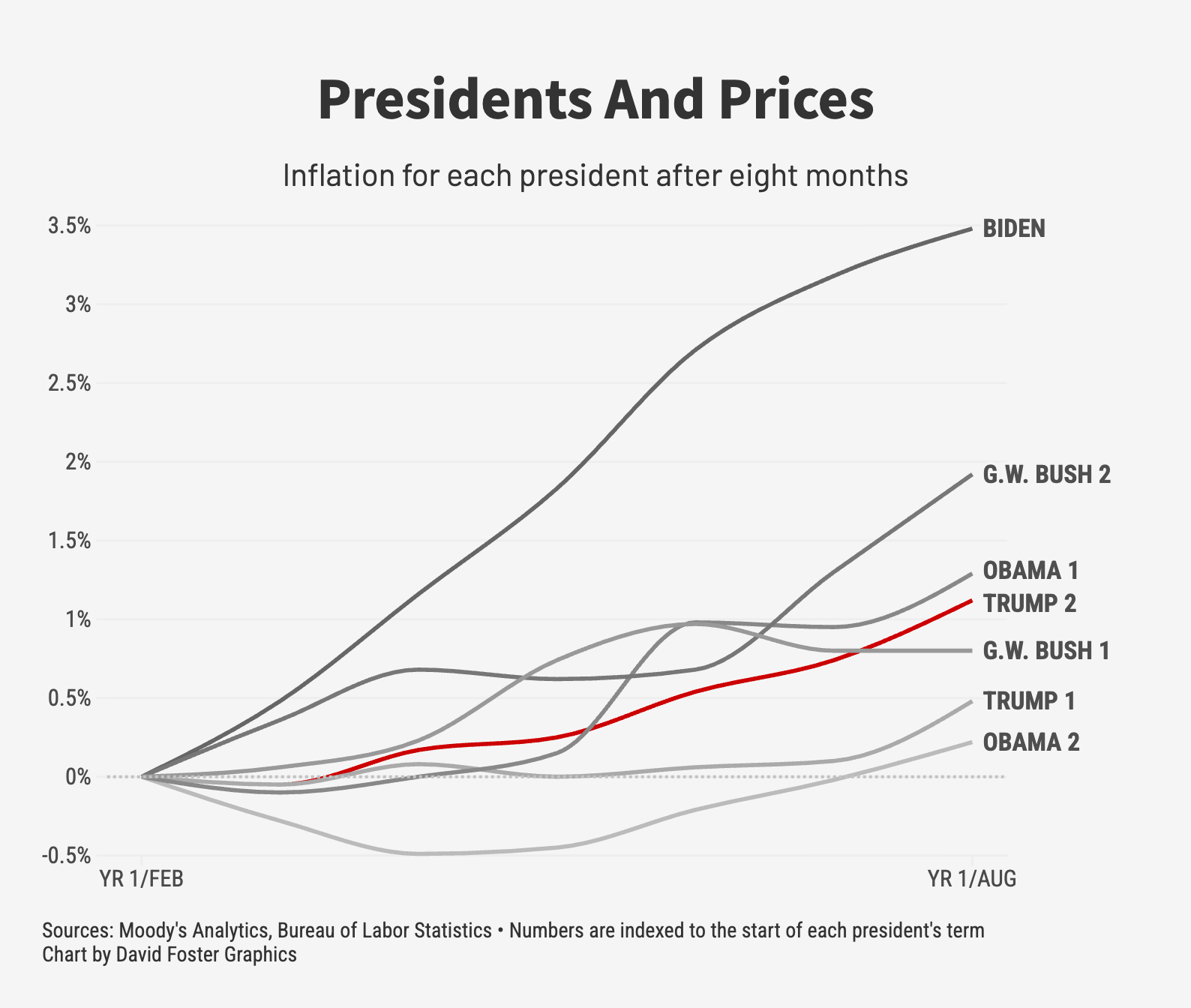
One obvious takeaway from that chart is that four years ago, President Joe Biden already had a serious inflation problem, even though most people weren’t talking about it yet. By August of Biden’s first year, prices had already risen by 3.5%. The bigger story back then was the emergence from the Covid pandemic and trillions of dollars of fiscal stimulus sloshing into the economy.
We know now, of course, that all that stimulus helped push inflation to a peak of 9% in 2022, corresponding with a sharp drop in Biden’s approval rating that never recovered. Inflation was getting back to normal by 2024, yet inflation fatigue clearly hurt Democratic presidential candidate Kamala Harris and helped the challenger Trump win the presidency.
If Americans weren’t so freshly burned by inflation, it might be a back-burner issue in 2025. Inflation under Trump so far is just 1.1%, which is in the middle of the pack for the seven presidential terms going back to George W. Bush’s first, which began in 2001. Inflation was higher at the same point in Bush’s second term, in 2005, and in President Barack Obama’s first term, in 2009. Yet inflation dogged neither of those presidents.
[Read next: Job growth under Trump is the weakest since the Great Recession]
Before Biden, in fact, the only serious spurt of inflation this century was a surge in oil and gasoline prices in 2008, when pump prices crested $4 per gallon for the first time. The Great Recession put an end to that, with a sharp contraction causing deflation for a time, as oil and gas prices crashed.
The problem for Trump in 2025 is that Americans are still scarred by inflation, after three years of high prices that wrecked family budgets. Trump exploited that while running for president in 2024. Surveys shows that Trump’s vow to “end inflation” helped him win millions of votes, and may have been decisive.
Voters now expect Trump to deliver, and they’re clearly worried that his tariffs will bring a return of Biden-style price hikes. Expected inflation under Trump has been the highest since 1981, according to University of Michigan surveys. That has come down a bit during the last two months, but respondents still think inflation a year from now will be 4.5%, much higher than the 21st century average of 3.1%.
Trump’s tariffs are a work in progress, which makes it hard for economists to estimate how much they really will push inflation up. Trump has raised the average tax on some $3 trillion worth of imports from 2.5% to about 17%. American importers are now paying about $20 billion more in tariffs each month than before Trump, and passing as much of that added cost along to their own customers as they can.
But two federal courts have invalidated the emergency basis Trump has cited to justify nearly 80% of the tariffs he has imposed, and the Supreme Court will take up the case this fall. If it upholds the lower court rulings, most of the Trump tariffs will go poof, sparing businesses and consumers billions in additional costs. Trump can impose tariffs under different justifications, but those take longer and tend to be narrower. So if the emergency tariffs disappear, inflation concerns might vanish as well.
If the Supreme Court lets those tariffs stand, most economists think inflation could peak at around 4.5% during the next several months, as the higher costs get fully passed on throughout the economy. That’s just half of the worst inflation under Biden, but it’s also more inflation than there would be without the tariffs. Trumpflation won’t get as bad as Bidenflation, but it doesn’t really need to be there at all.