


The man who tried to kill the Affordable Care Act eight years ago is now open to improving it. And President Trump’s startling change of heart could be the way out of the government shutdown that began on October 1.
Amid America’s ferocious political warfare, a quiet yet remarkable revolution has been underway involving public attitudes toward health care. The old worries about “socialized medicine” are fading. Americans increasingly get health care coverage through the government, and there are even many Republicans who now seem to like it.
Attitudes about health care matter now because Democrats are refusing to reopen the government until Republicans make a deal with them on health care subsidies. A set of tax credits that lowers insurance costs under the Affordable Care Act is set to expire at the end of the year. If they do, about 4 million Americans will lose coverage and millions of others will pay a lot more.
Democrats say they’ll vote for a spending bill that will reopen the government if Republicans agree to extend the ACA subsidies. Republicans have opposed everything about the ACA, aka Obamacare, since Democrats who controlled Congress in 2010 passed it on a party-line vote. Republicans in Congress now say they might consider extending the subsidies as part of different legislation, but not as part of a deal to reopen the government.
Most of the shutdown coverage focuses on the blame game, but if Democrats succeed in getting Republicans to extend any part of Obamacare, that will be a much bigger story. Republicans have long blasted the ACA as a welfare program the country can’t afford. In the real world, however, Americans of all stripes have been signing up for coverage under the ACA, with some saving thousands of dollars and others getting coverage they wouldn’t have had otherwise.
The ACA now provides coverage for 24 million Americans, with more than half of them living in GOP Congressional districts. Approval of the ACA has soared from a low of 33% in 2013 to 64% now. Among Republicans, approval has quintupled, from a low of 7% in 2013 to 36% now.
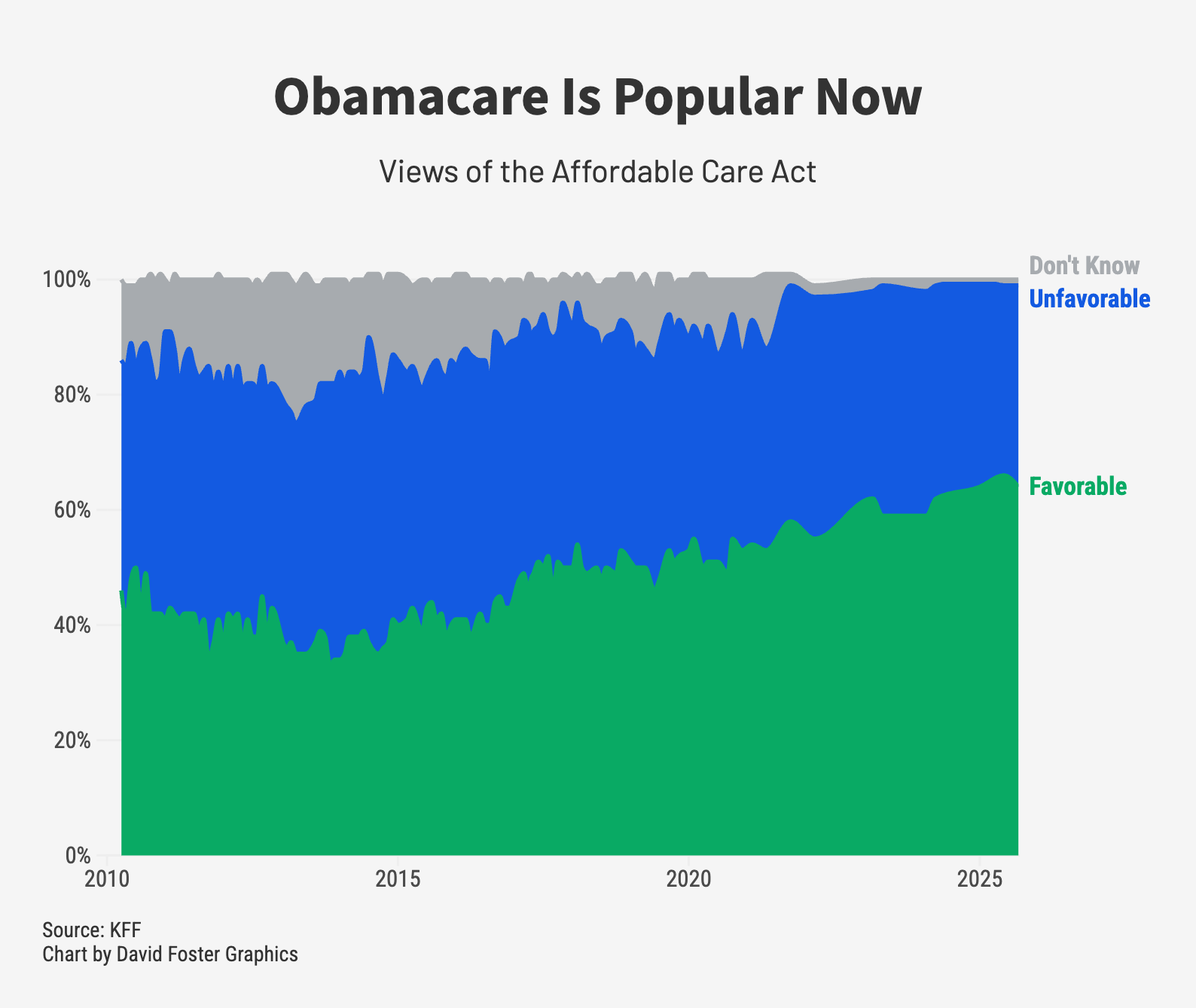
Trump famously led the charge to overturn the ACA in 2017, narrowly failing in the Republican-controlled Senate. Now he says he’s open to negotiating with Democrats on extending the health care subsidies, as long as it’s “the right deal.”
Other conservatives are following Trump into this previously uncharted Republican territory. Firebrand Rep. Marjorie Taylor Greene of Georgia called for Congress to extend the subsidies, saying it’s necessary to lower health care costs for her own adult kids. A number of other prominent Republicans seem to support extending the tax breaks in some form. Their constituents agree: A September KFF poll found that 57% of Trump supporters think Congress should extend the subsidies.
It’s no mystery why. The ACA has led to a dramatic improvement in coverage rates since it went into effect in 2014. Most people can be ideologically opposed to something until it saves them money and improves their quality of life. Then ideology doesn’t matter so much.
MGT articulated this ideological dissonance when she posted on social media, “I’m not a fan [of Obamacare]. But I’m absolutely disgusted that health insurance premiums will DOUBLE if the tax credits expire this year.” She’s willing to hold her nose and vote for the subsidies because it will make her family better off.
The biggest change in coverage under the ACA has been a surge of people covered under Medicaid, the insurance program for the poor. The ACA expanded Medicaid eligibility so that more adults would qualify. The portion of Americans covered by Medicaid jumped from 13.4% in 2008 to 21.2% in 2023, the last year for which data is available. Graphics guru David Foster put the data into this chart:
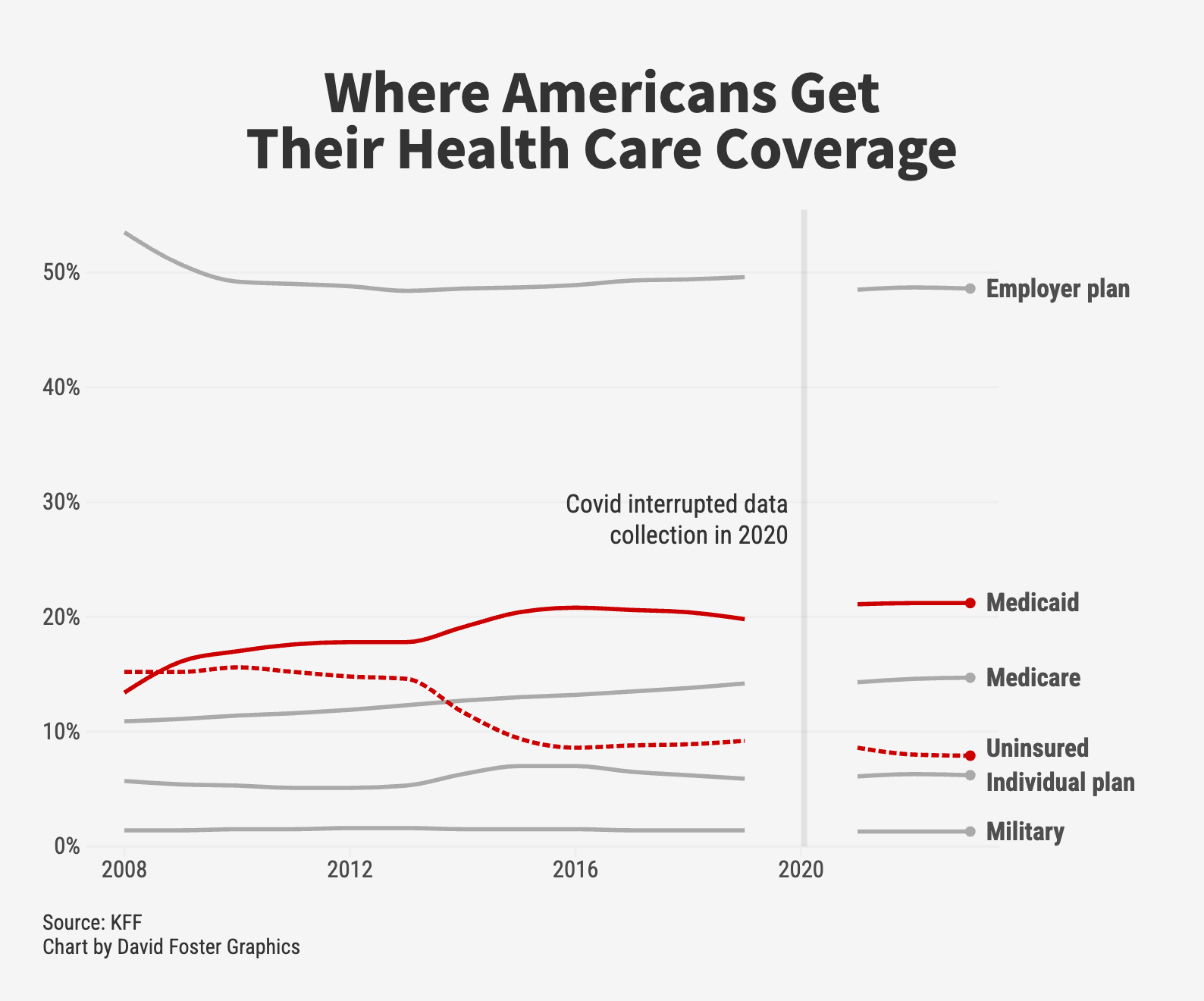
There’s been a slight increase in the portion of Americans purchasing an individual plan, which the ACA also helps cover. Medicare, which covers seniors, has also gained more enrollees, mainly because of an aging population.
Medicare and Medicaid combined now cover 35.9% of the population, up from 24.2% in 2008. Traditional employer-provided care has dropped from 53.5% of coverage to 48.6%. That’s the creep of socialized medicine that ACA opponents worried so much about.
Except that anybody enrolled in one of those government programs knows that it’s not the government providing the care. It just provides the coverage, or covers part of the cost. Aside from the military and a few specialized programs, most health care in the United States comes from the private sector, which certainly has its problems but is nothing like the British or Canadian models that haunt conservatives like a bogeyman.
So we now have more government-provided health care than ever, with the uninsured rate down from 15% before Obamacare to about 8%. The roof hasn’t caved in, as many ACA critics predicted. American health care remains the most expensive in the world, but that’s largely due to systemic problems that predated the ACA and require their own solutions.
Republicans still have a split personality on health care. The GOP tax bill Trump signed in July will cut Medicaid spending by nearly $1 trillion through 2034 and probably lead to reduced coverage. And there are still plenty of Republicans who want to prune Obamacare rather than expand it. Extending those ACA subsidies this year is certainly not a given.
But if Trump can change his tune, so can a lot of others.
It's a calamitously dangerous proposal for our beloved country that must be defeated at all costs... until doing so would start affecting my own family. Oops, didn't see that coming! 🤣🤣🤣 The hypocrisy from these unserious poseurs is astounding.