


THE TOP 5:
Shutdown bites. The government shutdown is starting to cause real pain—which means it might end soon. Food-aid funding for 42 million Americans ran out October 31, with some members of both parties saying that ought to be enough to get the government operating again. A huge federal union is pressuring Democrats to stop their opposition to refunding the government. And flight delays at airports around the country are worsening as air traffic controllers, already in short supply, increasingly balk at showing up to work without pay.
Democrats do seem to be fulfilling their mission of using the shutdown to draw attention to high health care costs. Premiums for millions of people enrolled in the Affordable Care Act are likely to soar if Republicans refuse to extend subsidies that lower costs for about 22 million people. ACA enrollees will notice those soaring premiums when they start to sign up for 2026 plans this month, which means Democrats may not need the shutdown any more to highlight those costs. People will notice on their own.
[Learn more: Why Trump is softening on Obamacare]
A hawkish cut, but only for a day. Stocks wobbled on Fed Day, October 29, after Federal Reserve Chair Jerome Powell said interest rate cuts weren’t on autopilot. The Fed cut short-term rates by a quarter-point, as expected, but Powell said another cut at the Fed’s next meeting in December “is not a foregone conclusion.” Oh no! Was Powell suddenly turning hawkish?
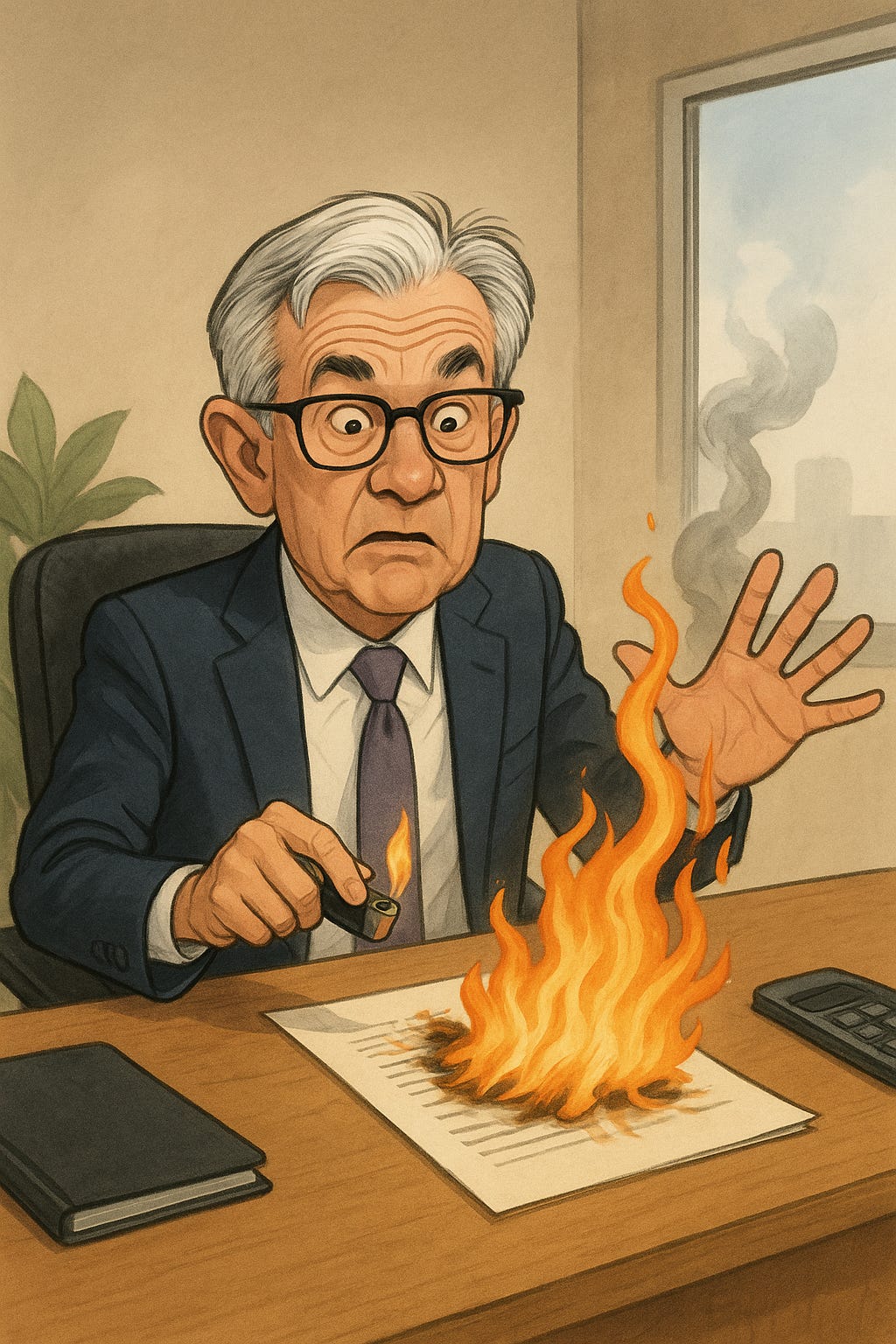
Traders thought so, and stocks sold off modestly through the following day. Then a new narrative emerged. “It was NOT a hawkish cut!” economist David Rosenberg of Rosenberg Research declared on Oct. 30. Patrick O’Hare of Briefing.com argued on October 31 that financial conditions are already loose enough and “one more rate cut before year-end is one too many.” Plus, Amazon booked killer earnings on October 30, bringing the focus back to the tech boom. By Halloween, everybody settled down and buyers were back. The S&P 500 ended the week up about six-tenths of a point, with the NASDAQ up a more robust 2.2%.
Trade truce: President Trump might be getting as tired of his trade war as everybody else is. On October 30, Trump announced a “truce” with China that sounded a bit more like capitulation by Trump. China will resume purchases of American soybeans and once again export rare-earth minerals to the United States. Trump will lower the overall tariff on China from 57% to 47%. Nobody has yet “won” or “lost” the Trump-China trade war, but China has homed in on Trump’s pain points—soybean farmers and hundreds of American companies that need rare-earths—and battled Trump to a draw, for now.
Did Trump chicken out again? Yes and no. Trump chickens out when he threatens insanely high tariffs that would be ruinous to his own economy if he actually went through with them. That bluff has lost its punch. But Trump has still raised the average tax on imports from 2.5% when he took office to about 17%. He’s pushed the average tax on Chinese imports from 21% to 47%. US importers are paying more in taxes and that will eventually cost everybody more. Trump also likes the power he gains from micromanaging trade, and isn’t likely to relinquish it.
[Learn more: Why Trump’s trade wars seem to be going in circles.]
Nuke tests? Wut? Trump left a lot of people puzzled after he said on October 29 that he’s ordered the Pentagon to resume nuclear weapons tests, something the United States hasn’t done since 1992. Trump is apparently peeved (or impressed) that Russian President Vladimir Putin is bragging about some new nuclear toys. A nuclear-powered missile called Burevestnik can supposedly fly for hours, evade conventional radars and carry a nuclear warhead to anywhere on the planet. A giant nuclear-power torpedo known as Poseidon is meant to set off a nuclear explosion in the ocean and create a tsunami able to swamp coastal cities. Putin has been talking up such weapons recently and he obviously got Trump’s attention, which is probably what he hoped for. As terrifying as these weapons might sound, however, security experts point out that Russia, like the USSR before it, has a history of touting fanciful superweapons that are impractical or far less capable than Kremlin pronouncements let on.
Trump, at any rate, seems to think he needs to flex some muscle in response, so his idea is to start once again detonating nukes in the western desert. Who wants that in their back yard?! The United States stopped conducting live nuclear tests because computer simulations do the job better, without spreading radiation or freaking people out. In The Atlantic, Tom Nichols, a professor emeritus at the US Naval War College, said “resuming nuclear testing is a terrible idea,” because it would needlessly trigger more of a global arms race than there already is. A lot of national security experts hope this is a Trump trial balloon that deflates, fast.
The first $5,000,000,000,000 company. Nvidia’s astonishing ascent made it the world’s first $5 trillion company this week, nearly a full trillion ahead of No. 2, Apple. Fun fact: I profiled Nvidia when Yahoo Finance named it Company of the Year all the way back in 2016. We told people how to pronounce the name, since many people had never heard of it. But the stock was up nearly 200% that year, and it kept going, so people obviously learned.
At the time, Nvidia was the 314th largest public company in America, with a market value of about $55 billion. It hit a $1 trillion valuation in the middle of 2023, $2 trillion in March 2024, $3 trillion about a year ago and $4 trillion in July of this year. So it has gained that last trillion in less than four months. Or not quite: Its market cap closed at $5.03 trillion on October 29 but has since dipped back to about $4.93 trillion. (Stats from S&P Capital IQ.)
Jensen Huang, Nvidia co-founder and CEO, is now worth about $176 billion, ninth richest on the Bloomberg billionaire’s list. Will he ever displace Elon Musk, who’s No. 1, at $457 billion? Not if the tech or artificial intelligence bubbles burst, a prospect that is generating some chatter. The Economist and the Atlantic recently mapped out how an AI crash could happen, something many investors are nervously considering. But most people don’t flee a bubble until everybody else starts to.
WHAT WILL MATTER NEXT WEEK:
Democratic Socialist Zohran Mamdani will probably become the next mayor of New York City on November 4. Conservative talking heads will explode, but if you’re one of the 330 million Americans who doesn’t live in NYC, why would you care? Besides, Mamdani may not be as socialistic as many fear. I explained why a couple of weeks ago.
Beleaguered Democrats hope their sad fortunes will improve slightly with wins in the November 4 governor’s races in Virginia and New Jersey. These races will generate a lot of overblown cable-news coverage and windy pronouncements about what message voters are sending Trump. But off-season elections aren’t usually as telling as the pundits want you to think.
Tariffs on trial. On November 5, the Supreme Court will hear an appeal that will determine whether 75% of the tariffs Trump has imposed this year are illegal and need to be revoked. Two lower courts have already found these “emergency” tariffs illegal, but SCOTUS is stacked 6-3 with conservatives who might favor Trump. The case is an existential threat to Trump’s trade war and also a test of whether the high court retains some independence or is largely in Trump’s pocket. The Court won’t rule right away, but several judges might telegraph whether they’re likely to keep or kill the tariffs. Stocks could react.
Layoff tally. Staffing firm Challenger, Gray & Christmas will publish its monthly layoff tally on Thursday, November 6, drawing more attention than usual because the government isn’t publishing the regular jobs report during the shutdown. A few big companies have announced five-digit layoffs recently, and workers increasingly worry about a weak labor-market. The Challenger report will give some clues about whether job-market weakness is anecdotal or more systemic.
[Learn more: Layoffs are suddenly making the “vibecession” seem like the real thing.]