


THE TOP 5:
The AI bubble didn’t pop yet. Stocks rose five trading days in a row, starting on November 21. The winning streak erased worries, for now, that the beginning of a big selloff was underway, possibly akin to the dot-com bust that began in 2000.
On November 20, the S&P 500 index closed 5.1% below the record high set on October 29. The tech-heavy NASDAQ led the selloff, down nearly 8% during the same timeframe. Traders worried that the artificial intelligence boom that has been driving stock values to the stratosphere was popping.
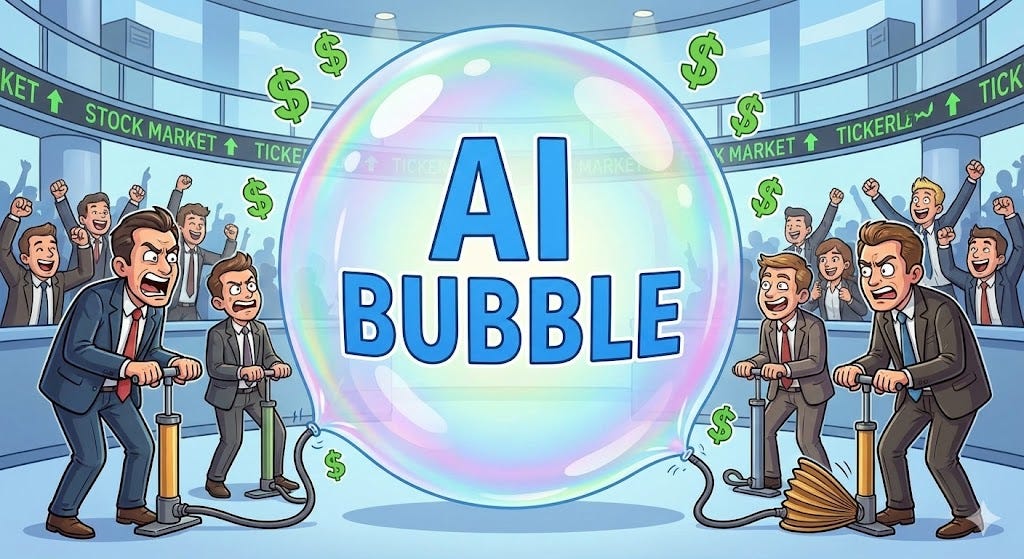
Well, not yet. Among other things, investors are stoked by the growing odds of a Federal Reserve rate cut when its next meeting concludes on December 10. The odds of a rate cut jumped from 30% a couple weeks ago to around 85%, according to the CME’s FedWatch tool. What changed? Not much, in the real economy. But a key Fed official recently said a rate cut might make sense given weak data on the job market.
There could still be an AI bubble destined to pop. It just didn’t happen this week.
[More: A step-by-step guide to the AI bubble.]
The shooting of two servicemembers in Washington, DC immediately became a political crusade. For unknown reasons, a 29-year-old emigre from Afghanistan allegedly shot two National Guard soldiers in the nation’s capital on November 26. One soldier died, while the other is seriously injured. The DC shooting is a bit more complicated than the typical spasm of senseless gun violence. The shooter worked with the CIA during the 20-year American war in Afghanistan, and came to the United States in 2021 as part of a program admitting Afghans who had helped US forces during the war. The Trump administration formalized the man’s admission to the United States earlier this year.
President Trump wasted no time using the attack to advance his immigration agenda, which is to severely limit the number of people migrating to the United States, for just about any reason. One day after the shootings, Trump said on social media that he planned to stop all migration from “third world countries” and impose “reverse migration” by expelling thousands who are legally entitled to be in the United States. Then the State Dept. halted all visas for anybody with an Afghan passport.
Obviously something went wrong if a refugee who should have been thoroughly vetted before entering the country shot up two servicemembers. It would be nice to know what. But we may never know. Trump immediately faulted Biden, without any specifics, turning the crime into a blamefest. One question that ought to be addressed is whether the shooting would even have happened if Trump hadn’t sent 2,000 Guard troops to DC in the first place, to deal with an “emergency” crime outbreak many city residents said was bogus. Did Trump’s unusual and probably unnecessary use of the Guard end up making them a target?
[I discussed the holiday shopping outlook on CNN on November 28. Here’s the clip:]
DOGE died. And good riddance. Trump administration officials confirmed this week that the “government efficiency” commission headed by Tesla CEO Elon Musk at the start of the year is officially out of business. The original idea was for Musk and his whiz kids to identify as much as $2 trillion of cutbacks in a federal budget of $7 trillion, and present a plan for a vast government overhaul by the middle of 2026. Instead, DOGE generated a bonfire of recrimination, with Musk stomping off after a few months and real budget experts lampooning the whole exercise as a farce.
If DOGE ends up forgotten, that might be the best possible outcome. There are worse possibilities. DOGE poked holes in government programs that are supposed to enhance American power around the world and protect us at home. One of the most incomprehensible DOGE targets was an agency called CISA that guards against attacks on US infrastructure, which experts say is very vulnerable to sabotage by enemies. DOGE slashed that agency’s personnel and hollowed out the agency. It’s a guarantee that Russia, China, Iran and North Korea noticed.
[More: Elon Musk’s “DOGE” produced no efficiency at all]
Trump’s Ukraine peace deal deadline came and went. And the war continues. Trump said Thanksgiving (an American holiday neither Ukraine nor Russia celebrates) was his deadline for Ukraine to accept a peace deal his envoy had largely worked out with the Russians. Ukraine was cagey, not rejecting the deal, but not accepting it either, while pledging to keep working on it. Trump hinted he would halt US aid to Ukraine if it didn’t agree to his Turkey Day truce, but what seems to be happening instead is more negotiating.
Trump’s effort to end the Ukraine war has been simplistic and naïve, given that Russian dictator Vladimir Putin has little reason to stop fighting unless he gets almost everything on his wish list. Yet some credible analysts are beginning to suggest a deal to stop the fighting, at least for a while, might be worth Ukraine making some concessions, no matter how painful. British analyst Mark Galeotti, for instance, says that Trump’s plan “has some promise, as a starting point for something that could stop the killing.”
Another wrinkle is that a mushrooming corruption investigation in Ukraine has begun to snag some of President Volodomyr Zelensky’s closest advisers. Peace may not be at hand, but something could change.
Humanity actually fixed something. Remember the ozone hole? That was a deterioration in the protective ozone layer, over Antarctica, that limits the amount of ultraviolet radiation hitting the earth, like planetary sunscreen. Chemical refrigerants used for decades had eroded the ozone layer, leading to the 1987 Montreal Protocol, which phased out their use worldwide.
It worked. A new government report documents the ongoing recovery of the ozone layer, “which remains on track to recover fully later this century.” It’s not news that the chemical ban helped avert what could have been a gigantic manmade disaster. But the latest update is a timely reminder that for everything we screw up, we’re capable of making things better.
~ ~ ~ ~ ~ ~ ~ ~ ~ ~ ~
WHAT WILL HAPPEN NEXT WEEK:
Something in Venezuela? Trump has been ratcheting up pressure on Venezuelan dictator Nicolás Maduro, by flooding the region with ships and other forces, blowing up boats supposedly ferrying drugs from Venezuela, and hinting at US attacks within the country itself. On November 29, Trump declared the airspace over Venezuela “closed.”
What’s his plan? Trump clearly wants to be able to claim some type of victory over drug cartels sending cocaine, heroin and fentanyl to the United States. If Trump could force Maduro from power, that might be good enough for him. It wouldn’t stop the flow of drugs to the United States or automatically improve the fortunes of Venezuela, which is basically a failed state. A US ground invasion is extremely unlikely, but air strikes are possible. Keep in mind that air strikes alone can be damaging, but they’re usually not enough on their own to drive an unwanted leader from power.
Trump is flirting with an Obamacare fix. Trump is toying with the idea of telling his Republican allies in Congress to extend health care subsidies that are due to expire at the end of the year. Those subsidies lower the cost of insurance for millions who buy it through the Affordable Care Act. If they expire on schedule, the out-of-pocket cost of an ACA plan could rise by more than $1,000 per person for more than 20 million Americans.
If you paid attention to the recently concluded government shutdown, you might recall that extending those subsidies was the Democrats’ main demand. They didn’t get what they wanted, but now Trump and some (not all) Republicans worry that letting health care costs rise for 20 million Americans could cost them dearly in next year’s midterm elections. Republicans have never had a meaningful plan to make health care more affordable for more people. Maybe they’re on the verge of coming up with one.
Another delayed jobs report. The monthly jobs report for November was due out December 5, but the shutdown delayed that until December 16. The Fed has to decide on another rate cut six days earlier, and one of the biggest questions is whether the job market is weakening enough to warrant a rate cut that’s supposed to be stimulative. The Fed will have to make that call without the official jobs numbers. A quarter-point cut is the most likely outcome.