


The Matterboard is our weekly assessment of what’s worth your attention and what isn’t. Here’s last week’s edition, here’s an overview of the project, and here’s the full archive.
~ ~ ~ ~ ~ ~ ~ ~ ~
PAY ATTENTION ⚠️
Blue tsunami. The midterm election outcome dominates the Pay Attention quadrant this week, due to huge gains by Democrats up and down the ballot that will change the balance of power in Washington and several state capitols. Democrats in the next Congress will launch numerous investigations into Trump administration self-dealing and possibly impeach some Trump Cabinet officials. Democratic state-level gains—such as a near sweep in Texas—will bring far more scrutiny to the data-center buildout, blocking some projects, forcing more disclosure, and bringing more benefits to communities that do build the huge computing facilities.
Democrats will also have more control in swing states crucial to the 2028 presidential election, including Arizona, Georgia, Michigan, North Carolina, Pennsylvania, Wisconsin, and … Texas, which is presumably now a swing state. That will check any effort by President Trump to rig the outcome two years from now, assuming he’s still in office. Trump threatened various challenges to this year’s midterm results if Democrats prevailed. But the results are so overwhelming that even Trump seems chastened.
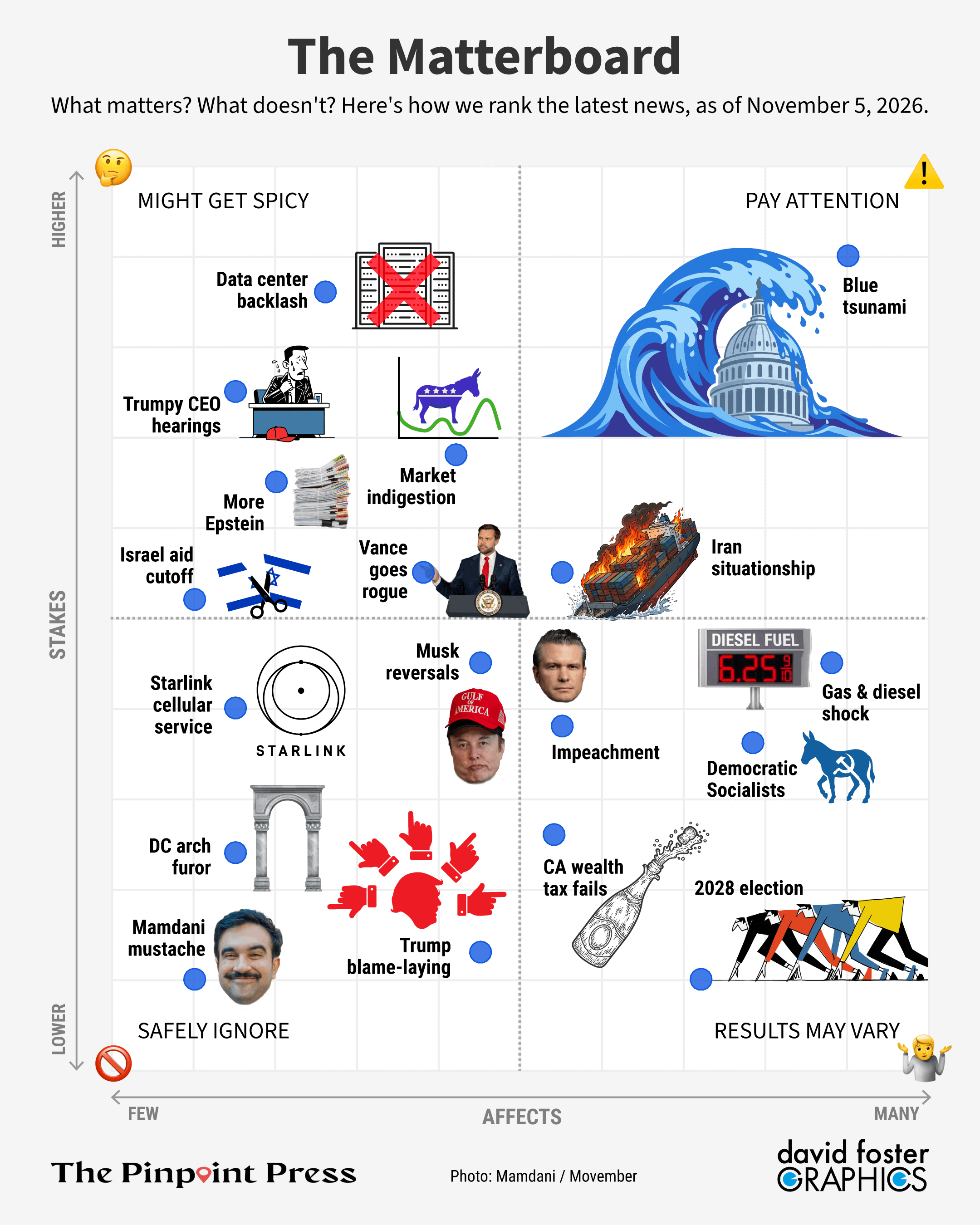
The Iran war has not reignited, and it may never. You might recall that Trump threatened a new wave of attacks against Iran once the midterms were over, with Iran vowing retaliation. That sent oil prices spiraling well over $100 per barrel for most of the last two months. But the elections were a screeching rebuke of Trump’s Iran war, and now Trump sounds like he’s losing interest in more fighting. Oil prices, in turn, have fallen to the lowest levels since early September. We predicted in late September that hostilities would recede—not intensify—after the elections, with oil prices getting close to pre-war levels by the end of the year.
MIGHT GET SPICY 🤔
Data centers took a beating in the midterms. They weren’t on the ballot, technically, but politicians who support them lost while candidates opposing them won. Texas, with more data centers than any other state, was ground zero. The upset winner of the governor’s race, Gina Hinojosa, wants to block all data center construction until the state legislature establishes a uniform regulatory framework. Stocks linked with artificial intelligence sank, but they may have been overpriced to start with.
[Why I lost money betting on the midterm elections]
Markets yo-yoed after Democrats won. Stocks rallied the first day after the election, then sank the second day. The two-day change in the S&P 500 index was a 2.7% loss, with tech stocks by 4%. This will settle down, but markets are trying to figure out how more Democratic control of Washington and state capitols will change the business climate for AI and other sectors. It could end up being less disruptive than the initial reaction suggests.
Vice President JD Vance went rogue after the midterms by saying on X that Trump’s Iran war caused the Republican blowout. Reporters rushed to figure out if Trump okayed Vance’s post or was blindsided by it. One theory is that a sort of palace coup is underway in which Vance, Tucker Carlson, and Donald Trump, Jr.—right, the president’s son—throw the old man under the bus to clear the way for Vance’s presumed 2028 presidential run. Others think Vance is cooked, no matter what. As VP, he’d be the heir apparent to Trump in any normal situation. But Trump is historically unpopular and Vance may never be able to escape that, even if he opposed Trump’s Iran war from the start.

Trumpy CEOs could get a summons to testify before Congress next year and explain whether their tightness with Trump earned them government favors or put any money into the Trump’s pocket. Democrats who will control all the key committees and hearing schedules have indicated they’d like to hear from SpaceX boss Elon Musk, Nvidia’s Jensen Huang, Meta’s Mark Zuckerberg, and others.