


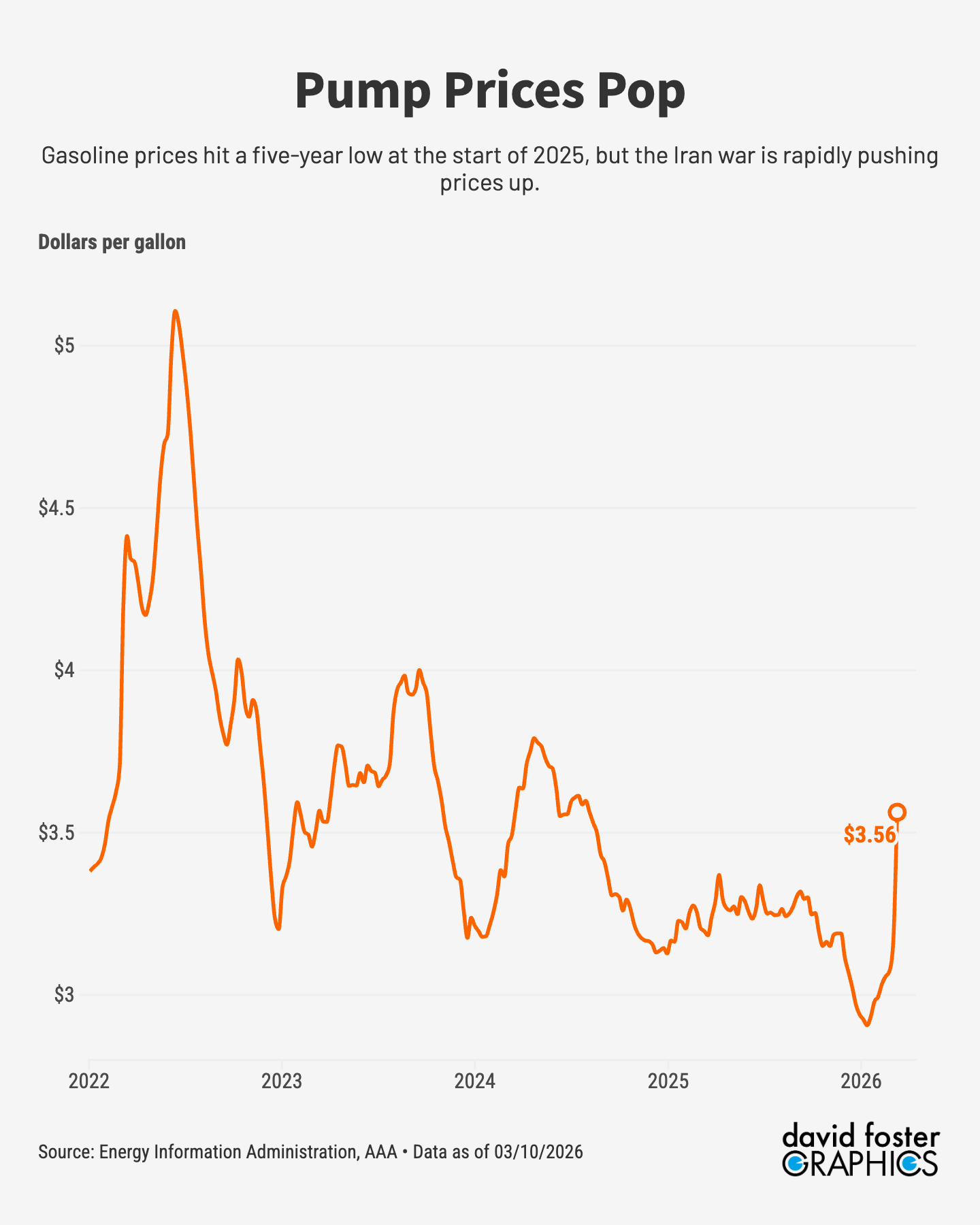
President Trump talks a lot of trash about the US economy, frequently claiming that job growth, inflation and many other things are better than they actually are. But he has generally been right about one thing: low gasoline prices. They started the year averaging less than $3 per gallon, the lowest pump price since the waning days of the Covid pandemic in 2021.
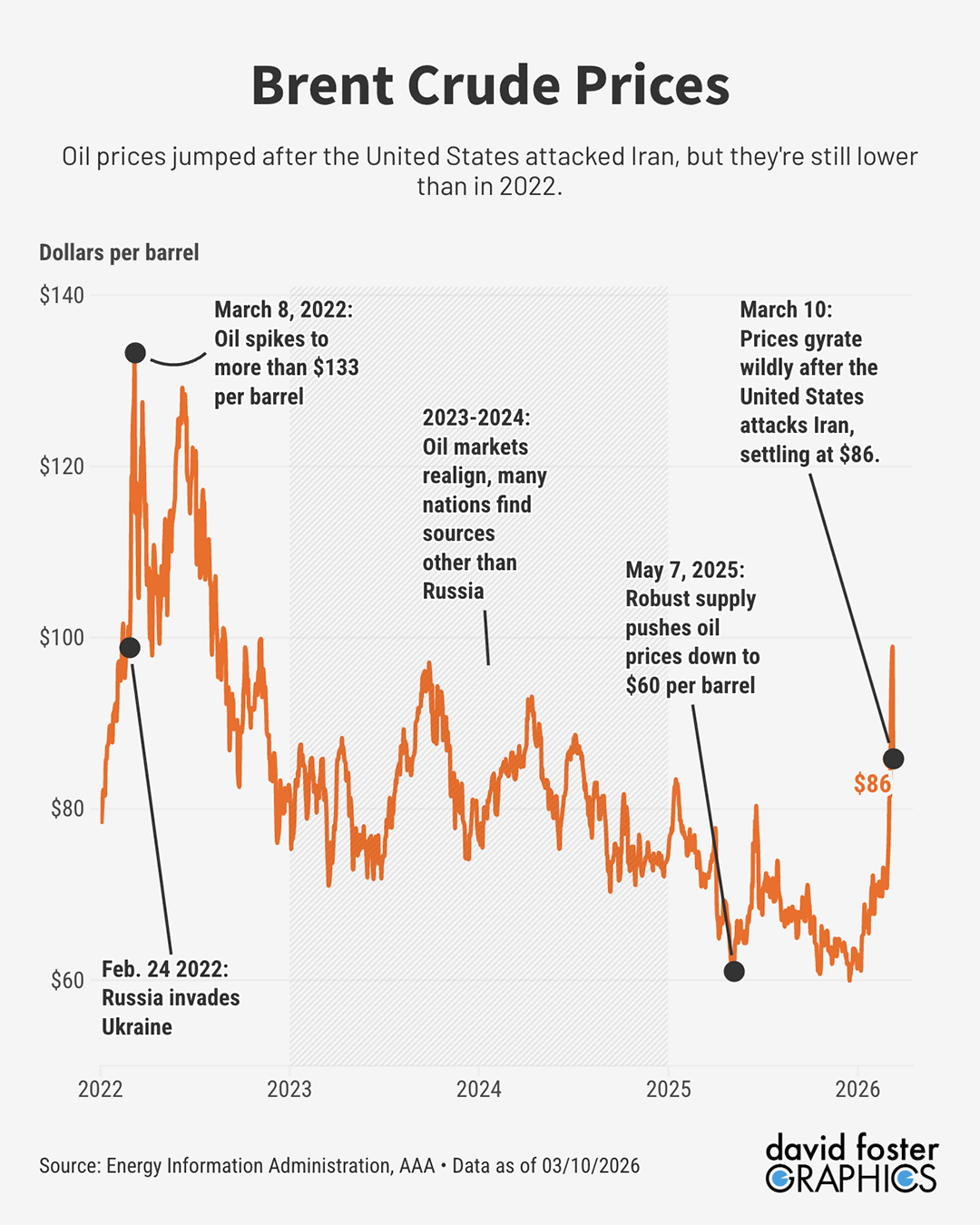
Trump himself put an end to that. The Iran war he started on February 28 pushed oil prices from a modest $66 per barrel in mid February to around $86, with a momentary panic on March 8 that sent prices soaring to $119. Prices are swinging wildly as traders price in a longer war or a shorter one, based on hints Trump gives about the state of the war and other signals from the Middle East.
Gasoline prices are following oil prices upward, with the average pump price jumping from $2.92 a month ago to $3.56, according to AAA. The wholesale price of gas is around $2.70, and the average spread between wholesale and retail prices during the last year has been about a dollar. That suggests pump prices could rise to about $3.70, and higher if oil spikes again.
This energy mania is driven completely by the de facto closure of the Hormuz Strait at the mouth of the Persian Gulf, a passageway for 20% of the world’s petroleum. Iran has threatened to attack oil tankers transiting the strait, and despite a withering bombing campaign by US and Israeli warplanes, it has the drones, mines and other weapons to do so. One drone hitting a tanker could cause considerable damage, and maritime insurance rates have skyrocketed.
Trump said the US government would offer insurance, but the details seem to be lagging. So most shippers in the region are waiting for hostilities to end. With storage tanks filling up, some producers, such as Kuwait and the UAE, have cut production.
If US forces in the Gulf are able to assure safe passage through the strait, oil prices will probably drift back to the $60 range they were at a month ago. But that would probably require Iran to swear off any tanker attacks, as part of a case-fire deal or some other arrangement. The biggest unknown is if Iran will do that, and when.
Trump’s biggest political concern this year is obviously the midterm elections in November. The best-case outcome for Trump and his fellow Republicans is a fast reopening of the strait that makes the recent leap in gas prices a hazy memory by November.
But that may not happen. The US Energy Information Administration just raised its forecast for Brent crude, the global standard, to $95 per barrel through mid May, to $80 per barrel over the summer, and to $70 by the end of the year. Its prior forecast was $64 throughout 2026.
Brent at $95 correlates with gasoline prices of roughly $4 per gallon. When Brent is $80, gas is around $3.70. If that scenario unfolds, gas prices will be nearly a dollar higher than the start of the year as the midterms draw near. Rising oil prices also raise transportation costs in many industries, pushing overall inflation higher.
Trump already faces angry voters frustrated with the high cost of housing, food and electricity. Trump promised to lower prices when he ran for president in 2024, and falling gas prices were the most tangible form of relief voters had seen during his presidency. Until now.
Trump message to voters? “Don’t be a panican.” That’s what he posted on social media on March 9, adding, “there is not an oil shortage. Prices will drop again soon.” He pointed out that the United States is supposed to receive 200 million barrels of oil from Venezuela, under a deal he made earlier this year.
That might sound like a lot, but 200 million barrels is only 10 days’ supply in the United States. And only some of it has arrived so far. Besides, there tends to be one global price that everybody pays, more or less, because oil is easily transportable and freely traded. In open markets such as the United States, nobody can hoard supply in order to lower prices.
Trump and other world leaders could try to ease the crunch by releasing oil from strategic reserves, but that didn’t do much to lower prices during the Biden years in 2022, when gas prices hit $5 per gallon. Plus, the US reserve remains depleted. Trump also eased some sanctions on Russian oil that went into place after Russia invaded Ukraine in 2022. That adds a bit to supply, at the cost of excusing Russia’s barbaric aggression.
The best move for Trump, and for American drivers, would be an end to the war that allows Middle East oil to start moving again. Trump says the war is “won,” but “not won enough,” which suggests the strait might open by … well, nobody knows. Maybe add a few spare bucks to your transportation budget.