


There will never be an official verdict on the import tariffs President Trump loves and cherishes. But the evidence is everywhere: They’re a flop.
Trump announced a $12 billion bailout for farmers on December 8 as if it were a privilege they should be grateful for. Yet the bailout is only necessary because Trump’s numerous trade wars have closed foreign markets to American food products.
The poster vegetable representing trade war collateral damage is the soybean. US soybean exports have collapsed this year, mainly because China stopped buying them after Trump imposed soaring tariffs on Chinese imports in April and May.
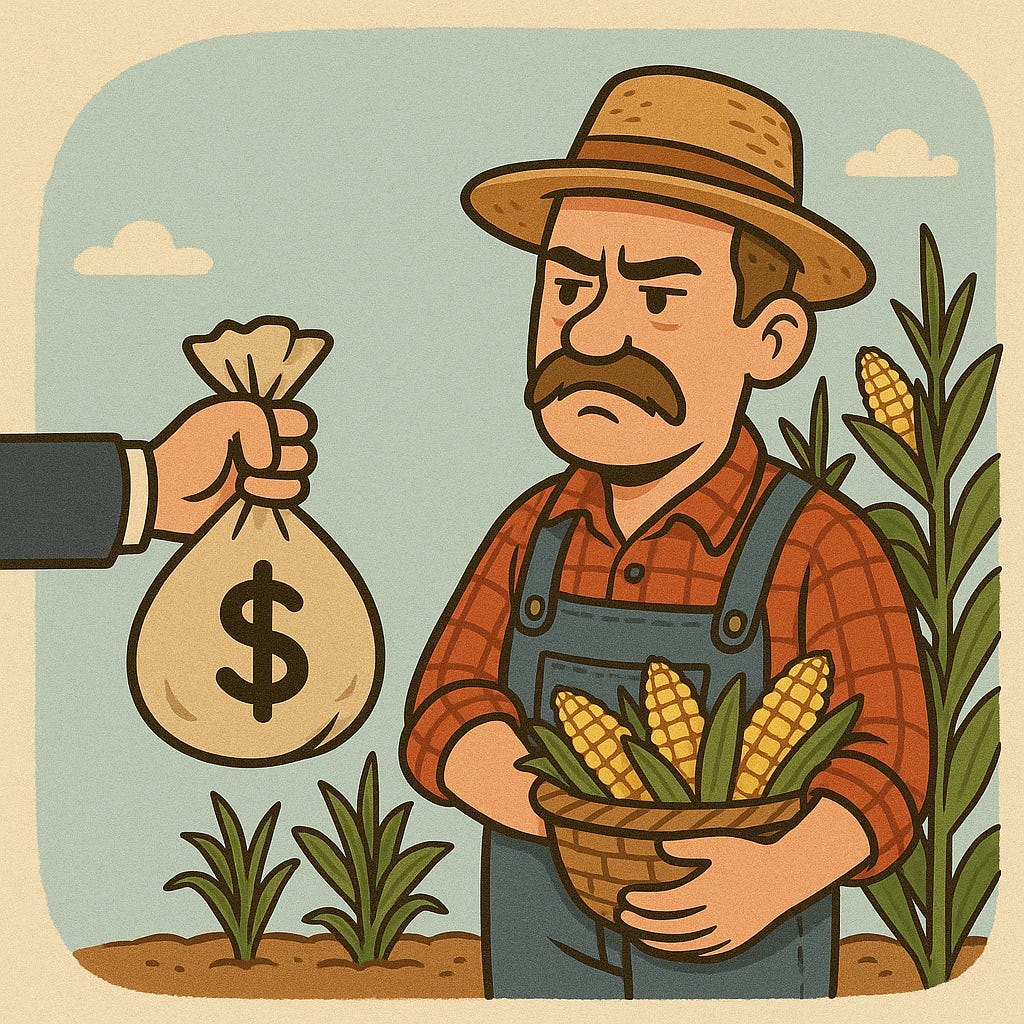
Trump made a deal with China in November that suspended some of the hostilities, with China agreeing to resume soybean purchases. But even if China fulfills its promises, US soybean exports to the world’s largest market will end the year one-third lower than in 2024. China replaced American soybeans with shipments from Brazil and Argentina.
Trump’s bet in his challenge to China is that the United States can inflict more economic pain on China than vice versa, giving Trump leverage to demand trade concessions. But China’s trade surplus just topped $1 trillion for the first time ever. Most other developed nations are bucking Trump and strengthening trade ties. That means more exports for China and more cheap imports for its trading partners. Trump’s trade wars have proved that America isn’t the only game in town.
For anybody who might have lost track of where the Trump trade war stands (almost everybody), Trump has imposed new tariffs on imports from more than 90 different countries. There are also new tariffs on specific product categories such as cars, car parts, steel and aluminum. Overall, Trump has ratcheted the average tax on imports from 2.5% to about 17%.

Some of those tax hikes are too much even for Trump. In November, Trump lifted tariffs on a couple hundred food items, in response to concerns that food prices had gotten too high. That came after Democratic candidates romped in a handful of off-year elections by addressing affordability concerns and arguing that Trump was raising voters’ living costs.
More Trump tariffs could disappear. The Supreme Court will soon rule on whether “emergency” tariffs that account for more than half of the new import taxes Trump has imposed are even legal. At a November hearing on the matter, a majority of justices seemed to doubt that Trump has the legal authority to impose tariffs in response to just about anything he considers an emergency. Two lower courts have already deemed those tariffs illegal. The Supreme Court could rule any time between now and the end of its term in June.
If the court strikes down the emergency tariffs—which Trump calls “reciprocal” tariffs—Trump could roll out new levies under different authorities. But some analysts think even Trump is tiring of his trade wars.
“Trump may not be in a position to simply swap out [emergency] tariffs for other blanket tariff authorities,” Henrietta Treyz of advisory firm Veda Partners argued in a recent analysis. “Reciprocal tariffs may altogether become a thing of the past.” She cites Trump’s falling approval rating, the recent Democratic wins and Trump’s own tariff pullbacks as signs that tariffs have become an albatross for Trump.
Have Trump’s tariffs accomplished anything? Trump and his aides brag about new revenue they’re bringing in, which could total nearly $160 billion this year. But that’s a tax hike on American importers and their customers, which the Yale Budget Lab says will cost the typical household $1,700 a year via higher prices, lost output and slower growth. At best, Trump is just redistributing money. At worst, he’s raising living costs, reducing output, and making everybody a little worse off, on average.
Trump says he wants to rebate the cost of tariffs by giving most families a $2,000 “tariff dividend” check. The Tax Foundation estimates such a payment would require 2 to 4 times as much revenue as the tariffs are taking in. The math would be even worse if the Supreme Court kills the “emergency” tariffs. Those rebate checks aren’t coming.
Trump also argues that his trade negotiations are generating billions of dollars of new investment in the United States by foreign governments and businesses. If that materializes, and the business prospects pan out, great. But these types of foreign commitments often turn into overhyped pledges that don’t yield much, like the notorious Foxconn boondoggle in Wisconsin.
Trump is so committed to tariffs that it’s hard to imagine he’d renounce them completely. But it would be in his interest to give it a rest before more tariff bailouts become necessary.
I think it was always going to end this way. Better late than never. Everyone knows DJT is a natural-born whack-job who takes advice from folks on the fringes. What's most disturbing and shocking is the acquiescence and negligence of our "Article 1" branch of government and the ruling GOP in all of this - how despicable that they feel like they can't speak up! Alpha males, my foot.
So, if the average increase to the American consumer is $1,700 per year, why is the $2,000 rebate so off the mark? I am not sure how much the Yale study is estimating for “lost output and slower growth”. Someone has to be wrong.
The rebate will never happen. The tariffs are an excuse to cover the shortfall in tax revenue created by the recent tax cuts. I can’t wait for the chaos that will occur when the Supreme Court steps in.