


If you’re planning to skip President Trump’s State of the Union speech tonight, here’s another justification: Presidential speeches have gotten way too long. And Trump is the worst offender.
Graphics guru David Foster and I couldn’t resist turning some data on presidential speech length into this handy chart:
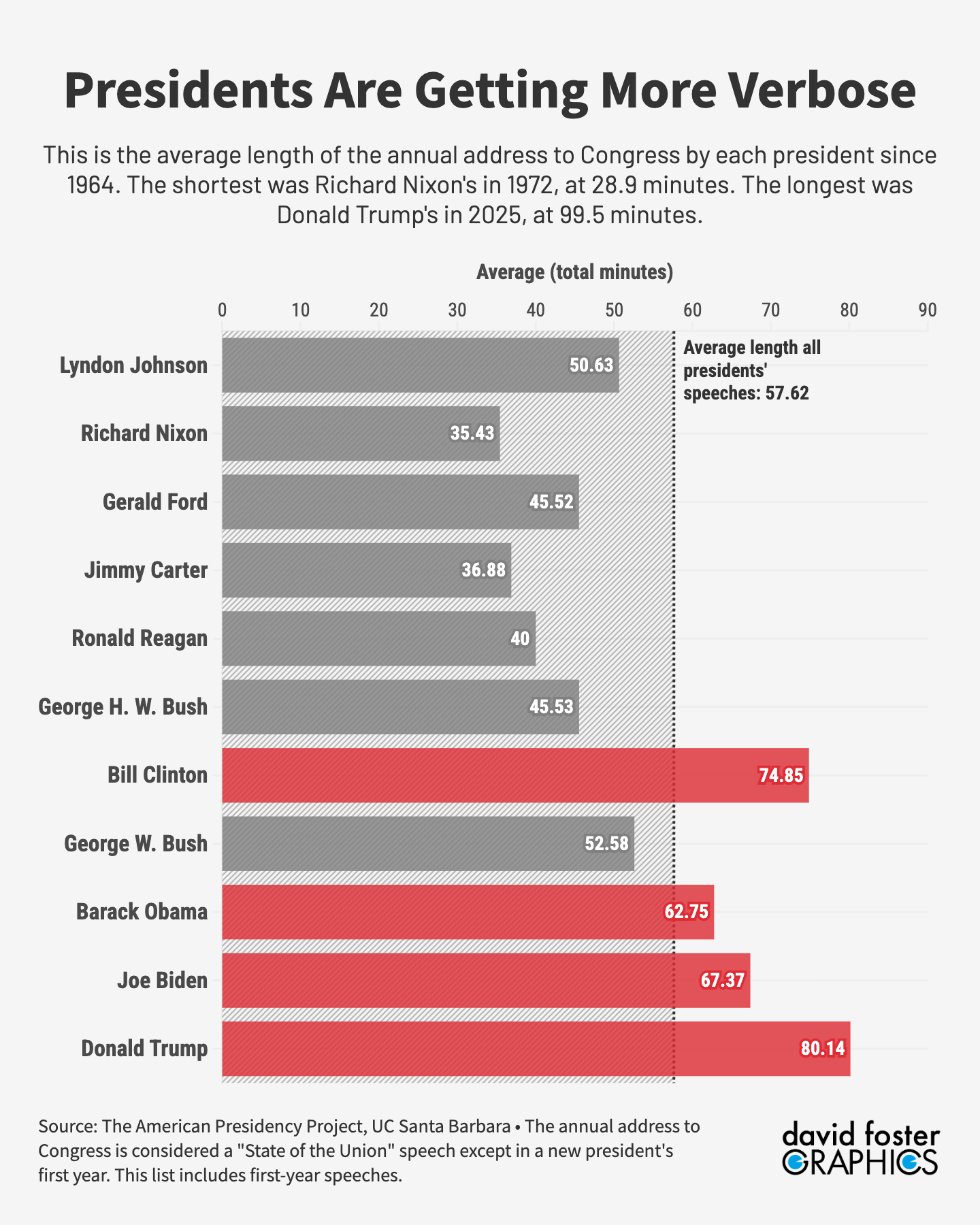
The trend is obvious: The annual presidential address to Congress gets longer and longer. The shortest speech since 1964 was Richard Nixon’s in 1972, which ended after less than 29 minutes. The longest was Trump’s speech last year, at nearly 100 minutes. The data comes from the American Presidency Project at UC Santa Barbara.
Why are these speeches getting so long? Part of it probably has to do with the rise of TV as a theatrical spectacle. Presidents now view the annual speech as a chance to hammer home their priorities and talking points to the largest audience they’ll face all year.
Trump is notoriously windy. He meanders and goes off-script and seems to think the audience loves his digressions. Bill Clinton, whose 89-minute speech in 2000 was the longest until Trump beat him last year, was quite a talker as well, perhaps because he thought his charm would grow in direct proportion to the length of his soliloquy.
These interminable speeches are out of step with modern audiences, who want shorter snippets of information, like on TikTok. Some critics complain that the national attention span is regressing to childlike levels. But it could be that the nation’s leaders just talk too damn much.
Trump, tonight, is expected to tout all his accomplishments of the last year, such as … well, you decide. He might also lay out new plans to lower the cost of housing, food, health care and energy. Or he might say, again, that affordability is a “hoax.”
Political geeks will be watching to see if he disses the Supreme Court, which recently overturned his beloved emergency tariffs. And the ayatollahs in Iran might be watching to see if Trump delivers some new clue about when his threatened attack might come.
Enjoy the speech. Or not!
In re: The USSC Tariff Ruling
The only parts of the 170 page USSC ruling that are accepted by the majority (6-3) are (1) the first 6 pages and the carryover conclusion on page 7, (2) pages 14-19 and the carryover conclusion on page 20 and (3) the page 21 conclusion that (a) Federal Circuit case No. 25-250 is affirmed (the appeal from the Court of International Trade) and (b) the DC District Court lacked jurisdiction.
My conclusion, therefore, is that the USSC IS SAYING THAT THE CIT RULING IS CORRECT BECAUSE NO PRESIDENT HAS THE POWER TO UNILATERALLY IMPOSE TAXES IN PEACETIME.
By the time Trump’s ruse that a current account deficit creates an emergency (a literal IMPOSSIBILITY) allowing a 15% tariff is ruled unlawful, the sole contribution of that action will be to further demonstrate the fundamental flaw of all tariffs: ONLY “taxes on incomes, from whatever source derived” provides sustainable support for U.S. revenues and debts.
In short, the entirety of Trump’s trade policy is without demonstrable merit by law, by economics reflected in mandatory accounting rules and by logic.
Maybe he’ll explain why the US government and our tax dollars should fund the Board of Peace and what qualifications he brings to the table that justify making him the head of the organization for the rest of his life
Imagine if Obama used $10 billion of our tax dollars to set up an organization in which he put himself in charge for life