


We used to call April 15 Tax Day. Now it’s more like Tax Evasion Day.
The federal government under Republican control has consistently gutted the Internal Revenue Service, the agency that enforces tax law and collects federal taxes. The result is a massive, hidden giveaway to the wealthy at the expense of ordinary working Americans. If any feature of government reveals systemic rot, it’s this wink-and-nod tolerance of tax dodging by elites, for elites.
President Trump is a notorious tax dodger who would probably abolish the IRS, if he could, and rely on voluntary tax payments by the few suckers willing to pay. But Republican hostility toward tax enforcement predates him. Republicans have been gutting the IRS and encouraging tax evasion since well before Trump first ran for office in 2015.
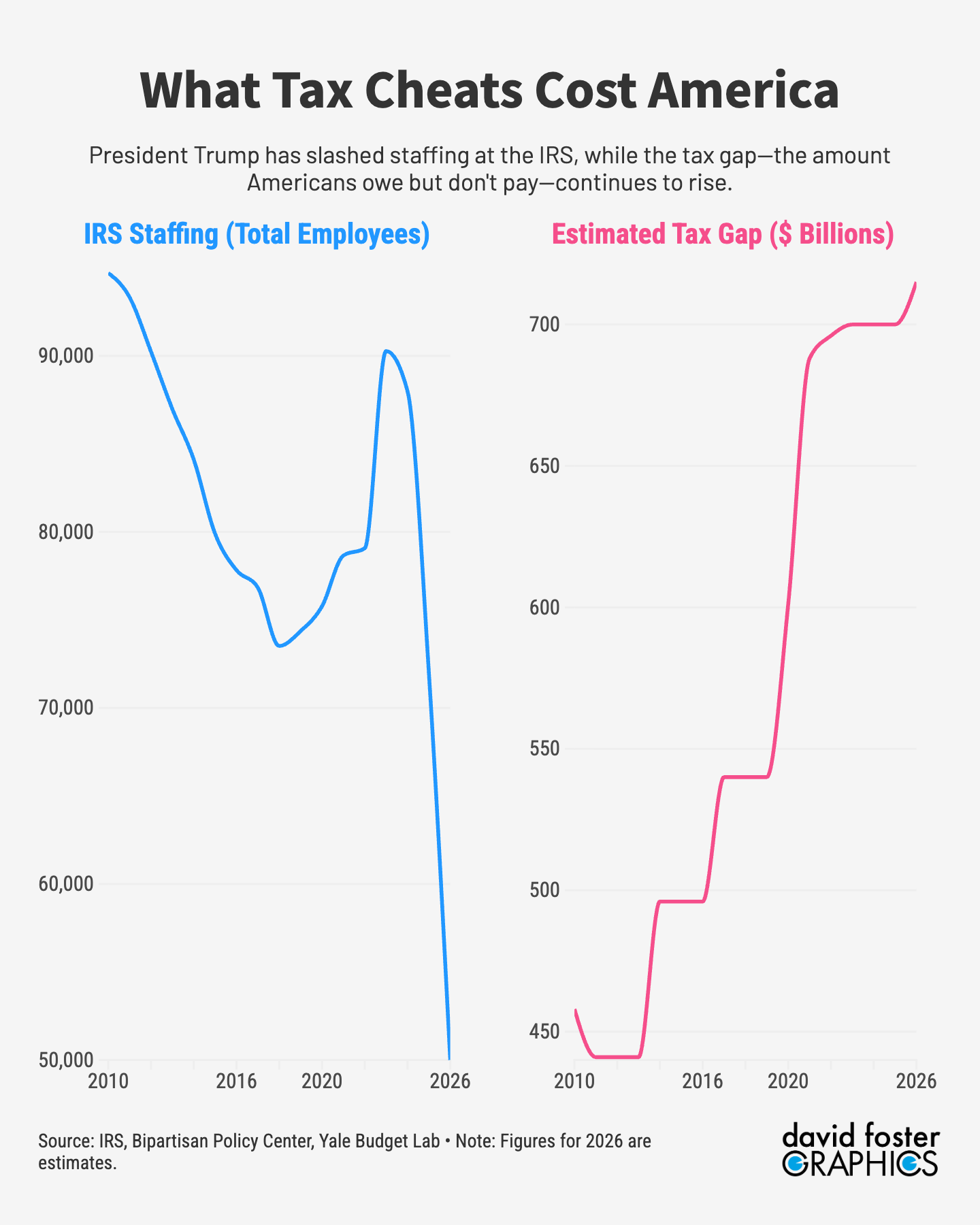
Starting in 2010, Congressional Republicans adopted a deliberate strategy to starve the IRS of funding, forcing it to reduce staff, cancel technology upgrades, and conduct fewer audits. By 2020, IRS funding had fallen by 20% in inflation-adjusted dollars, and staffing had declined by 22%. The agency examined 46% fewer individual returns and 37% fewer corporate returns.
The IRS will never collect every dollar US taxpayers legitimately owe. But the portion it can collect is directly related to enforcement, for the obvious reason that it takes cops to catch criminals, and more cops raises the hit rate.
[See 4 reasons for investor optimism]
In 2020, the IRS estimated that the “tax gap” for that year—the amount Americans owed in taxes, but didn’t pay—was $601 billion. Over the prior decade, the amount of unpaid taxes totaled around $4.5 trillion. The single most effective way to reduce annual budget deficits is to narrow the tax gap and collect more of the taxes Americans are obligated to pay.
In 2022, when Democrats controlled both houses of Congress, President Joe Biden signed legislation that boosted IRS funding by $79 billion over a decade. The money was intended to upgrade mainframe-era technology, hire thousands of new auditors and provide many other tools needed to chase down wealthy tax cheats flanked by armies of lawyers and accountants.
Investments in tax enforcement generate the best returns in the federal budget. The Congressional Budget Office estimated that the $79 billion in new funding for the IRS would generate $204 billion in new revenue, for a net gain of $124 billion. Other analysts thought the return might be higher. From a budget perspective, that’s free money. Better enforcement also makes the system more fair, boosting confidence in the system.
[See all of Trump’s losing causes]
Republicans aren’t having any of that. Since 2023, when Republicans regained control of the House, they’ve rescinded about $53 billion of the $79 billion in new funding for the IRS. Trump, via last year’s “DOGE” cuts, went further by slashing IRS staffing by at least 27,000 employees. Trump administration officials say their goal is to cut the IRS’s total payroll to about 50,000 people, which would be a 55% reduction from the 90,000 workers the IRS had in 2023. Staffing is heading back toward levels of the 1960s.
Trump has ushered in a golden age for tax cheats. The Yale Budget Lab estimates that Republican cutbacks in funding and staffing will lead to $861 billion in foregone federal revenue over a decade. That’s money Americans legally owe in taxes, but simply won’t pay.
The Wall Street Journal recently reported on the glee among some wealthy Americans at the IRS’s evisceration. “They have defunded the police,” one tax expert told the Journal. Another said there’s a new mentality among cheaters, which is “the IRS isn’t going to catch me.”
Ordinary workers who earn most or all of their income from a paycheck are the least likely to cheat, simply because it’s hard to do. Employers report their income to the government and withhold income tax. There aren’t many opportunities to dodge.
Business owners and wealthier people earning most of their income from investments have a much greater ability to fudge the numbers. Accountants and lawyers can establish complex tax shelters, while offshore accounts hide money from auditors. The huge cutback in audits at the IRS means many fishy returns won’t even get a second look.
[See the economic toll of the Iran war, so far]
As a reminder: The United States already has a giant budget problem called the national debt, now at a grotesque $39 trillion. Politicians of both parties routinely decry this gross abdication of fiscal responsibility, and the easiest way to do something about it would be to maximize tax enforcement.
Republicans: Nah
The tax gap this year is around $700 billion. The Yale Budget Lab estimates that within the next 10 years, the government will miss out on $7 trillion in tax revenue Americans owe, but won’t pay. That means Americans who pay what they owe are subsidizing those who don’t. A revolution once resulted from something similar.
What the GOP did to IRS funding is truly a travesty. The return on investment was HUUUGE. A true conservative would want everyone to obey the law (yes, including tax law) and for the government to enforce the law and prosecute law-breakers. What the GOP did with the IRS funding last year smacks of legislative arson rather than any kind of constitutional conservatism.
I am more referring to Medicare and Social Services fraud. It’s rampant and easy.