


My news feeds are filled with rants and laments about the bloodletting at the Washington Post, where billionaire owner Jeff Bezos just canned some 30% of the newsroom staff. As a fellow journalist who’s been laid off myself, I certainly empathize.
But there’s a pious tone to all the criticism of Bezos, as if he owes it to journalism to operate a storied news organization at a loss, indefinitely. He could easily do that. But the benevolent billionaire is a bad business model, and there’s no reason the news media should be exempt from the creative destruction that every other industry has to face in a competitive capitalist economy.
The First Amendment is a national treasure that protects the news media, and every citizen, from the power of tyrants to silence them. But the First Amendment doesn’t say publishers have the right to be funded. News organizations must finance themselves, like every other business or nonprofit. From what we know, the Post (which doesn’t report its finances since it is privately owned) has been losing money since well before Bezos bought it in 2013. Bezos is apparently moving to stem the losses, which includes shutting down underperforming sections such as sports and books and cashiering more than 300 journalists.
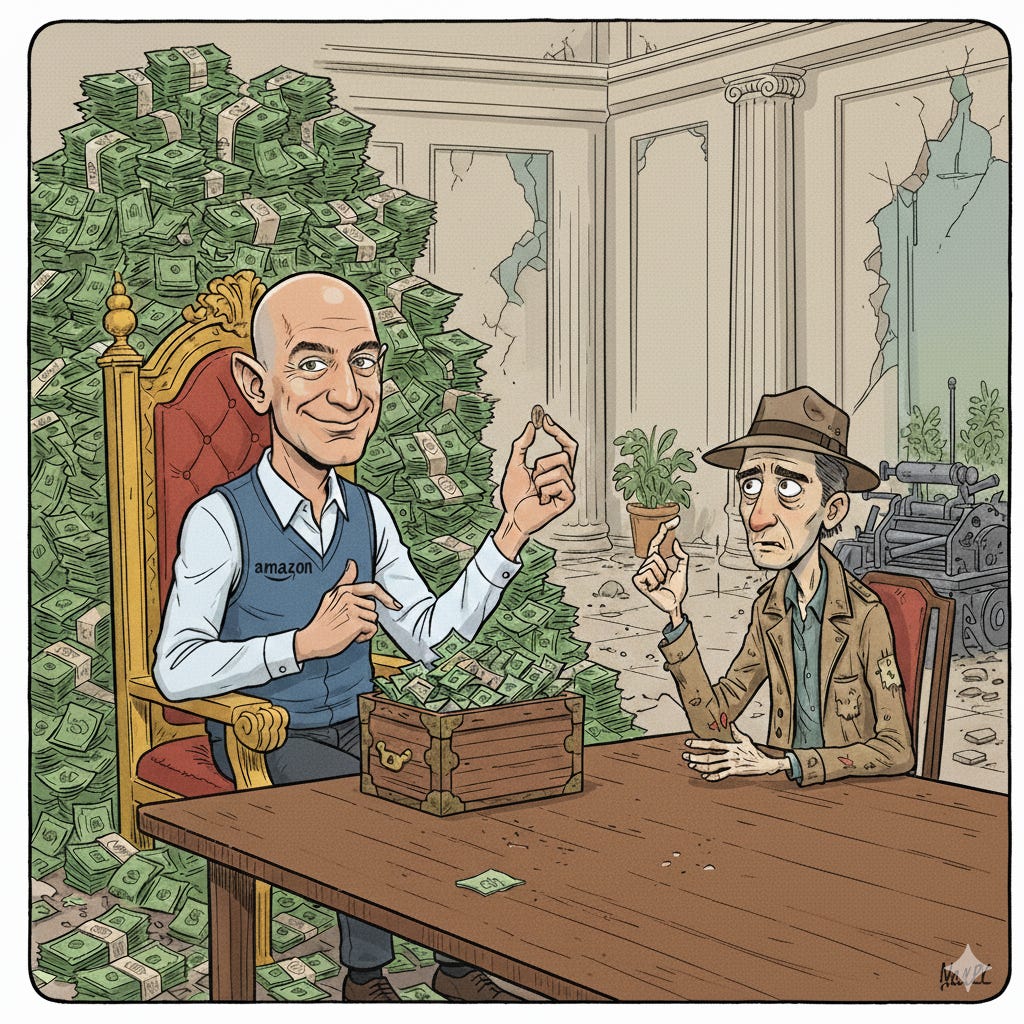
The easy argument is that Bezos, who’s worth $250 billion, should simply run the Post out of his own gigantic pocket. “If Bezos took one percent of his net worth and put it into a trust that would endow the paper, he would be remembered as the savior of the Post and not the destroyer,” New Yorker writer Ruth Marcus, a Post alum, said recently in the magazine.
Geez. What business wouldn’t want a rich godfather to forever protect it from competitive pressure! There are even a few model billionaires willing to do this, such as Laurene Powell Jobs, who bought The Atlantic in 2017, and Marc Benioff, who bought Time in 2018.
With wealth inequality worsening and billionaires accumulating unprecedented gobs of money, there’s a growing feeling that rich owe the rest of us something. One manifestation of this soak-the-rich ethos is the idea of a wealth tax on assets, to force billionaires with relatively low incomes to fork over more of their holdings. Some prognosticators foresee a future in which artificial-intelligence makes most work obsolete and citizens will receive a kind of universal basic income funded by tech overlords such as Elon Musk and Mark Zuckerberg, who end up with all the money.
[How to survive America in 2026]
Billionaires can be notoriously stingy and disagreeable, however, and the best counterweight to billionaire control of everything is human innovation at every level of the economy. Success today means businesses in every sector must scrap it out, fight for relevance and never become lazily dependent on easy revenue. And there’s plenty of precedent for the turmoil now gripping the Post.
The media has been in near constant upheaval since the Internet began to destroy 20th century business models in the late 1990s. To its fans (including me), the Post might have special status for its groundbreaking work on the Watergate scandal and the Pentagon Papers in the 1970s, plus a lot of other fantastic journalism since then. But that doesn’t make it immune to the economic and technological changes buffeting everybody else.
[Who’s up and who’s down in the K-shaped economy]
More than 3,500 US newspapers have gone out of business during the last 20 years. Time Inc. was a 20th-century media powerhouse that got split up into parts and sold off like pieces of an old jalopy a few years back. Many storied media names that survived are husks living off a familiar brand and not much else.
At the same time, hundreds of new media organizations have sprung up, in almost every case oriented as digital-first operations without the deadweight legacies of printing costs or broadcast transmissions fees. The Washington Post now competes with Politico, Punchbowl News, Semafor, Axios and many other startups, some of them launched by Post veterans. This is creative destruction. Old business models die while new business models take off. The rabid pace of both the creation and the destruction will probably continue as AI opens new opportunities and presents new threats.
The Post, like a lot of other news organizations, seems to have bungled its strategy for adapting to the digital age. “The reporters didn’t fail, the editors didn’t fail,” Marcus said in the New Yorker. “The business side failed.”
[Check out the Pinpoint Press Better-Off Index]
That may be true, and it could be that Bezos, the genius who built Amazon, stinks at running a newspaper. Exhibit A is the big dustup over Bezos’s 2024 decision to withhold an endorsement of Kamala Harris in the presidential election, and end the practice of endorsing anybody. Post staffers howled, basically accusing Bezos of sucking up to Donald Trump, who went on to win a second presidential term. Several hundred thousand subscribers canceled their subscriptions.
That incident was a compound fracture in which a ham-handed corporate decision highlighted the Post’s musty traditions. Most successful news startups don’t endorse candidates. This is an outdated anachronism that probably influences very few voters and is out of place in an era where trust is media is low. By making the decision just a few days before the 2024 presidential election, Bezos guaranteed maximum controversy. The smart move would have been to do it well before the election, or after. Bezos’s terrible timing created a needless uproar that put the Post’s own evolutionary strain in full public view. Lose-lose.
Journalism has become a very difficult business with generally low profit margins and the unhappy task of keeping people’s attention when they are bombarded with stimuli. Yet we still have profitable and respectable news organizations. The New York Times seems to have found a way of subsidizing news reporting with games and recipes that subscribers are willing to pay for. Other news organizations make money by hosting conferences and other events or offering business services. Some partner with deep-pocketed sponsors. Coverage of celebrities and saucier news can bring a paying audience or lucrative advertising.
The Washington Post is not closing. It is going through a crucible moment with the opportunity to shed hidebound habits, innovate, find new ways to connect with its customers and maybe become profitable. This is normal in the turbulent digital economy we have today. Facing and surmounting the same stresses as millions of other Americans ought to make those journalists better.
Having been to “news deserts” in Pocatello ID and Minot ND, … the printed word is dead.
But what passes for newspapers are national propaganda pieces and a smattering of “Joe saw a moose!” And “local boy earns merit badge”
There is a decided lack of diversity of thought and narrow mindedness expands (oxymoron?)… I guess I will continue to let Fox News and CNN and other “opinionists” tell me about vax facts and whether contrails are making me sterile…. And the local news is sports only now.
I wonder what motivated him to buy it in the first place. It seems paradoxical to his character in general. He was pretty hands off until this last election.