


Financial news headlines are touting a jump in oil prices and a stock-market selloff as markets try to digest the US-Iran war that President Trump kicked off on February 28.
There’s a better way to look at it: Market reaction to the biggest Middle East war in more than 20 years is extremely restrained, with investors likely confident it will cause no lasting damage to corporate profits or the world economy.
Oil prices tell the story. Brent crude, the global benchmark, has jumped from $71 per barrel to $79 in the aftermath of the US attack. That’s an 11% increase practically overnight, which is why you see headlines such as “Oil prices surge….”
But this is a tame scenario compared with what many traders expected in a shooting war with Iran, which is oil prices well above $100 per barrel. The current elevated prices are actually well within the normal range of the last four years.
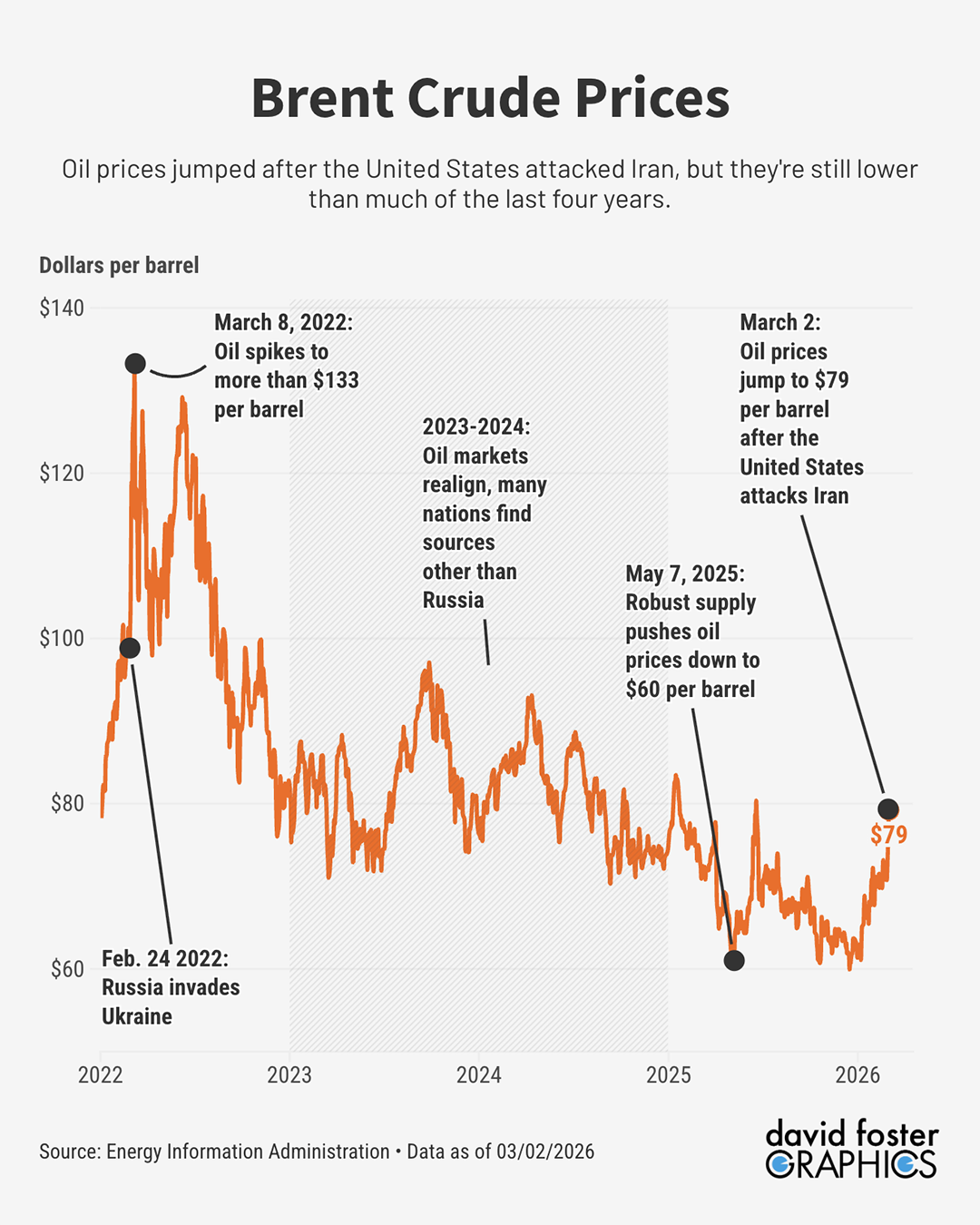
Higher oil prices are a negative for stocks, since they mean higher energy costs for companies. Yet the stock selloff on the first trading day after the war started turned into a slight gain. That suggests investors think higher oil prices will be very short-lived.
Simply put, $80 oil is no big deal. Crude went higher than current levels at the beginning of 2025, not because of any crisis, but simply because supplies were tight. Oil prices were also above current levels for much of 2023 and 2024. And they spiked to $133 per barrel in 2022, after Russia’s invasion of Ukraine.
In the worst wartime scenario, Iran would mine the Strait of Hormuz at the mouth of the Persian Gulf, where much of the oil from Kuwait, Saudi Arabia and other petrostates must pass to enter global markets. Iran was also expected to attack other nations’ energy infrastructure in the event of a war, possibly knocking out supply at the source.
Now that the war is here, this is what actually happened: A lot of tanker traffic through the Strait of Hormuz is stalled, but not because of mines. Insurers have been instructing ships not to pass until the situation is safer, else they forfeit their coverage. So a lot of oil on the water is temporarily stuck in place.
Iran has attacked some regional oil infrastructure, including a huge refinery in Saudi Arabia. But energy infrastructure is pretty robust, and the Saudis said the damage was “limited.”
“Once the Strait of Hormuz starts fully flowing with tankers again, and it will, the geopolitical premium will quickly reverse,” economist Peter Boockvar wrote in a March 2 analysis. “The strait has not been shut, it’s just been voluntarily stunted with shipments because of the lack of insurance and obvious safety concerns.”
Other non-happenings are also important. One reason Iran probably hasn’t tried to block the Strait of Hormuz is that it would lock in its own oil exports, throttling a crucial source of cash for what remains of the theocratic regime. Blocking the strait would also irritate China, which buys most of Iran’s exported oil and is a key patron Iran can’t afford to ignore.
Nor has the United States attacked Iranian oil infrastructure. It would be counterproductive to do so. Though most of Iran’s oil exports go to China, it still provides around 4% of the world’s oil supply, and if that oil disappeared, China would have to get oil from somewhere else. The lost supply would put much stronger upward pressure on oil prices than we’ve seen so far.
US and Israeli attacks are rapidly dissipating Iran’s military power and its ability to disrupt oil flows. Wars are unpredictable and there’s always a risk of catastrophe. But there’s a good chance oil prices won’t go much higher than they already are, and will return to pre-war levels.
With crude around $80, US gasoline prices should jump by about 25 cents, which would put them at around $3.25 on average. President Trump cites low gas prices as one of his main achievements, and he’ll want to get those back to $3 or lower. More than anybody, Trump controls what happens next in this war, and his passion for cheap energy may be the ultimate green flag for markets.
Like you have said many times the big problem here is regime change.Who will next leaders be because ,the people of IRAN have suffered under military leadership.i hope it works out for them. Say a prayer for them.