


The “Golden Age” President Trump keeps crowing about has some curious characteristics. One of them is a dramatic slowdown in hiring.
In 2024, job gains averaged 168,000 per month. So far in 2024, job growth has averaged just 75,000 per month, less than half the 2024 rate.
The slowdown is intensifying, with employers creating just 22,000 jobs in August. The average of the last four months is an anemic 27,000 new jobs.
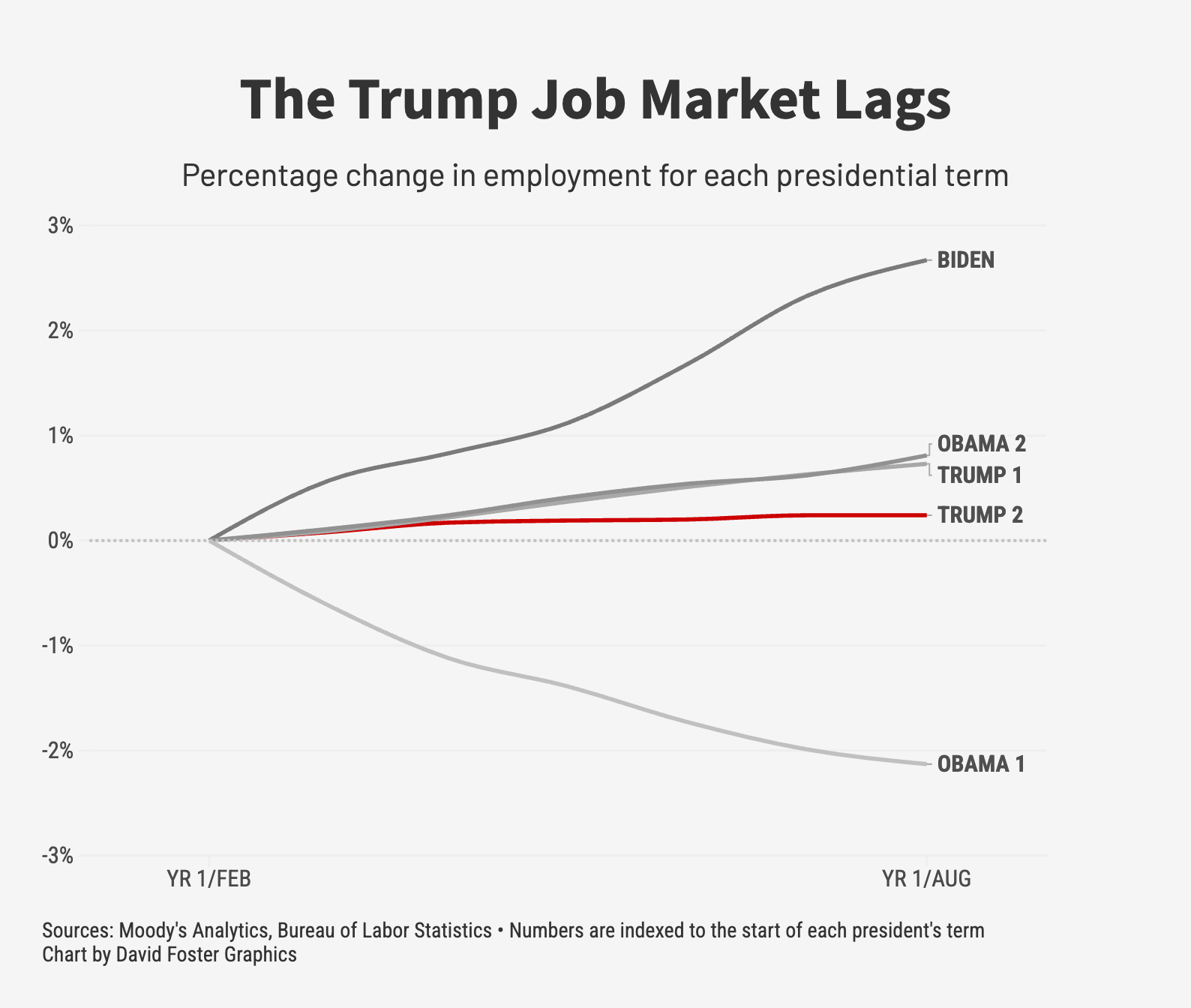
This pace of job growth is the worst since President Obama took office in 2009, in the midst of the Great Recession. Data provided by Moody’s Analytics shows employment growth of just 0.24% since Trump took office. Job growth at the same point in Biden’s term was 2.7%. During Trump’s first term, it was .73%. During Obama’s second term it was .81%.
The low point for the 21st century was Obama’s first term, when employment at the eighth month was down 2.1%. Those numbers are indexed to the start of each president’s term, to allow for apples-to-apples comparisons.
Graphics guru David Foster put the Moody’s data into this insightful chart:
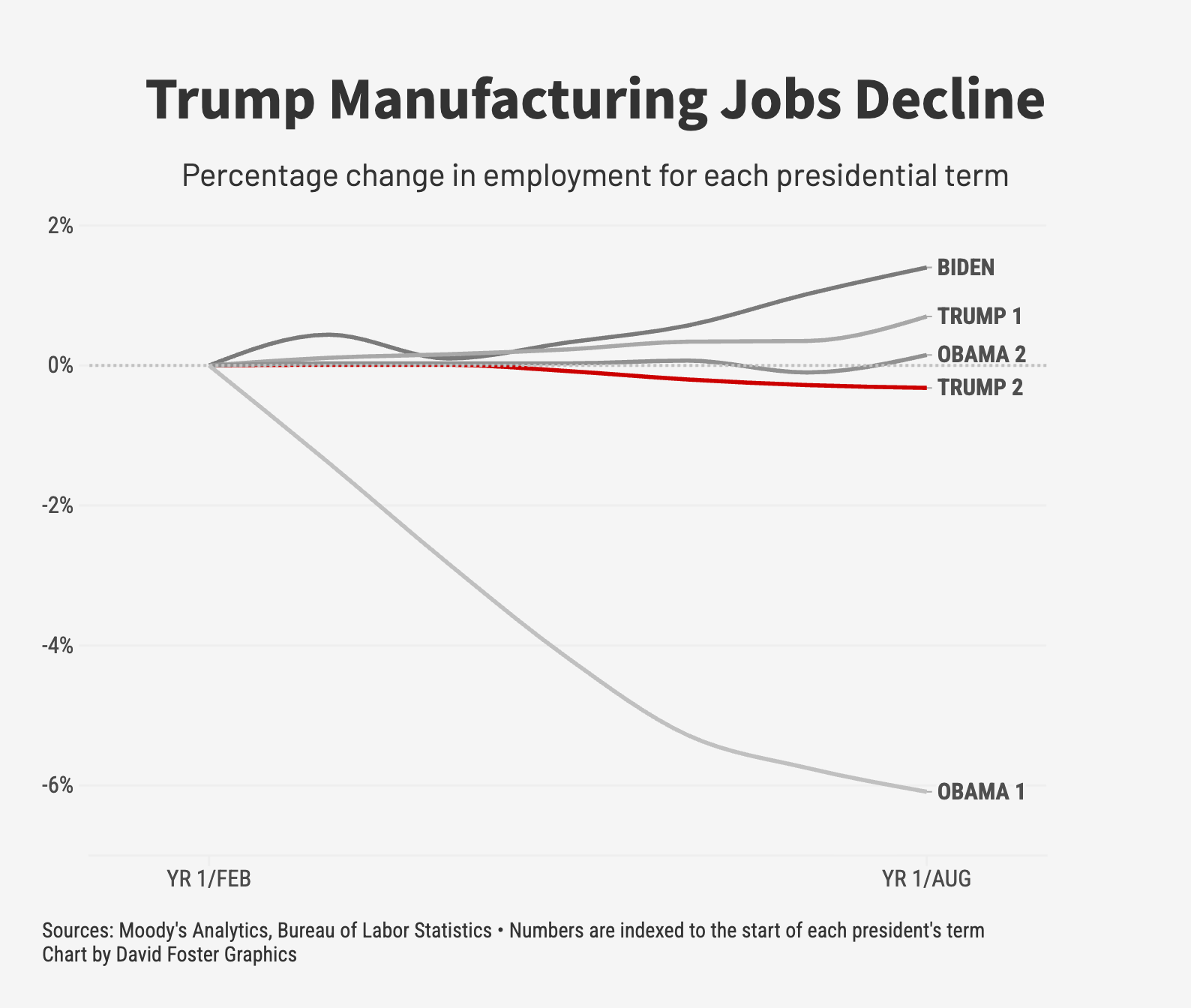
Manufacturing employment under Trump is doing even worse, with a 0.3% decline since he took office. Once again, that’s the worst showing since 2009. Manufacturing employment was up slightly at the eighth month of Biden’s single term, Trump’s first term and Obama’s second term. In August of 2009, manufacturing employment was down a whopping 6.1%.
Here’s another Foster chart:
It’s usually too simplistic to link economic developments directly to any given president’s actions. Yet Trump has pursued two distinct policies that economists have warned would depress hiring, along with overall economic growth.
One is Trump’s aggressive deportation effort, which is reducing the size of the labor force. Yes, many of those workers are (or were) unauthorized migrants, so you could argue they shouldn’t have been in the labor force to start with. But economically speaking, workers are workers, regardless of their legal status. And fewer workers means less spending, less economic activity and less overall hiring.
Trump’s tariffs are also probably depressing hiring. Tariffs are a tax on imports that raise costs to businesses and consumers and cause a lot of uncertainty. The erratic nature of Trump’s on-and-off tariffs, including legal challenges that could invalidate many of them, has made it hard for thousands of businesses to manage cash flow and forecast their financials. Smaller businesses, especially. Amid uncertainty, businesses stop hiring.
Trump isn’t about to take the blame for the hiring crash. He has set up a whole range of scapegoats, including the Federal Reserve and the economists producing the statistics. To blame the messenger even more, the White House is working up a report on the Bureau of Labor Statistics, which is not going to be a love letter. It will probably attempt to lay the groundwork for new methodologies that disguise the Trump slowdown and present alternative numbers more favorable to Trump.
Fake government data would be yet another uncertainty for markets, since official numbers tell us much of what we know about the economy. There are other data sources, plus companies know from their own order flows and other metrics how their businesses are doing. But if Trump starts faking the job numbers, the most likely outcome is that hiring will get even worse and the economy might start losing jobs.
Gold is in the eye of the beholder.