


One of the discredited practices of the US government during the Vietnam War was tracking the “body count” as a measure of success. American commanders would tally the enemy dead after battles, like points in a ballgame, and report the carnage as if it would determine the direction of the war. The Americans handily won the body count competition in Vietnam—but lost the war.
Commanders in the Iran War of 2026 aren’t reporting body counts, thankfully. Instead, they’re tracking bomb deliveries as a proxy for who’s winning. Defense Secretary Pete Hegseth tells us with stern determination that the “most intense day of strikes inside Iran” is underway, with “the most fighters, the most bombers, the most strikes” and so on. Then he tells us again the next day that the campaign against Iran is more intense still, as if the United States can dial up the bombing ad infinitum.
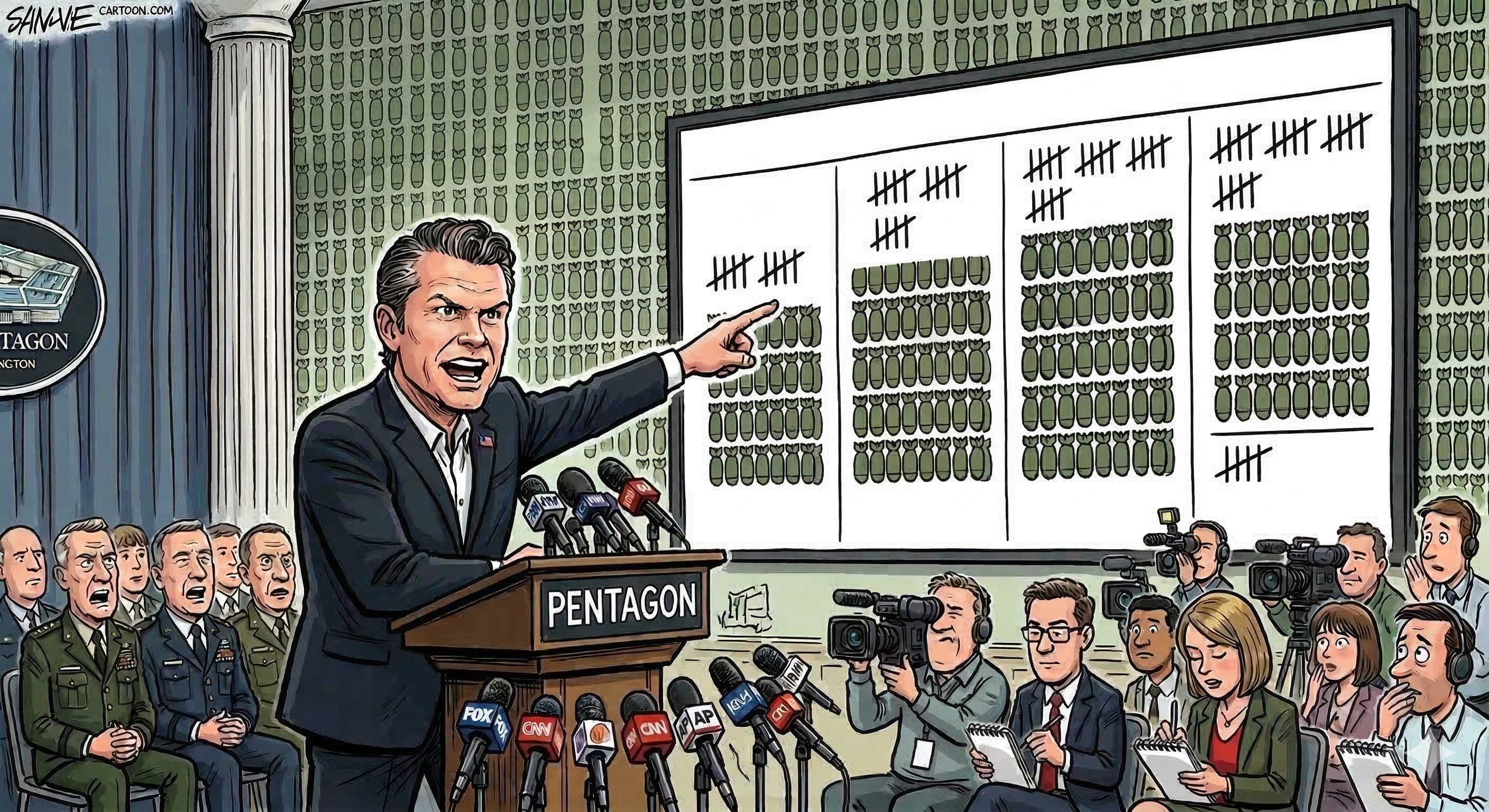
Central Command tells us that 10 days into the war, it has struck more than 5,000 targets with more than 12,000 munitions. The Israeli contribution is 2,500 targets struck with more than 7,500 bombs. Iran’s arsenal, meanwhile, is petering out. Iran’s ballistic firings have dropped by 90% since the start of the war, with Iranian drone launches down 83%, according to Gen. Dan Caine, Chairman of the Joint Chiefs of Staff.
It’s all very impressive. The United States is winning the military campaign and the numbers war. But there’s always a political element to war, and this the United States is not winning, at least not yet.
Iran’s clerical regime remains in power and is still striking neighboring Gulf countries with missiles and drones. There are reports of Iran mining the Strait of Hormuz, to blow up any oil tankers that try to transit. The threat alone has stopped all commercial traffic through the strait, keeping 20% of the world’s petroleum off the market and sending prices up 25% to 40%.
[I chatted recently with Adam Shapiro of AI Invest about the war. Here’s our 14-minute discussion. 👇]
The lessons of the Vietnam War included renewed focus on asymmetries. The enemy may be more determined than the good guys, for instance, especially if the war is on his turf. The enemy may also be able to absorb more pain and bear a higher cost. And if you have an Achilles heel, a single point of failure, the enemy can exploit that no matter how overwhelming your military advantage.
President Trump and his war counsel seem to have overlooked the asymmetric advantages Iran might have in a war. The main American vulnerability on display right now is the vital importance of oil flowing through the Strait of Hormuz, which Iran has been able to stop. America’s firepower overmatch hasn’t solved that problem.
Trump, for instance, says the military campaign in Iran has been so successful that there is “practically nothing left to target.” Yet the oil still isn’t flowing, and energy markets are going into occasional frenzies on signs that the closure will last longer or shorter than the last guesstimate.
Trump may be right about the diminution of targets in Iran, but targets may now be the wrong metric. The real mission now is reopening the strait and removing the Iranian threat to shipping, and bomb tonnage doesn’t seem to be the right tool for the job. Small Iranian ships able to place mines or launch drones are now likely hiding in civilian ports, and there may be too many of them to count on finding and sinking each craft.
Democratic Sen. Chris Murphy of Connecticut said on social media on March 11 that he received a classified update on the war from Trump administration officials, who have “no plan” to reopen the strait. “They don’t know how to get it safely back open,” Murphy said, “which is unforgiveable, because this part of the disaster was 100% foreseeable.”
Trump is acting nonchalant about the “temporary” spike in oil prices, but he’s clearly unnerved by the closure of the strait, a scenario Pentagon strategists have war-gamed for decades. Trump has said the US government will provide maritime insurance for oil tankers that can’t get it elsewhere, and offered US Navy escorts for tankers. Yet still no tankers are passing. Either Trump can’t deliver or shipping companies don’t want to take the risk when Iran seems determined to hit one of their ships.
Iran’s leaders aren’t strategic geniuses. They blundered by failing to take Trump’s threats seriously, by poking a bear one too many times, and by attacking neighboring nations now uniformly allied against them. Many Iranian leaders are now dead as a result. Those who remain face massive new vulnerabilities and might still lose control.
But they’ve played their one strong card pretty effectively and exploited their asymmetric ability to disrupt oil flows. Trump should have seen it coming, but he may have been mesmerized by all the hardware bristling on American bases and ships. He’s now learning the limits of bombing and the empty promise of favorable statistics.
I no a lot of people are going to say let us use our heads for something positive but, there or none when it comes to a WAR.The only advice i have is you need to do it quick. The old General now deceased Patton once said go like hell and strike before they can .If Trump was smart he would have already sent troops. The best would have cleaned up the mess they left on the ground .Hegseth is another yes man.
Totally on point.
Two side items:
a) I heard a report that a frustrated Trump called on oil companies and/or their shipping providers to just "man up" (my paraphrasing) and somehow come up with the guts needed to make their way thru the Hormuz strait regardless of the risk posed by Iran. Yeah, like that's gonna happen! Who's on the hook for damages incurred -- maybe Trump via his Bored of Peace budget?
b) One huge error Iran made was to convene an in-person high-level *daytime* meeting at Khomenei HQ, thinking that Israel & US would attack only at night. I'm personally OK they made this oversight but that was a big unforgivable one from their perspective.