


Democrats scored an overpowering victory on Election Day. Then stocks sank. So Democrats are bad for stocks?
The answer is no, or at least, they’re no worse for stocks than Republicans are. But the blue wave in the November 3 midterm elections signals some changes ahead, including changes many Americans want. Investors are now changing their outlook—and they should. Stocks are reacting accordingly.
Voters delivered a strong message on artificial intelligence and data centers in particular: Slow down and stop giving giant tech companies whatever they want. Exit polls showed 76% of voters oppose construction of new data centers in their own communities. States passed 40 new ballot measures to strengthen regulation of these computing hubs. Democrats winning the governorships in Texas, Ohio, and Georgia campaigned on tougher AI regulation, and voters said yes.
[What Democrats need now: A convincing leader]
So AI-related stocks sold off, as if the data center boom is about to come to a screeching halt. You can see the carnage in this chart showing tech stocks overall, AI stocks in particular, and non-tech stocks. (Tech stocks are represented by the State Street Technology Select Sector ETF; AI stocks are represented by the Global X Artificial Intelligence & Technology ETF; non-tech stocks are represented by the ProShares S&P 500 Ex-Technology ETF.)
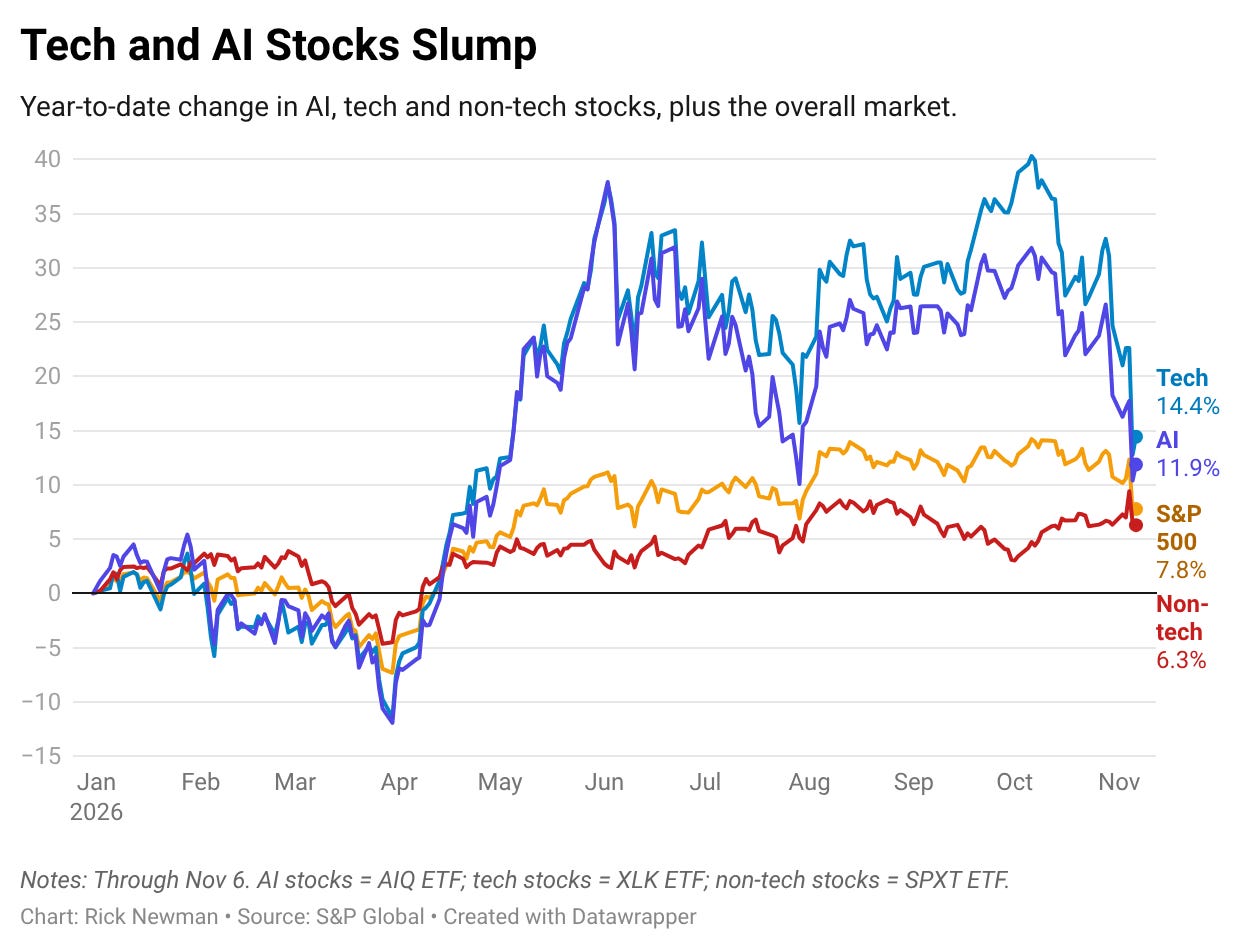
Tech and AI stocks are still ahead of the overall market. But that flight into the stratosphere that began in April looks like it’s over. Is this the AI bubble bursting?
Nobody knows, and there are smart analysts on both sides of the question. Ed Yardeni of Yardeni Research wrote on November 8 that “we think the boom will continue … but the speed of the boom will slow.” He points out that the demand for computing power remains extremely strong, which no election is likely to slow.
Investor George Noble is a prominent skeptic who thinks a “total collapse in technology stocks” could be coming. Like others, he thinks the return on massive amounts of AI investment by tech firms will never be enough to justify the current valuations of those stocks.